Pls help with all three questions!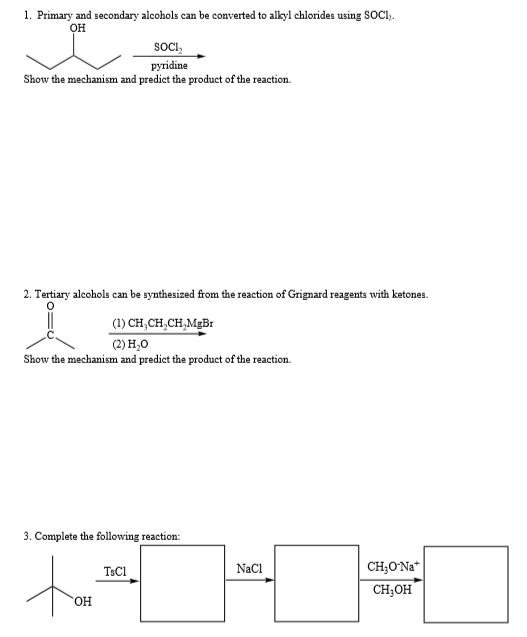
Homework Answers

Add Answer to:
Pls help with all three questions!
1. Primary and secondary alcohols can be converted to alkyl...
1. Primary and secondary alcohols can be converted to alkyl chlorides using SOCl2. Show the each...
 1. Primary and secondary alcohols can be converted to alkyl
chlorides using SOCl2. Show the each step for the mechanism and
predict the product of the reaction.
1. Primary and secondary alcohols can be converted to alkyl chlorides using SOCl2 SOCI2 pyridine Show the mechanism and predict the product of the reaction.
1. Primary and secondary alcohols can be converted to alkyl
chlorides using SOCl2. Show the each step for the mechanism and
predict the product of the reaction.
1. Primary and secondary alcohols can be converted to alkyl chlorides using SOCl2 SOCI2 pyridine Show the mechanism and predict the product of the reaction.
13 SN1: Synthesis of tert-Butyl Chloride Alkyl halides can be prepared from their corresponding alcohols via...
 13 SN1: Synthesis of tert-Butyl Chloride Alkyl halides can be prepared from their corresponding alcohols via an acid catalyzed substitution reaction. The mechanism of these acid catalyzed substitution reactions are labeled as Syl (substitution, nucleophilic, unimolecular) and S2 (substitution, nucleophilic, bimolecular). Tertiary alcohols follow the Snl route, primary alcohols follow the S2 route, and secondary alcohols can follow either path. Under acidic conditions, the mechanism (Figure 1) of the Sul reaction involves rapid protonation of the alcohol, followed by the...
Experiment 14 SN2: Synthesis of 1-Bromobutane Alkyl halides can be prepared from their corresponding alcohols via...
 Experiment 14 SN2: Synthesis of 1-Bromobutane Alkyl halides can be prepared from their corresponding alcohols via an acid catalyzed substitution reaction. The mechanism of these acid catalyzed substitution reactions are labeled as SNI (substitution, nucleophilie, unimolecular) and S2 (substitution, nucleophilie, bimolecular). Tertiary alcohols follow the Syl route, primary alcohols follow the S2, route and secondary alcohols can follow either path. Sth CyHe 81 CH? Br-CH e-OH- -C-OH OH Figure / Conversion of 1-butanol into 1-bromobutane by an Sp2 mechanism The...
13 SN1: Synthesis of tert-Butyl Chloride Alkyl halides can be prepared from their corresponding alcohols via...
 13 SN1: Synthesis of tert-Butyl Chloride Alkyl halides can be prepared from their corresponding alcohols via an acid catalyzed substitution reaction. The mechanism of these acid catalyzed substitution reactions are labeled as Syl (substitution, nucleophilic, unimolecular) and S2 (substitution, nucleophilic, bimolecular). Tertiary alcohols follow the Snl route, primary alcohols follow the S2 route, and secondary alcohols can follow either path. Under acidic conditions, the mechanism (Figure 1) of the Sul reaction involves rapid protonation of the alcohol, followed by the...
21-Ketones are easily reduced to secondary alcohols. b- Primary CH, CCH, a-Secondary alcohol alcohol C- to...
 21-Ketones are easily reduced to secondary alcohols. b- Primary CH, CCH, a-Secondary alcohol alcohol C- to acetaldehyde acid d-to carboxylic 22-Ozonolysis of alkenes yields aa-ketones if one of the unsaturated carbon atoms is disubstituted b-alcohol C-carboxylic acid d-alkane 23-Aldehyde C=0 is more polarized than ketone C-0 because a-As in carbocations, more alkyl groups stabilize + character b-Ketone has more alkyl groups, stabilizing the C=0 carbon inductively cc- due to a and b d- none of the above 24-Aldehydes and unhindered...
please help with wtiyhing the mechanism for these 3 problem. thanks SUBSTITUTION REACTIONS · Alcohols can...
 please help with wtiyhing the mechanism for these 3 problem.
thanks
SUBSTITUTION REACTIONS · Alcohols can be synthesized from alkyl halides via substitution (see Unit 7): R-X > R-OH • The substitution occurs by SN1 or SN2 depending on the substrate: Stang Ne + NaOH primery alkyl halide OH ( Naci) SN2 он (weak Nu tertiary alky halide 6 не) SNI ADDITION REACTIONS · Alcohols can by synthesized from alkenes through addition reactions (see Unit 8): aod-catalyzad hydation Ho/n, so....
please help with wtiyhing the mechanism for these 3 problem.
thanks
SUBSTITUTION REACTIONS · Alcohols can be synthesized from alkyl halides via substitution (see Unit 7): R-X > R-OH • The substitution occurs by SN1 or SN2 depending on the substrate: Stang Ne + NaOH primery alkyl halide OH ( Naci) SN2 он (weak Nu tertiary alky halide 6 не) SNI ADDITION REACTIONS · Alcohols can by synthesized from alkenes through addition reactions (see Unit 8): aod-catalyzad hydation Ho/n, so....
1. a) Give the IUPAC names of these alcohols. b) State whether they are primary, secondary...
 1. a) Give the IUPAC names of these alcohols. b) State whether they are primary, secondary or tertiary group, do this for each one Y secondary or tertiary alcohols. If a molecule contains more than one -OH 2. Ethane-1,2-diol (MW = 62.1 g/mol) has a boiling point of 198°C, and 1-propanol (MW-60.1 g/mol) has a boiling point of 97°C. Explain the difference in boiling point drawing the structures as part of your answer. 3. One of these compounds has a...
13 SN1: Synthesis of tert-Butyl Chloride Alkyl halides can be prepared from their corresponding alcohols via...
 13 SN1: Synthesis of tert-Butyl Chloride Alkyl halides can be prepared from their corresponding alcohols via an acid catalyzed substitution reaction. The mechanism of these acid catalyzed substitution reactions are labeled as SNI (substitution, nucleophilic, unimolecular) and S 2 (substitution, nucleophilic, bimolecular). Tertiary alcohols follow the Syl route, primary alcohols follow the Sy2 route, and secondary alcohols can follow either path. Under acidic conditions, the mechanism (Figure 1) of the Syl reaction involves rapid protonation of the alcohol, followed by...
This is for the Grignard Reaction laboratory. Please help me answer this question, much appreciated. 1....
This is for the Grignard Reaction laboratory. Please help me answer this question, much appreciated. 1. If a student performing Laboratory with Grignard reaction accidently used acetone as the reaction solvent instead of diethyl ether, what would the major organic product(s) be? Draw the structure of the product(s) (no mechanism necessary). b. What was the purpose of adding magnesium sulfate in this experiment? c. Grignard reagents react with both aldehyde and ketone functional groups. How do you predict the reaction...
2. Predict the product(s) of each of the reaction conditions below. Specify the substrate type (primary,...
 2. Predict the product(s) of each of the reaction conditions
below. Specify the substrate type (primary, secondary, or tertiary
alkyl halide), nucleophile (strong or poor), and the solvent type
(protic or aptrotic). Specify the type of reaction mechanism (SN1
or SN2), show the curved arrow mechanism and draw the products as
3D structures to illustrate stereochemistry.
Predict the product(s) of each of the reaction conditions below. Specify the substrate type (1º, 2º, or 3 alkyl halide). mucleophile (strong or poor),...
2. Predict the product(s) of each of the reaction conditions
below. Specify the substrate type (primary, secondary, or tertiary
alkyl halide), nucleophile (strong or poor), and the solvent type
(protic or aptrotic). Specify the type of reaction mechanism (SN1
or SN2), show the curved arrow mechanism and draw the products as
3D structures to illustrate stereochemistry.
Predict the product(s) of each of the reaction conditions below. Specify the substrate type (1º, 2º, or 3 alkyl halide). mucleophile (strong or poor),...
 1. Primary and secondary alcohols can be converted to alkyl
chlorides using SOCl2. Show the each step for the mechanism and
predict the product of the reaction.
1. Primary and secondary alcohols can be converted to alkyl chlorides using SOCl2 SOCI2 pyridine Show the mechanism and predict the product of the reaction.
1. Primary and secondary alcohols can be converted to alkyl
chlorides using SOCl2. Show the each step for the mechanism and
predict the product of the reaction.
1. Primary and secondary alcohols can be converted to alkyl chlorides using SOCl2 SOCI2 pyridine Show the mechanism and predict the product of the reaction.
 13 SN1: Synthesis of tert-Butyl Chloride Alkyl halides can be prepared from their corresponding alcohols via an acid catalyzed substitution reaction. The mechanism of these acid catalyzed substitution reactions are labeled as Syl (substitution, nucleophilic, unimolecular) and S2 (substitution, nucleophilic, bimolecular). Tertiary alcohols follow the Snl route, primary alcohols follow the S2 route, and secondary alcohols can follow either path. Under acidic conditions, the mechanism (Figure 1) of the Sul reaction involves rapid protonation of the alcohol, followed by the...
 Experiment 14 SN2: Synthesis of 1-Bromobutane Alkyl halides can be prepared from their corresponding alcohols via an acid catalyzed substitution reaction. The mechanism of these acid catalyzed substitution reactions are labeled as SNI (substitution, nucleophilie, unimolecular) and S2 (substitution, nucleophilie, bimolecular). Tertiary alcohols follow the Syl route, primary alcohols follow the S2, route and secondary alcohols can follow either path. Sth CyHe 81 CH? Br-CH e-OH- -C-OH OH Figure / Conversion of 1-butanol into 1-bromobutane by an Sp2 mechanism The...
 13 SN1: Synthesis of tert-Butyl Chloride Alkyl halides can be prepared from their corresponding alcohols via an acid catalyzed substitution reaction. The mechanism of these acid catalyzed substitution reactions are labeled as Syl (substitution, nucleophilic, unimolecular) and S2 (substitution, nucleophilic, bimolecular). Tertiary alcohols follow the Snl route, primary alcohols follow the S2 route, and secondary alcohols can follow either path. Under acidic conditions, the mechanism (Figure 1) of the Sul reaction involves rapid protonation of the alcohol, followed by the...
 21-Ketones are easily reduced to secondary alcohols. b- Primary CH, CCH, a-Secondary alcohol alcohol C- to acetaldehyde acid d-to carboxylic 22-Ozonolysis of alkenes yields aa-ketones if one of the unsaturated carbon atoms is disubstituted b-alcohol C-carboxylic acid d-alkane 23-Aldehyde C=0 is more polarized than ketone C-0 because a-As in carbocations, more alkyl groups stabilize + character b-Ketone has more alkyl groups, stabilizing the C=0 carbon inductively cc- due to a and b d- none of the above 24-Aldehydes and unhindered...
 please help with wtiyhing the mechanism for these 3 problem.
thanks
SUBSTITUTION REACTIONS · Alcohols can be synthesized from alkyl halides via substitution (see Unit 7): R-X > R-OH • The substitution occurs by SN1 or SN2 depending on the substrate: Stang Ne + NaOH primery alkyl halide OH ( Naci) SN2 он (weak Nu tertiary alky halide 6 не) SNI ADDITION REACTIONS · Alcohols can by synthesized from alkenes through addition reactions (see Unit 8): aod-catalyzad hydation Ho/n, so....
please help with wtiyhing the mechanism for these 3 problem.
thanks
SUBSTITUTION REACTIONS · Alcohols can be synthesized from alkyl halides via substitution (see Unit 7): R-X > R-OH • The substitution occurs by SN1 or SN2 depending on the substrate: Stang Ne + NaOH primery alkyl halide OH ( Naci) SN2 он (weak Nu tertiary alky halide 6 не) SNI ADDITION REACTIONS · Alcohols can by synthesized from alkenes through addition reactions (see Unit 8): aod-catalyzad hydation Ho/n, so....
 1. a) Give the IUPAC names of these alcohols. b) State whether they are primary, secondary or tertiary group, do this for each one Y secondary or tertiary alcohols. If a molecule contains more than one -OH 2. Ethane-1,2-diol (MW = 62.1 g/mol) has a boiling point of 198°C, and 1-propanol (MW-60.1 g/mol) has a boiling point of 97°C. Explain the difference in boiling point drawing the structures as part of your answer. 3. One of these compounds has a...
 13 SN1: Synthesis of tert-Butyl Chloride Alkyl halides can be prepared from their corresponding alcohols via an acid catalyzed substitution reaction. The mechanism of these acid catalyzed substitution reactions are labeled as SNI (substitution, nucleophilic, unimolecular) and S 2 (substitution, nucleophilic, bimolecular). Tertiary alcohols follow the Syl route, primary alcohols follow the Sy2 route, and secondary alcohols can follow either path. Under acidic conditions, the mechanism (Figure 1) of the Syl reaction involves rapid protonation of the alcohol, followed by...
 2. Predict the product(s) of each of the reaction conditions
below. Specify the substrate type (primary, secondary, or tertiary
alkyl halide), nucleophile (strong or poor), and the solvent type
(protic or aptrotic). Specify the type of reaction mechanism (SN1
or SN2), show the curved arrow mechanism and draw the products as
3D structures to illustrate stereochemistry.
Predict the product(s) of each of the reaction conditions below. Specify the substrate type (1º, 2º, or 3 alkyl halide). mucleophile (strong or poor),...
2. Predict the product(s) of each of the reaction conditions
below. Specify the substrate type (primary, secondary, or tertiary
alkyl halide), nucleophile (strong or poor), and the solvent type
(protic or aptrotic). Specify the type of reaction mechanism (SN1
or SN2), show the curved arrow mechanism and draw the products as
3D structures to illustrate stereochemistry.
Predict the product(s) of each of the reaction conditions below. Specify the substrate type (1º, 2º, or 3 alkyl halide). mucleophile (strong or poor),...
Most questions answered within 3 hours.
-
Where is the error in this code sequence?
String s1 = "Hello";
String s2 = "ello";...
asked 10 months ago -
Financial data for Joel de Paris, Inc., for last year
follow:
Joel de Paris, Inc.
Balance...
asked 10 months ago -
Consider this reaction:
Al2(SO4)3 (aq)+ BaCl3
(aq) Al2Cl6 (aq)- +
3BaSO4(s) . What is the...
asked 10 months ago -
Suppose that Savneet is considering increasing her
recent random sample from 20 car rentals to 40...
asked 10 months ago -
Trucks arrive at an unloading terminal at an average rate of 120
per hour.
Trucks arrive...
asked 10 months ago -
Why are methanol and ethanol completely soluble in water while
octanol is not very little soluble....
asked 10 months ago -
A facilities manager at a university reads in a research report
that the mean amount of...
asked 10 months ago -
When the CuSO4 is rehydrated by adding water to the anhydrous
compound, is this an endothermic...
asked 10 months ago -
A ray of sunlight is passing from diamond into crown glass; the
angle of incidence is...
asked 10 months ago -
A block of mass 0.249 kg is placed on top of a light, vertical
spring of...
asked 10 months ago -
how do the kidneys compensate in the presences of acidosis
a) trigger hyperventilate
b) reserve acid...
asked 10 months ago -
Question 501 pts
The rental rate of capital to the firm increases. Which of the
following...
asked 10 months ago