organic chemistry revision problems. stuck on this page.
Homework Answers
Add Answer to:
organic chemistry revision problems. stuck on this
page.
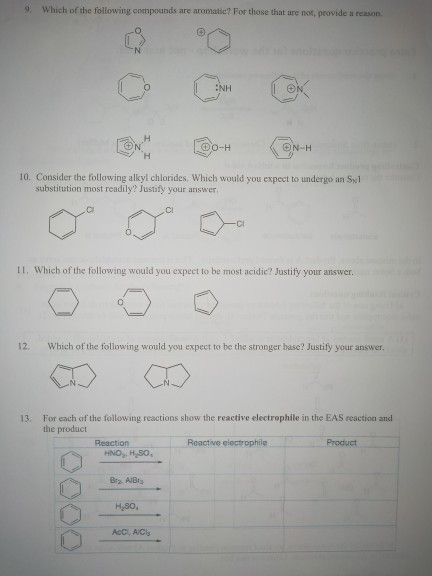
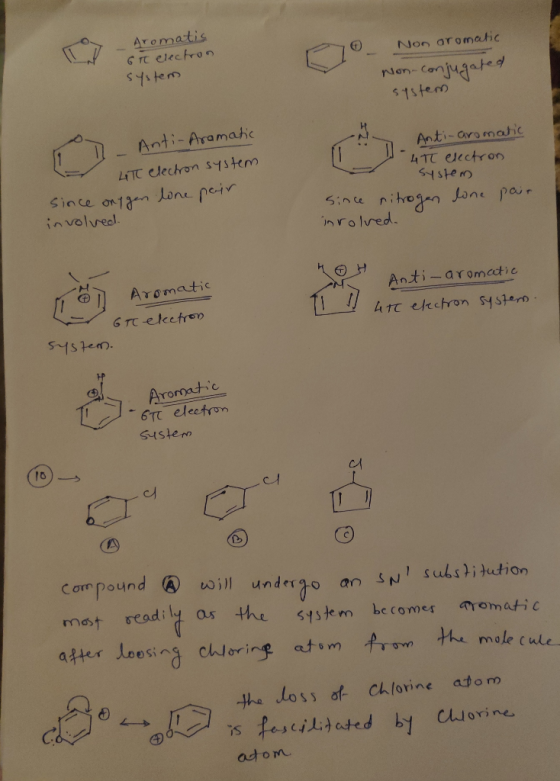
9. Which of the following compounds are aromatic?...
10. Consider the following alkyl chlorides. Which would you expect to undergo an SN1 substitution most...
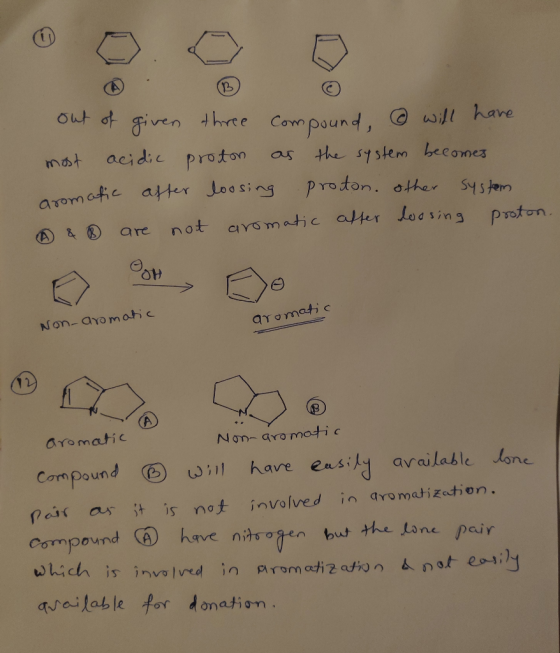
 10. Consider the following alkyl chlorides. Which would you expect to undergo an SN1 substitution most readily? Justify your answer CI CI 11. Which of the following would you expect to be most acidic? Justify your answer Which of the following would you expect to be the stronger base? Justify your answer 12.
Nil 1. Which of the following compounds is least reactive by electrophilic aromatic nitration or sulfonation?...
 Nil 1. Which of the following compounds is least reactive by electrophilic aromatic nitration or sulfonation? Briefly explain why. 2. Give the major product(s) of the following SpAr reactions. For an o-/p-director, show both products. If no reaction occurs, state why the reaction does not occur. CO,H HNO, H2SO4 +CH.CLAICH SOH Zn(Hg) AICI ? HỌC-CH-C-Cl + HCI/Heat CH3
organic chemistry 353 2. (4 pts.) Arrange the following in order of increasing electrophilic aromatic substitution...
 organic chemistry 353
2. (4 pts.) Arrange the following in order of increasing electrophilic aromatic substitution reactivity (4 = most reactive): SO3H OH e 3. (4 pts.) Briefly describe why alkenes undergo addition and aromatic compounds undergo substitution. n Briefly describe w 4. (5 pts. Provide an example of an EAS reaction creates an arene that is less reactive than benzene (be specific, include reagents, you do not need to show the mechanism)
organic chemistry 353
2. (4 pts.) Arrange the following in order of increasing electrophilic aromatic substitution reactivity (4 = most reactive): SO3H OH e 3. (4 pts.) Briefly describe why alkenes undergo addition and aromatic compounds undergo substitution. n Briefly describe w 4. (5 pts. Provide an example of an EAS reaction creates an arene that is less reactive than benzene (be specific, include reagents, you do not need to show the mechanism)
Which compound is the least reactive in the aromatic electrophilic substitution reaction? What product would you...
 Which compound is the least reactive in the aromatic
electrophilic substitution reaction?
What product would you expect from the following reaction?
Answer both, please.
1. Which compound is the least reactive in the aromatic electrophilic substitution reaction? NH . B NH С. SOH Logo D. NO2 E 2. What product would you expect from the following reaction? CO.CH ÇO.CH А ÇOCH B OCH, D CO.CH E
Which compound is the least reactive in the aromatic
electrophilic substitution reaction?
What product would you expect from the following reaction?
Answer both, please.
1. Which compound is the least reactive in the aromatic electrophilic substitution reaction? NH . B NH С. SOH Logo D. NO2 E 2. What product would you expect from the following reaction? CO.CH ÇO.CH А ÇOCH B OCH, D CO.CH E
250 ChemActivity 29 Electrophilic Aromatic Substitution no ChemActivity 29 Part A: Electrophilic Aromatic Substitution (What products...
 250 ChemActivity 29 Electrophilic Aromatic Substitution no ChemActivity 29 Part A: Electrophilic Aromatic Substitution (What products are formed when a strong electrophile is added to benzene?) Model 1: (review) Electrophilic Addition of HCI Rani o g cyclohexene carbocation intermediate Run 2 U X benzene This product carbocation intermediate DOES NOT Critical Thinking Questions 1 For Rxn I (above) draw curved arrows showing the mechanism of electrophilic addition of HCl. Include an appropriate carbocation intermediate in the box above. Figure 1:...
Please help with questions 1-5. I have attached the additional lab information pages for help if...
 Please help with questions 1-5. I have attached the additional
lab information pages for help if you are unclear on anything
please review those.
We were unable to transcribe this imageEAS 97 5. Calculate the theoretical yiel te the theoretical yield of iodinated salicylamide (product) ass Todination reaction. (Show your calculations.) mide (product) assuming a mono- le, your starting material, is shown in Figure 4. ces in the functional group region of the spectrum IR spectrum of salicylamide, your starting...
Please help with questions 1-5. I have attached the additional
lab information pages for help if you are unclear on anything
please review those.
We were unable to transcribe this imageEAS 97 5. Calculate the theoretical yiel te the theoretical yield of iodinated salicylamide (product) ass Todination reaction. (Show your calculations.) mide (product) assuming a mono- le, your starting material, is shown in Figure 4. ces in the functional group region of the spectrum IR spectrum of salicylamide, your starting...
Which of the following compounds is the most reactive toward electrophilic aromatic substitution? IV H III...
 Which of the following compounds is the most reactive toward electrophilic aromatic substitution? IV H III IT IN
answer any that you can please B. Effect of substituents on EAS B1. Rank each of...
 answer any that you can please
B. Effect of substituents on EAS B1. Rank each of the following sets from the most reactive (+1) to the least reactive (4) act more DANHAS CH WA B2. Predict the major product for the following reactions. If there is no reaction, write 'R' NO, C AICI: nog do m HOS нoss B Bra FeBig CHCI La AICI Falkijan we do 0, WALD 0.0 NO, HNO3 ON ON Brz FeBig OH H,SO C. Synthesis...
answer any that you can please
B. Effect of substituents on EAS B1. Rank each of the following sets from the most reactive (+1) to the least reactive (4) act more DANHAS CH WA B2. Predict the major product for the following reactions. If there is no reaction, write 'R' NO, C AICI: nog do m HOS нoss B Bra FeBig CHCI La AICI Falkijan we do 0, WALD 0.0 NO, HNO3 ON ON Brz FeBig OH H,SO C. Synthesis...
which products would be obtained by 40. Select he best synthesis of Which of the following...
 which products would be obtained by
40. Select he best synthesis of Which of the following compounds will not undergo nucleophilic aromatic substitution? 44. a. 1-chioro-2,4 dinitrobenzene сснз m-chloronitrobenzene (CHshCCI CH,CCI 41. Provide the reagentís) necessary to AICI3 oluene to AICI, benzoic acid. b. NBS, heat d.1.COz 2, но. Provide the structure of the major product(s) for the CH CCI AICİ3 Benzene b) AICI 3 42. (CH3)2C CH2 HF following reaction. Benzene AICly 45. Which of the following would be...
which products would be obtained by
40. Select he best synthesis of Which of the following compounds will not undergo nucleophilic aromatic substitution? 44. a. 1-chioro-2,4 dinitrobenzene сснз m-chloronitrobenzene (CHshCCI CH,CCI 41. Provide the reagentís) necessary to AICI3 oluene to AICI, benzoic acid. b. NBS, heat d.1.COz 2, но. Provide the structure of the major product(s) for the CH CCI AICİ3 Benzene b) AICI 3 42. (CH3)2C CH2 HF following reaction. Benzene AICly 45. Which of the following would be...
please help in all sections asap!! Which of the following reactions would produce isopropylbenzene as the...
 please help in all sections asap!!
Which of the following reactions would produce isopropylbenzene as the major product? ОН AICI: H2SO4 H2SO4 AICI3 IV I all of these Predict the product for the following reaction fuming H2SO4 SO3H Predict the structure of the major product for the following reaction Which of the following compounds will not undergo nucleophilic aromatic substitution? 1-chloro-2,4-dinitrobenzene 1-bromo-4-nitrobenzene O-chloronitrobenzene m-chloronitrobenzene p-chloronitrobenzene Choose the correct sequence of reagents for the following transformation. 2) 3 . NH2 2)...
please help in all sections asap!!
Which of the following reactions would produce isopropylbenzene as the major product? ОН AICI: H2SO4 H2SO4 AICI3 IV I all of these Predict the product for the following reaction fuming H2SO4 SO3H Predict the structure of the major product for the following reaction Which of the following compounds will not undergo nucleophilic aromatic substitution? 1-chloro-2,4-dinitrobenzene 1-bromo-4-nitrobenzene O-chloronitrobenzene m-chloronitrobenzene p-chloronitrobenzene Choose the correct sequence of reagents for the following transformation. 2) 3 . NH2 2)...
 10. Consider the following alkyl chlorides. Which would you expect to undergo an SN1 substitution most readily? Justify your answer CI CI 11. Which of the following would you expect to be most acidic? Justify your answer Which of the following would you expect to be the stronger base? Justify your answer 12.
 Nil 1. Which of the following compounds is least reactive by electrophilic aromatic nitration or sulfonation? Briefly explain why. 2. Give the major product(s) of the following SpAr reactions. For an o-/p-director, show both products. If no reaction occurs, state why the reaction does not occur. CO,H HNO, H2SO4 +CH.CLAICH SOH Zn(Hg) AICI ? HỌC-CH-C-Cl + HCI/Heat CH3
 organic chemistry 353
2. (4 pts.) Arrange the following in order of increasing electrophilic aromatic substitution reactivity (4 = most reactive): SO3H OH e 3. (4 pts.) Briefly describe why alkenes undergo addition and aromatic compounds undergo substitution. n Briefly describe w 4. (5 pts. Provide an example of an EAS reaction creates an arene that is less reactive than benzene (be specific, include reagents, you do not need to show the mechanism)
organic chemistry 353
2. (4 pts.) Arrange the following in order of increasing electrophilic aromatic substitution reactivity (4 = most reactive): SO3H OH e 3. (4 pts.) Briefly describe why alkenes undergo addition and aromatic compounds undergo substitution. n Briefly describe w 4. (5 pts. Provide an example of an EAS reaction creates an arene that is less reactive than benzene (be specific, include reagents, you do not need to show the mechanism)
 Which compound is the least reactive in the aromatic
electrophilic substitution reaction?
What product would you expect from the following reaction?
Answer both, please.
1. Which compound is the least reactive in the aromatic electrophilic substitution reaction? NH . B NH С. SOH Logo D. NO2 E 2. What product would you expect from the following reaction? CO.CH ÇO.CH А ÇOCH B OCH, D CO.CH E
Which compound is the least reactive in the aromatic
electrophilic substitution reaction?
What product would you expect from the following reaction?
Answer both, please.
1. Which compound is the least reactive in the aromatic electrophilic substitution reaction? NH . B NH С. SOH Logo D. NO2 E 2. What product would you expect from the following reaction? CO.CH ÇO.CH А ÇOCH B OCH, D CO.CH E
 250 ChemActivity 29 Electrophilic Aromatic Substitution no ChemActivity 29 Part A: Electrophilic Aromatic Substitution (What products are formed when a strong electrophile is added to benzene?) Model 1: (review) Electrophilic Addition of HCI Rani o g cyclohexene carbocation intermediate Run 2 U X benzene This product carbocation intermediate DOES NOT Critical Thinking Questions 1 For Rxn I (above) draw curved arrows showing the mechanism of electrophilic addition of HCl. Include an appropriate carbocation intermediate in the box above. Figure 1:...
 Please help with questions 1-5. I have attached the additional
lab information pages for help if you are unclear on anything
please review those.
We were unable to transcribe this imageEAS 97 5. Calculate the theoretical yiel te the theoretical yield of iodinated salicylamide (product) ass Todination reaction. (Show your calculations.) mide (product) assuming a mono- le, your starting material, is shown in Figure 4. ces in the functional group region of the spectrum IR spectrum of salicylamide, your starting...
Please help with questions 1-5. I have attached the additional
lab information pages for help if you are unclear on anything
please review those.
We were unable to transcribe this imageEAS 97 5. Calculate the theoretical yiel te the theoretical yield of iodinated salicylamide (product) ass Todination reaction. (Show your calculations.) mide (product) assuming a mono- le, your starting material, is shown in Figure 4. ces in the functional group region of the spectrum IR spectrum of salicylamide, your starting...
 Which of the following compounds is the most reactive toward electrophilic aromatic substitution? IV H III IT IN
 answer any that you can please
B. Effect of substituents on EAS B1. Rank each of the following sets from the most reactive (+1) to the least reactive (4) act more DANHAS CH WA B2. Predict the major product for the following reactions. If there is no reaction, write 'R' NO, C AICI: nog do m HOS нoss B Bra FeBig CHCI La AICI Falkijan we do 0, WALD 0.0 NO, HNO3 ON ON Brz FeBig OH H,SO C. Synthesis...
answer any that you can please
B. Effect of substituents on EAS B1. Rank each of the following sets from the most reactive (+1) to the least reactive (4) act more DANHAS CH WA B2. Predict the major product for the following reactions. If there is no reaction, write 'R' NO, C AICI: nog do m HOS нoss B Bra FeBig CHCI La AICI Falkijan we do 0, WALD 0.0 NO, HNO3 ON ON Brz FeBig OH H,SO C. Synthesis...
 which products would be obtained by
40. Select he best synthesis of Which of the following compounds will not undergo nucleophilic aromatic substitution? 44. a. 1-chioro-2,4 dinitrobenzene сснз m-chloronitrobenzene (CHshCCI CH,CCI 41. Provide the reagentís) necessary to AICI3 oluene to AICI, benzoic acid. b. NBS, heat d.1.COz 2, но. Provide the structure of the major product(s) for the CH CCI AICİ3 Benzene b) AICI 3 42. (CH3)2C CH2 HF following reaction. Benzene AICly 45. Which of the following would be...
which products would be obtained by
40. Select he best synthesis of Which of the following compounds will not undergo nucleophilic aromatic substitution? 44. a. 1-chioro-2,4 dinitrobenzene сснз m-chloronitrobenzene (CHshCCI CH,CCI 41. Provide the reagentís) necessary to AICI3 oluene to AICI, benzoic acid. b. NBS, heat d.1.COz 2, но. Provide the structure of the major product(s) for the CH CCI AICİ3 Benzene b) AICI 3 42. (CH3)2C CH2 HF following reaction. Benzene AICly 45. Which of the following would be...
 please help in all sections asap!!
Which of the following reactions would produce isopropylbenzene as the major product? ОН AICI: H2SO4 H2SO4 AICI3 IV I all of these Predict the product for the following reaction fuming H2SO4 SO3H Predict the structure of the major product for the following reaction Which of the following compounds will not undergo nucleophilic aromatic substitution? 1-chloro-2,4-dinitrobenzene 1-bromo-4-nitrobenzene O-chloronitrobenzene m-chloronitrobenzene p-chloronitrobenzene Choose the correct sequence of reagents for the following transformation. 2) 3 . NH2 2)...
please help in all sections asap!!
Which of the following reactions would produce isopropylbenzene as the major product? ОН AICI: H2SO4 H2SO4 AICI3 IV I all of these Predict the product for the following reaction fuming H2SO4 SO3H Predict the structure of the major product for the following reaction Which of the following compounds will not undergo nucleophilic aromatic substitution? 1-chloro-2,4-dinitrobenzene 1-bromo-4-nitrobenzene O-chloronitrobenzene m-chloronitrobenzene p-chloronitrobenzene Choose the correct sequence of reagents for the following transformation. 2) 3 . NH2 2)...
Most questions answered within 3 hours.
-
Where is the error in this code sequence?
String s1 = "Hello";
String s2 = "ello";...
asked 10 months ago -
Financial data for Joel de Paris, Inc., for last year
follow:
Joel de Paris, Inc.
Balance...
asked 10 months ago -
Consider this reaction:
Al2(SO4)3 (aq)+ BaCl3
(aq) Al2Cl6 (aq)- +
3BaSO4(s) . What is the...
asked 10 months ago -
Suppose that Savneet is considering increasing her
recent random sample from 20 car rentals to 40...
asked 10 months ago -
Trucks arrive at an unloading terminal at an average rate of 120
per hour.
Trucks arrive...
asked 10 months ago -
Why are methanol and ethanol completely soluble in water while
octanol is not very little soluble....
asked 10 months ago -
A facilities manager at a university reads in a research report
that the mean amount of...
asked 10 months ago -
When the CuSO4 is rehydrated by adding water to the anhydrous
compound, is this an endothermic...
asked 10 months ago -
A ray of sunlight is passing from diamond into crown glass; the
angle of incidence is...
asked 10 months ago -
A block of mass 0.249 kg is placed on top of a light, vertical
spring of...
asked 10 months ago -
how do the kidneys compensate in the presences of acidosis
a) trigger hyperventilate
b) reserve acid...
asked 10 months ago -
Question 501 pts
The rental rate of capital to the firm increases. Which of the
following...
asked 10 months ago