

Homework Answers
It might go like the following---

Product A is the major kinetically controlled product here. But the reaction doesn't stop after forming A. With the group -SMe attached to the alkene, SN1 can happen by the opening of bromonium ring, forming a carbocation, which is stabilized by conjugation with the Sulfur loan pair. Now, Bromide ion doesn't generally act as a base by abstracting proton; but with positive charge on the adjacent Sulfur atom the acidity of the -CH3 proton is enhanced, thus forming a stable Sulfur ylide(shown above). Now, this CH2- is a good nucleophile and does a NGP(Neighboring Group Participation) on the carbon bearing positive charge. After that, bromide attacks the less substituted carbon to open the ring(attack on the other carbon generates product A),forming 1,3-dibromide and Sulfide gets methylated either by the starting alkene or the initially formed product A, to form product B.
Actually the formation of product A is reversible, because bromide is a good nucleophile as well as a good leaving group. Thus after a long time there should be a considerable amount of product B along with the "expected" product A.
Thus the formation of B can be explained.
Add Answer to:
I'm not sure if 4 is correct so I just wanted some
clarification, and for 5...
So I'm looking for some clarification on the products from this rxn. I got two different...
 So I'm looking for some clarification on the products from
this rxn. I got two different kinds and just want to make sure I'm
correct. Thanks!
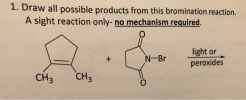
1. Draw all possible products from this bromination reaction. A sight reaction only- no mechanism required. N-Br light or peroxides CH₃ CH₂
So I'm looking for some clarification on the products from
this rxn. I got two different kinds and just want to make sure I'm
correct. Thanks!
1. Draw all possible products from this bromination reaction. A sight reaction only- no mechanism required. N-Br light or peroxides CH₃ CH₂
So i got an 80 and i am not sure which two i got wrong. each...
 So i got an 80 and i am not sure which two i got wrong. each
question is worth 10 points. If someone could please help find
which two i got wrong it would be greatly appreciated! I will
rate!
QUESTION 1 What is the overall yield of Product D in the following step-wise synthesis? The % yield of each step is noted at the bottom of each arrow. Step 1 Step 2 Step 3 А B D 90% 80%...
So i got an 80 and i am not sure which two i got wrong. each
question is worth 10 points. If someone could please help find
which two i got wrong it would be greatly appreciated! I will
rate!
QUESTION 1 What is the overall yield of Product D in the following step-wise synthesis? The % yield of each step is noted at the bottom of each arrow. Step 1 Step 2 Step 3 А B D 90% 80%...
I just need the blank data table with all the reactions shown. I need ALL 36...
 I just need the blank data table with
all the reactions shown. I need ALL 36 spaces for reacting
solutions. I don't need the observations. Please
help.
ARE hem 310 LAB EXPERIMENT #6 Chemical Reactions: Double Replacements I. OBJECTIVES 1. To perform and record observations of some chemical reactions. 2. To gain skill in writing balanced equations from observations of chemical reactions using known reactants. 3. To look for ions that, if present, may cause the compounds to be insoluble...
I just need the blank data table with
all the reactions shown. I need ALL 36 spaces for reacting
solutions. I don't need the observations. Please
help.
ARE hem 310 LAB EXPERIMENT #6 Chemical Reactions: Double Replacements I. OBJECTIVES 1. To perform and record observations of some chemical reactions. 2. To gain skill in writing balanced equations from observations of chemical reactions using known reactants. 3. To look for ions that, if present, may cause the compounds to be insoluble...
 So I'm looking for some clarification on the products from
this rxn. I got two different kinds and just want to make sure I'm
correct. Thanks!
1. Draw all possible products from this bromination reaction. A sight reaction only- no mechanism required. N-Br light or peroxides CH₃ CH₂
So I'm looking for some clarification on the products from
this rxn. I got two different kinds and just want to make sure I'm
correct. Thanks!
1. Draw all possible products from this bromination reaction. A sight reaction only- no mechanism required. N-Br light or peroxides CH₃ CH₂
 So i got an 80 and i am not sure which two i got wrong. each
question is worth 10 points. If someone could please help find
which two i got wrong it would be greatly appreciated! I will
rate!
QUESTION 1 What is the overall yield of Product D in the following step-wise synthesis? The % yield of each step is noted at the bottom of each arrow. Step 1 Step 2 Step 3 А B D 90% 80%...
So i got an 80 and i am not sure which two i got wrong. each
question is worth 10 points. If someone could please help find
which two i got wrong it would be greatly appreciated! I will
rate!
QUESTION 1 What is the overall yield of Product D in the following step-wise synthesis? The % yield of each step is noted at the bottom of each arrow. Step 1 Step 2 Step 3 А B D 90% 80%...
 I just need the blank data table with
all the reactions shown. I need ALL 36 spaces for reacting
solutions. I don't need the observations. Please
help.
ARE hem 310 LAB EXPERIMENT #6 Chemical Reactions: Double Replacements I. OBJECTIVES 1. To perform and record observations of some chemical reactions. 2. To gain skill in writing balanced equations from observations of chemical reactions using known reactants. 3. To look for ions that, if present, may cause the compounds to be insoluble...
I just need the blank data table with
all the reactions shown. I need ALL 36 spaces for reacting
solutions. I don't need the observations. Please
help.
ARE hem 310 LAB EXPERIMENT #6 Chemical Reactions: Double Replacements I. OBJECTIVES 1. To perform and record observations of some chemical reactions. 2. To gain skill in writing balanced equations from observations of chemical reactions using known reactants. 3. To look for ions that, if present, may cause the compounds to be insoluble...
Most questions answered within 3 hours.
-
Where is the error in this code sequence?
String s1 = "Hello";
String s2 = "ello";...
asked 10 months ago -
Financial data for Joel de Paris, Inc., for last year
follow:
Joel de Paris, Inc.
Balance...
asked 10 months ago -
Consider this reaction:
Al2(SO4)3 (aq)+ BaCl3
(aq) Al2Cl6 (aq)- +
3BaSO4(s) . What is the...
asked 10 months ago -
Suppose that Savneet is considering increasing her
recent random sample from 20 car rentals to 40...
asked 10 months ago -
Trucks arrive at an unloading terminal at an average rate of 120
per hour.
Trucks arrive...
asked 10 months ago -
Why are methanol and ethanol completely soluble in water while
octanol is not very little soluble....
asked 10 months ago -
A facilities manager at a university reads in a research report
that the mean amount of...
asked 10 months ago -
When the CuSO4 is rehydrated by adding water to the anhydrous
compound, is this an endothermic...
asked 10 months ago -
A ray of sunlight is passing from diamond into crown glass; the
angle of incidence is...
asked 10 months ago -
A block of mass 0.249 kg is placed on top of a light, vertical
spring of...
asked 10 months ago -
how do the kidneys compensate in the presences of acidosis
a) trigger hyperventilate
b) reserve acid...
asked 10 months ago -
Question 501 pts
The rental rate of capital to the firm increases. Which of the
following...
asked 10 months ago