
Homework Answers
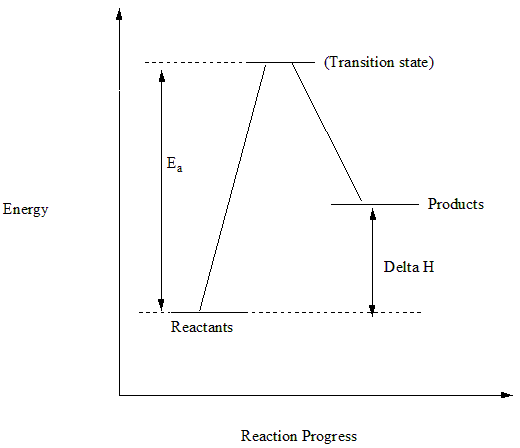
In an endothermic reaction, energy is absorbed by the reactants as they convert to products.
First, the reactants gain sufficient energy to go to a transition state by acquiring energy called 'activation energy'.
Hence, the difference in energy between the reactants and transition state is the activation energy Ea.
If a reactant molecule has energy equal to or greater than
activation energy, it can cross the activation barrier and convert
to product. The difference in energy between the product and the
reactant is termed as  If the product is higher in energy than the reactant, then net
energy is absorbed by the reaction from the surrounding meaning,
the value of
If the product is higher in energy than the reactant, then net
energy is absorbed by the reaction from the surrounding meaning,
the value of  is positive for the endothermic reaction.
Hence, we can draw the reaction profile diagram with energy in y axis and reaction progress in x axis as follows:
Add Answer to:
3. Energy Diagrams: Using the axes below, draw an energy diagram for an endothermic reaction. Label...
2. Oxidation and Reduction: Answer the following questions by circling the appropriate choice. [A] A substance...
 2. Oxidation and Reduction: Answer the following questions by circling the appropriate choice. [A] A substance is oxidized when it... gains electrons loses electrons [B] A substance is reduced when it... gains electrons loses electrons (C) In this reaction, identify which reactant was oxidized and which product was reduced. 2 Fe2O3 + 3 S→ 4 Fe + 3 SO2 3. Energy Diagrams: Using the axes below, draw an energy diagram for an endothermic reaction. Label the following in your diagram:...
Based on the energy diagram below: + + a) Label the axes of the graph (energy...
 Based on the energy diagram below: + + a) Label the axes of the graph (energy is in units of mo! b) What is the energy of the reactants? c) What is the energy of the products? d) What is the energy of the transition state? e) Calculate the activation energy of the forward reaction (reactants products) f) Calculate the activation energy of the reverse reaction (products reactants): g) Calculate the total energy of the forward reaction: h) Calculate the...
Energy diagrams 7. Draw an energy diagram for the reaction below. Label the axes, reactants, products,...
 Energy diagrams 7. Draw an energy diagram for the reaction below. Label the axes, reactants, products, intermediates, transition state, AG, AG 5 points D (BC are intermediates!) Step A™B is rate-limiting and A three-reaction where AG®= -13 kJ A B C the energies of the species are C>B> A>D.
3. Please answer the following questions concerning the two energy diagrams depicted below. (10 pts) Energy...
 3. Please answer the following questions concerning the two energy diagrams depicted below. (10 pts) Energy Diagram A 20 Energy Diagram B (a) Do the energy diagrams represent concerted or stepwise reactions? (b) Label the axes, the reactants (R), products (P), any intermediates (1), activation energy (E.), enthalpy of reaction (AH"), and transition state(s) (TS) on the above diagrams. (c) Do the energy diagrams represent endothermic or exothermic reactions? (d) Which energy diagram represents the faster reaction? (e) Which energy...
3. Please answer the following questions concerning the two energy diagrams depicted below. (10 pts) Energy...
 3. Please answer the following questions concerning the two energy diagrams depicted below. (10 pts) Energy Diagram A Energy Diagram B (a) Do the energy diagrams represent concerted or stepwise reactions? (b) Label the axes, the reactants (R), products (P), any intermediates (1), activation energy (E.), enthalpy of reaction (AH'), and transition state(s) (TS) on the above diagrams. (C) Do the energy diagrams represent endothermic or exothermic reactions? (d) Which energy diagram represents the faster reaction? (e) Which energy diagram...
10) Shown below is a reaction energy diagram. Answer the questions below using this diagram. Products...
 10) Shown below is a reaction energy diagram. Answer the questions below using this diagram. Products NRG Reactants a) ( Reaction Pathway Is this reaction exothermic or endothermic? Draw on the diagram how Activation Energy (E) is measured. Draw on the diagram how the Enthalpy (AH) is measured. b) ( c) C
3. Please answer the following questions concerning the two energy diagrams depicted below. (10 pts) Energy...
 3. Please answer the following questions concerning the two energy diagrams depicted below. (10 pts) Energy Diagram A 30 25 20 15 10 0 10 15 20 25 Energy Diagram B 30 25 20 15 10 15 20 25 10 (a) Do the energy diagrams represent concerted or stepwise reactions? Concerted (b) Label the axes, the reactants (R), products (P), any intermediates (), activation energy (E), enthalpy of reaction (AH), and transition state(s) (TS) on the above diagrams. (c) Do...
Label the energy diagrams with the following: Reactants, Products, Activation energy (include arrow) Heat absorbed or...
 Label the energy diagrams with the following: Reactants, Products, Activation energy (include arrow) Heat absorbed or Heat released (include arrow) Potential Energy Potential Energy Reaction Progress Exothermic reaction Reaction Progress Endothermic reaction
Model 1 - Potential Energy Diagrams 1) The energy (enthalpy) change of a reaction can be...
 Model 1 - Potential Energy Diagrams 1) The energy (enthalpy) change of a reaction can be determined by the following expression: Activated Complex Transition State AH = Energy products - Energy reactants Activation Energy, E Reactants Consider the energy change for the reaction in Model 1 (the graph to the left). Potential Energy (kJ/mol) Energy change (AH) Products a) The energy change shown is (positive/negative). b) This reaction is (endothermic / exothermic). c) These (reactants / transition state) has more...
(8 points) On the diagram below, label the following: Reactants, Products, Activated Complex, Activation Energy (E.),...
 (8 points) On the diagram below, label the following: Reactants, Products, Activated Complex, Activation Energy (E.), and Enthalpy of the Reaction (AH). State if the reaction is endothermic or exothermic. Explain how you arrived at your answer. 250 2001 PE Reaction pathway
 2. Oxidation and Reduction: Answer the following questions by circling the appropriate choice. [A] A substance is oxidized when it... gains electrons loses electrons [B] A substance is reduced when it... gains electrons loses electrons (C) In this reaction, identify which reactant was oxidized and which product was reduced. 2 Fe2O3 + 3 S→ 4 Fe + 3 SO2 3. Energy Diagrams: Using the axes below, draw an energy diagram for an endothermic reaction. Label the following in your diagram:...
 Based on the energy diagram below: + + a) Label the axes of the graph (energy is in units of mo! b) What is the energy of the reactants? c) What is the energy of the products? d) What is the energy of the transition state? e) Calculate the activation energy of the forward reaction (reactants products) f) Calculate the activation energy of the reverse reaction (products reactants): g) Calculate the total energy of the forward reaction: h) Calculate the...
 Energy diagrams 7. Draw an energy diagram for the reaction below. Label the axes, reactants, products, intermediates, transition state, AG, AG 5 points D (BC are intermediates!) Step A™B is rate-limiting and A three-reaction where AG®= -13 kJ A B C the energies of the species are C>B> A>D.
 3. Please answer the following questions concerning the two energy diagrams depicted below. (10 pts) Energy Diagram A 20 Energy Diagram B (a) Do the energy diagrams represent concerted or stepwise reactions? (b) Label the axes, the reactants (R), products (P), any intermediates (1), activation energy (E.), enthalpy of reaction (AH"), and transition state(s) (TS) on the above diagrams. (c) Do the energy diagrams represent endothermic or exothermic reactions? (d) Which energy diagram represents the faster reaction? (e) Which energy...
 3. Please answer the following questions concerning the two energy diagrams depicted below. (10 pts) Energy Diagram A Energy Diagram B (a) Do the energy diagrams represent concerted or stepwise reactions? (b) Label the axes, the reactants (R), products (P), any intermediates (1), activation energy (E.), enthalpy of reaction (AH'), and transition state(s) (TS) on the above diagrams. (C) Do the energy diagrams represent endothermic or exothermic reactions? (d) Which energy diagram represents the faster reaction? (e) Which energy diagram...
 10) Shown below is a reaction energy diagram. Answer the questions below using this diagram. Products NRG Reactants a) ( Reaction Pathway Is this reaction exothermic or endothermic? Draw on the diagram how Activation Energy (E) is measured. Draw on the diagram how the Enthalpy (AH) is measured. b) ( c) C
 3. Please answer the following questions concerning the two energy diagrams depicted below. (10 pts) Energy Diagram A 30 25 20 15 10 0 10 15 20 25 Energy Diagram B 30 25 20 15 10 15 20 25 10 (a) Do the energy diagrams represent concerted or stepwise reactions? Concerted (b) Label the axes, the reactants (R), products (P), any intermediates (), activation energy (E), enthalpy of reaction (AH), and transition state(s) (TS) on the above diagrams. (c) Do...
 Label the energy diagrams with the following: Reactants, Products, Activation energy (include arrow) Heat absorbed or Heat released (include arrow) Potential Energy Potential Energy Reaction Progress Exothermic reaction Reaction Progress Endothermic reaction
 Model 1 - Potential Energy Diagrams 1) The energy (enthalpy) change of a reaction can be determined by the following expression: Activated Complex Transition State AH = Energy products - Energy reactants Activation Energy, E Reactants Consider the energy change for the reaction in Model 1 (the graph to the left). Potential Energy (kJ/mol) Energy change (AH) Products a) The energy change shown is (positive/negative). b) This reaction is (endothermic / exothermic). c) These (reactants / transition state) has more...
 (8 points) On the diagram below, label the following: Reactants, Products, Activated Complex, Activation Energy (E.), and Enthalpy of the Reaction (AH). State if the reaction is endothermic or exothermic. Explain how you arrived at your answer. 250 2001 PE Reaction pathway
Most questions answered within 3 hours.
-
Where is the error in this code sequence?
String s1 = "Hello";
String s2 = "ello";...
asked 10 months ago -
Financial data for Joel de Paris, Inc., for last year
follow:
Joel de Paris, Inc.
Balance...
asked 10 months ago -
Consider this reaction:
Al2(SO4)3 (aq)+ BaCl3
(aq) Al2Cl6 (aq)- +
3BaSO4(s) . What is the...
asked 10 months ago -
Suppose that Savneet is considering increasing her
recent random sample from 20 car rentals to 40...
asked 10 months ago -
Trucks arrive at an unloading terminal at an average rate of 120
per hour.
Trucks arrive...
asked 10 months ago -
Why are methanol and ethanol completely soluble in water while
octanol is not very little soluble....
asked 10 months ago -
A facilities manager at a university reads in a research report
that the mean amount of...
asked 10 months ago -
When the CuSO4 is rehydrated by adding water to the anhydrous
compound, is this an endothermic...
asked 10 months ago -
A ray of sunlight is passing from diamond into crown glass; the
angle of incidence is...
asked 10 months ago -
A block of mass 0.249 kg is placed on top of a light, vertical
spring of...
asked 10 months ago -
how do the kidneys compensate in the presences of acidosis
a) trigger hyperventilate
b) reserve acid...
asked 10 months ago -
Question 501 pts
The rental rate of capital to the firm increases. Which of the
following...
asked 10 months ago