
Homework Answers
Answer is option B) MPC = .8
as ∆Y = ∆ C + ∆ S
& Multiplier is , m = 1/ MPS
MPS = ∆S/∆Y
= 4/20 = .2
Thus as MPS + MPC = 1
So MPC = 1-MPS = .8
Add Answer to:
QUESTION 1 Change in Consumption Change in Income Change in Saving Assumed Increase in Investment Second...
Change in Income Change in Consumption Change in Saving Assumed Increase in Investment $20 $ $4.00...
Change in Income Change in Consumption Change in Saving Assumed Increase in Investment $20 $ $4.00 Second Round $ $12.80 $ All other Rounds $ $51.20 $ Totals $ $ $20.00 Refer to the given table, which illustrates the multiplier process. The total change in consumption resulting from the initial change in investment will be: A) $100 B) $96 C) $180 D) $80
Change in consumption Change in saving $5 Change in income Initial round $29 Second round $...
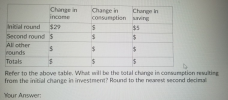 Change in consumption Change in saving $5 Change in income Initial round $29 Second round $ All other rounds Totals A A A Refer to the above table. What will be the total change in consumption resulting from the initial change in investment? Round to the nearest second decimal Your Answer:
10.) An economy has a marginal propensity to consume and Y* , income-expenditure equilibrium GDP,...
 10.) An economy has a marginal propensity to consume and Y* , income-expenditure equilibrium GDP, equals $500 billion. Given an autonomous increase in plannėd investment of $10 billion, show the rounds of increased spending that take place by completing the accompanying table. The first and second rows are filled in for you. In the first row the increase of planned investment spending of $10 billion raises real GDP and YD by $10 billion, leading to an increase in consumer spending...
Question 4 If a $2000 increase in income leads to an $1600 increase in consumption expenditures,...
 Question 4 If a $2000 increase in income leads to an $1600 increase in consumption expenditures, then the marginal propensity to consume is Not yet answered Select one: Marked out of 2.00 p Flag question a. 0.2 and the multiplier is 1.25. b. 0.2 and the multiplier is 1.25. C. 0.8 and the multiplier is 5. d. 0.8 and the multiplier is 8. O Question 5 The interest-rate effect is partially explained by the fact that a lower price level...
Suppose that investment demand increases by $200 billion and no leakages occur except household saving. Assume...
Suppose that investment demand increases by $200 billion and no leakages occur except household saving. Assume further that households have a marginal propensity to consume of 75 percent. Instructions: Enter your responses rounded to one decimal place. a. Compute four rounds of multiplier effects. Changes in This Cycle's Spending Cumulative Change in Spending (in billions) (in billions) First cycle $200.0 $200.0 Second cycle Third cycle Fourth cycle b. What will be the final cumulative impact on spending? billion
According to the table, the value of the marginal propensity to consume is Income Consumption $1,000 $900 $2,000...
 According to the table, the value of the marginal propensity to consume is Income Consumption $1,000 $900 $2,000 $1,700 $3,000 $2,500 $4,000 $3.300 $5,000 $4,100 0.8 O 0.7 0.9. 0.6. 0.5. D Question 26 1 pts Injecting new money into the economy eventually causes O stagflation. O unemployment. O arecession. inflation. deflation.
According to the table, the value of the marginal propensity to consume is Income Consumption $1,000 $900 $2,000 $1,700 $3,000 $2,500 $4,000 $3.300 $5,000 $4,100 0.8 O 0.7...
According to the table, the value of the marginal propensity to consume is Income Consumption $1,000 $900 $2,000 $1,700 $3,000 $2,500 $4,000 $3.300 $5,000 $4,100 0.8 O 0.7 0.9. 0.6. 0.5. D Question 26 1 pts Injecting new money into the economy eventually causes O stagflation. O unemployment. O arecession. inflation. deflation.
According to the table, the value of the marginal propensity to consume is Income Consumption $1,000 $900 $2,000 $1,700 $3,000 $2,500 $4,000 $3.300 $5,000 $4,100 0.8 O 0.7...
In Econoland, let the amount of consumption that is independent of income is equal to 80;...
In Econoland, let the amount of consumption that is independent of income is equal to 80; all expenditures are in billion US dollars. Investment in the economy is autonomous at 600. From any dollar change in national income, households use up ¾ of it to spend on consumption. Government spending is fixed at 300, and the tax rate is known to be 5%. The correct statement based on this case is Group of answer choices a. multiplier is 4 b....
Use the table below to answer the question. Disposable Income $10.000 $20,000 $30,000 $40.000 Consumption $12,000...
 Use the table below to answer the question. Disposable Income $10.000 $20,000 $30,000 $40.000 Consumption $12,000 $20.000 $28,000 $36.000 The marginal propensity to save (MPS) is equal to and the marginal propensity to consume (MPC) is equal to 0.2:0.8 O 0.25:0.75 O 0.75:0.25 O 0.8:0.2 Use the table below to answer the question. Disposable Income $10,000 $20,000 $30,000 $40,000 Consumption $12,000 $20,000 $28,000 $36,000 Autonomous consumptly is equal to: $1,000 O $4,000. O $10,000. O $12,000.
Real GDP, consumption, and the marginal propensity to consume (MPC) for five hypothetical countri...
Real GDP, consumption, and the marginal propensity to consume (MPC) for five hypothetical countries are shown in the table below. a. Enter the current level of saving in the appropriate column in the table. b. Now suppose that GDP increases by $20 billion in each of the five countries. What would be the new level level of saving in each country? Show your answers in the table below. Country Real GDP (Billions) Consumption (Billions) MPC Current Level of Saving (Billions)...
Suppose the consumption function is given by C = 100 + 0.75(Y-T). Investment is 50, government...
Suppose the consumption function is given by C = 100 + 0.75(Y-T). Investment is 50, government expenditure is 200, taxes are 250. What is the marginal propensity to consume in this case? What does it mean economically (1 points) What are the autonomous components here? (0.5 point) What is the equilibrium income? Also, calculate consumption. (1 point) Draw a labelled graph to show the equilibrium income. (1.5 points) Suppose investment spending increases to 100. What is the effect of this change on...
 Change in consumption Change in saving $5 Change in income Initial round $29 Second round $ All other rounds Totals A A A Refer to the above table. What will be the total change in consumption resulting from the initial change in investment? Round to the nearest second decimal Your Answer:
 10.) An economy has a marginal propensity to consume and Y* , income-expenditure equilibrium GDP, equals $500 billion. Given an autonomous increase in plannėd investment of $10 billion, show the rounds of increased spending that take place by completing the accompanying table. The first and second rows are filled in for you. In the first row the increase of planned investment spending of $10 billion raises real GDP and YD by $10 billion, leading to an increase in consumer spending...
 Question 4 If a $2000 increase in income leads to an $1600 increase in consumption expenditures, then the marginal propensity to consume is Not yet answered Select one: Marked out of 2.00 p Flag question a. 0.2 and the multiplier is 1.25. b. 0.2 and the multiplier is 1.25. C. 0.8 and the multiplier is 5. d. 0.8 and the multiplier is 8. O Question 5 The interest-rate effect is partially explained by the fact that a lower price level...
 According to the table, the value of the marginal propensity to consume is Income Consumption $1,000 $900 $2,000 $1,700 $3,000 $2,500 $4,000 $3.300 $5,000 $4,100 0.8 O 0.7 0.9. 0.6. 0.5. D Question 26 1 pts Injecting new money into the economy eventually causes O stagflation. O unemployment. O arecession. inflation. deflation.
According to the table, the value of the marginal propensity to consume is Income Consumption $1,000 $900 $2,000 $1,700 $3,000 $2,500 $4,000 $3.300 $5,000 $4,100 0.8 O 0.7...
According to the table, the value of the marginal propensity to consume is Income Consumption $1,000 $900 $2,000 $1,700 $3,000 $2,500 $4,000 $3.300 $5,000 $4,100 0.8 O 0.7 0.9. 0.6. 0.5. D Question 26 1 pts Injecting new money into the economy eventually causes O stagflation. O unemployment. O arecession. inflation. deflation.
According to the table, the value of the marginal propensity to consume is Income Consumption $1,000 $900 $2,000 $1,700 $3,000 $2,500 $4,000 $3.300 $5,000 $4,100 0.8 O 0.7...
 Use the table below to answer the question. Disposable Income $10.000 $20,000 $30,000 $40.000 Consumption $12,000 $20.000 $28,000 $36.000 The marginal propensity to save (MPS) is equal to and the marginal propensity to consume (MPC) is equal to 0.2:0.8 O 0.25:0.75 O 0.75:0.25 O 0.8:0.2 Use the table below to answer the question. Disposable Income $10,000 $20,000 $30,000 $40,000 Consumption $12,000 $20,000 $28,000 $36,000 Autonomous consumptly is equal to: $1,000 O $4,000. O $10,000. O $12,000.
Most questions answered within 3 hours.
-
Where is the error in this code sequence?
String s1 = "Hello";
String s2 = "ello";...
asked 10 months ago -
Financial data for Joel de Paris, Inc., for last year
follow:
Joel de Paris, Inc.
Balance...
asked 10 months ago -
Consider this reaction:
Al2(SO4)3 (aq)+ BaCl3
(aq) Al2Cl6 (aq)- +
3BaSO4(s) . What is the...
asked 10 months ago -
Suppose that Savneet is considering increasing her
recent random sample from 20 car rentals to 40...
asked 10 months ago -
Trucks arrive at an unloading terminal at an average rate of 120
per hour.
Trucks arrive...
asked 10 months ago -
Why are methanol and ethanol completely soluble in water while
octanol is not very little soluble....
asked 10 months ago -
A facilities manager at a university reads in a research report
that the mean amount of...
asked 10 months ago -
When the CuSO4 is rehydrated by adding water to the anhydrous
compound, is this an endothermic...
asked 10 months ago -
A ray of sunlight is passing from diamond into crown glass; the
angle of incidence is...
asked 10 months ago -
A block of mass 0.249 kg is placed on top of a light, vertical
spring of...
asked 10 months ago -
how do the kidneys compensate in the presences of acidosis
a) trigger hyperventilate
b) reserve acid...
asked 10 months ago -
Question 501 pts
The rental rate of capital to the firm increases. Which of the
following...
asked 10 months ago