So I have this question on a test not sure how to do this. Thanks in advance for any help you may provide me.

Homework Answers
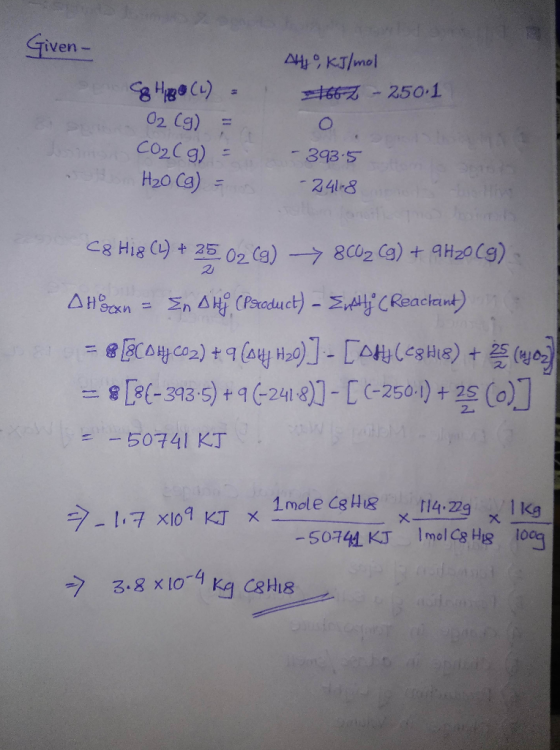
First of all the values provided in the question is incorrect as the Octane should be (C8H18) rather than (C2H4O)and the value of Delta Hf should be (-250.1 KJ/mol).
Please find the solution with correct Values:
Add Answer to:
So I have this question on a test not sure how to do this. Thanks
in...
I just want to see the steps on how to work out the problem, thanks. 18....
 I
just want to see the steps on how to work out the problem,
thanks.
18. Octane (CHıx) undergoes combustion according to the following thermochemical equation. 2C3H13() + 2502(g) → 16CO2(g) + 18H2011 AHnx = -1.0940 * 10ºkJ/mol What is the standard enthalpy of formation of liquid octane? AH* (CO2(g)) = -393.5 kJ/mol and AH® (H20(0) = -285.8 kJ/mol A.-250 kJ/mol B. -10,940. kl/mol C.-2188 kJ/mol D. -495 kJ/mol E. 495 kJ/mol
I
just want to see the steps on how to work out the problem,
thanks.
18. Octane (CHıx) undergoes combustion according to the following thermochemical equation. 2C3H13() + 2502(g) → 16CO2(g) + 18H2011 AHnx = -1.0940 * 10ºkJ/mol What is the standard enthalpy of formation of liquid octane? AH* (CO2(g)) = -393.5 kJ/mol and AH® (H20(0) = -285.8 kJ/mol A.-250 kJ/mol B. -10,940. kl/mol C.-2188 kJ/mol D. -495 kJ/mol E. 495 kJ/mol
can you do the 7 and 9 ? can you also show and explain me step...
 can you do the 7 and 9 ? can you also show and explain
me step by step?
D. 49.6 kJ E. 57.3 kJ 7. Butane (C4H10) undergoes combustion in excess oxygen to generate gaseous carbon dioxide and water. Given AH° [C4H10(g)] = -124.7 kJ/mol, AH° [CO2(g)] = -393.5 kJ/mol, AH [H2O(g)] = -241.8 kJ/mol, how much energy is released (kJ) when 8.30 g of butane is burned? Combustion of butane: 2 CH2(g) + 13 O2(g) → 8 CO2(g) +...
can you do the 7 and 9 ? can you also show and explain
me step by step?
D. 49.6 kJ E. 57.3 kJ 7. Butane (C4H10) undergoes combustion in excess oxygen to generate gaseous carbon dioxide and water. Given AH° [C4H10(g)] = -124.7 kJ/mol, AH° [CO2(g)] = -393.5 kJ/mol, AH [H2O(g)] = -241.8 kJ/mol, how much energy is released (kJ) when 8.30 g of butane is burned? Combustion of butane: 2 CH2(g) + 13 O2(g) → 8 CO2(g) +...
I need someone to show me how to solve thus problem, I think I have the...
I need someone to show me how to solve thus problem, I think I have the right idea, but I may be plugging in something wrong. What is ΔS° at 298 K for the following reaction? Fe2O3(s)+ 3CO(g)→ 3CO2(g) + 2Fe(s) Substance ΔG°f(kJ/mol) ΔH°f(kJ/mol) Fe2O3(s). -741.0 -822.2 CO(g) -137.2 -110.5 CO2(g) -394.4 -393.5 Thanks
The specific heat of iron is 0.450 J/g°C 1127 Chapter 6 Discussion Problems 1. How much energy must be transferred t...
 The specific heat of iron is 0.450 J/g°C
1127 Chapter 6 Discussion Problems 1. How much energy must be transferred to raise the temperature of a cup of coffee (250 mL) from 20.5°C 10 95.6°C? Assume density and specific heat is the same as Water 4.16 Ig/ml 2. An 38.5 g piece of iron with temperature 78.8°C is placed in a beaker containing 244 g of water at 18.8°C. When thermal equilibrium is reached, what is the final temperature? Assume...
The specific heat of iron is 0.450 J/g°C
1127 Chapter 6 Discussion Problems 1. How much energy must be transferred to raise the temperature of a cup of coffee (250 mL) from 20.5°C 10 95.6°C? Assume density and specific heat is the same as Water 4.16 Ig/ml 2. An 38.5 g piece of iron with temperature 78.8°C is placed in a beaker containing 244 g of water at 18.8°C. When thermal equilibrium is reached, what is the final temperature? Assume...
i missed this question on a chem test recently, and im not quiet sure how to...
 i missed this question on a chem test recently, and im not
quiet sure how to do this type of problem. i have been able to
solve a few very simple versions, but not this one.
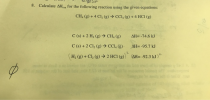
UUUJ SE 8. Calculate AH, for the following reaction using the given equations: CH, (g) + 4 CI, (g) → CCI, (g) + 4 HCI (g) C(s) + 2 H, (g) → CH. (g) C(s) + 2 CI, (g) → CCL (9) (H, (8)...
i missed this question on a chem test recently, and im not
quiet sure how to do this type of problem. i have been able to
solve a few very simple versions, but not this one.
UUUJ SE 8. Calculate AH, for the following reaction using the given equations: CH, (g) + 4 CI, (g) → CCI, (g) + 4 HCI (g) C(s) + 2 H, (g) → CH. (g) C(s) + 2 CI, (g) → CCL (9) (H, (8)...
Not sure if i balanced the equation out. I am completely lost on how to do A and B. thanks for the help in advance 2...
 Not sure if i balanced the equation out. I am completely lost
on how to do A and B. thanks for the help in advance
2 Fe(s) +5_CO2(g) | Fe2O3(s) + 5_C(s) + | 02(g) — First, balance the equation. (2 points) Then answer the following questions. How many grams of Co, will be produced if 3940. g of iron is also produced? (3 points) b. How many grams of carbon are necessary to react completely with 25.7 kg of...
Not sure if i balanced the equation out. I am completely lost
on how to do A and B. thanks for the help in advance
2 Fe(s) +5_CO2(g) | Fe2O3(s) + 5_C(s) + | 02(g) — First, balance the equation. (2 points) Then answer the following questions. How many grams of Co, will be produced if 3940. g of iron is also produced? (3 points) b. How many grams of carbon are necessary to react completely with 25.7 kg of...
Calorimetry Problems: AH = m(at), Exercise #6: Enthalpy Problems 300 kg of water cools from 5...
 Calorimetry Problems: AH = m(at), Exercise #6: Enthalpy Problems 300 kg of water cools from 5 to 20 How much beat energy was released by the water? Co H2O(l) is 4.180 J/gºC. 4. How much heat energy is required to heat 45 g of sheet Fe from 24°C to 200."C?, of Fe(s) is 0.449 J/gºC. 3. A food chemist combusts 56 g of a chocolate bar in a calorimeter containing 1.5 L of water (density Ho mL). The initial temperature...
I hope the answer is clear and correct thanks Question 1 (1 point) What is the...
 I hope the answer is clear and correct thanks
Question 1 (1 point) What is the change in enthalpy (in kJ mol'?) for the following reaction F2(g) + Cabr,(s) CaF() + Brz(1) O 1) -112 kJmo12 O2) 504 kJmo11 03) -504 kJmol 1 04) 537 kJmo11 O 5) -537 kJmol'i Question 2 (1 point) What is true about the following reaction at 25°C? F,(g) + 2HCl(g) 2 2017(g) + H (9) Ahrº=76 kJ mol'i Asr°=-10.13 J mol'i Ki Agrº=79 kJ...
I hope the answer is clear and correct thanks
Question 1 (1 point) What is the change in enthalpy (in kJ mol'?) for the following reaction F2(g) + Cabr,(s) CaF() + Brz(1) O 1) -112 kJmo12 O2) 504 kJmo11 03) -504 kJmol 1 04) 537 kJmo11 O 5) -537 kJmol'i Question 2 (1 point) What is true about the following reaction at 25°C? F,(g) + 2HCl(g) 2 2017(g) + H (9) Ahrº=76 kJ mol'i Asr°=-10.13 J mol'i Ki Agrº=79 kJ...
how do i do these two questions? Assume that the reaction: CO(g) + H2O(g) = CO2(g)...
 how do i do these two questions?
Assume that the reaction: CO(g) + H2O(g) = CO2(g) + H2(g) occurs in an ideal mixture of ideal gases. At 700.K, K=3.61. At this temperature, AG° equals: Select one: a.-7.47 kJ b. Oku 0 C. -3.74 kJ o d. 7.47 kJ -200 kJ. For the following reaction producing 1 mol of oxygen gas at a particular temperature, AH NO(g) +O3(g) → NO2(g) + O2(g) The activation energy is 11 kJ/mol. What is the...
how do i do these two questions?
Assume that the reaction: CO(g) + H2O(g) = CO2(g) + H2(g) occurs in an ideal mixture of ideal gases. At 700.K, K=3.61. At this temperature, AG° equals: Select one: a.-7.47 kJ b. Oku 0 C. -3.74 kJ o d. 7.47 kJ -200 kJ. For the following reaction producing 1 mol of oxygen gas at a particular temperature, AH NO(g) +O3(g) → NO2(g) + O2(g) The activation energy is 11 kJ/mol. What is the...
General Chemistry I! Workshop 8: Gibb's Free Energy Part I. (2 pts) Write down and balance...
 General Chemistry I! Workshop 8: Gibb's Free Energy Part I. (2 pts) Write down and balance chemical equations for (a) the reaction for burning 1 mole of hydrogen gas in oxygen to produce liquid water and (b) the reaction for burning 1 mole of liquid propane (CsHs) in oxygen to produce carbon dioxide gas and liquid water: (a) (b) Now look at the two reactions and discuss with yo group the following questions: (a) Which of these two methods of...
 I
just want to see the steps on how to work out the problem,
thanks.
18. Octane (CHıx) undergoes combustion according to the following thermochemical equation. 2C3H13() + 2502(g) → 16CO2(g) + 18H2011 AHnx = -1.0940 * 10ºkJ/mol What is the standard enthalpy of formation of liquid octane? AH* (CO2(g)) = -393.5 kJ/mol and AH® (H20(0) = -285.8 kJ/mol A.-250 kJ/mol B. -10,940. kl/mol C.-2188 kJ/mol D. -495 kJ/mol E. 495 kJ/mol
I
just want to see the steps on how to work out the problem,
thanks.
18. Octane (CHıx) undergoes combustion according to the following thermochemical equation. 2C3H13() + 2502(g) → 16CO2(g) + 18H2011 AHnx = -1.0940 * 10ºkJ/mol What is the standard enthalpy of formation of liquid octane? AH* (CO2(g)) = -393.5 kJ/mol and AH® (H20(0) = -285.8 kJ/mol A.-250 kJ/mol B. -10,940. kl/mol C.-2188 kJ/mol D. -495 kJ/mol E. 495 kJ/mol
 can you do the 7 and 9 ? can you also show and explain
me step by step?
D. 49.6 kJ E. 57.3 kJ 7. Butane (C4H10) undergoes combustion in excess oxygen to generate gaseous carbon dioxide and water. Given AH° [C4H10(g)] = -124.7 kJ/mol, AH° [CO2(g)] = -393.5 kJ/mol, AH [H2O(g)] = -241.8 kJ/mol, how much energy is released (kJ) when 8.30 g of butane is burned? Combustion of butane: 2 CH2(g) + 13 O2(g) → 8 CO2(g) +...
can you do the 7 and 9 ? can you also show and explain
me step by step?
D. 49.6 kJ E. 57.3 kJ 7. Butane (C4H10) undergoes combustion in excess oxygen to generate gaseous carbon dioxide and water. Given AH° [C4H10(g)] = -124.7 kJ/mol, AH° [CO2(g)] = -393.5 kJ/mol, AH [H2O(g)] = -241.8 kJ/mol, how much energy is released (kJ) when 8.30 g of butane is burned? Combustion of butane: 2 CH2(g) + 13 O2(g) → 8 CO2(g) +...
 The specific heat of iron is 0.450 J/g°C
1127 Chapter 6 Discussion Problems 1. How much energy must be transferred to raise the temperature of a cup of coffee (250 mL) from 20.5°C 10 95.6°C? Assume density and specific heat is the same as Water 4.16 Ig/ml 2. An 38.5 g piece of iron with temperature 78.8°C is placed in a beaker containing 244 g of water at 18.8°C. When thermal equilibrium is reached, what is the final temperature? Assume...
The specific heat of iron is 0.450 J/g°C
1127 Chapter 6 Discussion Problems 1. How much energy must be transferred to raise the temperature of a cup of coffee (250 mL) from 20.5°C 10 95.6°C? Assume density and specific heat is the same as Water 4.16 Ig/ml 2. An 38.5 g piece of iron with temperature 78.8°C is placed in a beaker containing 244 g of water at 18.8°C. When thermal equilibrium is reached, what is the final temperature? Assume...
 i missed this question on a chem test recently, and im not
quiet sure how to do this type of problem. i have been able to
solve a few very simple versions, but not this one.
UUUJ SE 8. Calculate AH, for the following reaction using the given equations: CH, (g) + 4 CI, (g) → CCI, (g) + 4 HCI (g) C(s) + 2 H, (g) → CH. (g) C(s) + 2 CI, (g) → CCL (9) (H, (8)...
i missed this question on a chem test recently, and im not
quiet sure how to do this type of problem. i have been able to
solve a few very simple versions, but not this one.
UUUJ SE 8. Calculate AH, for the following reaction using the given equations: CH, (g) + 4 CI, (g) → CCI, (g) + 4 HCI (g) C(s) + 2 H, (g) → CH. (g) C(s) + 2 CI, (g) → CCL (9) (H, (8)...
 Not sure if i balanced the equation out. I am completely lost
on how to do A and B. thanks for the help in advance
2 Fe(s) +5_CO2(g) | Fe2O3(s) + 5_C(s) + | 02(g) — First, balance the equation. (2 points) Then answer the following questions. How many grams of Co, will be produced if 3940. g of iron is also produced? (3 points) b. How many grams of carbon are necessary to react completely with 25.7 kg of...
Not sure if i balanced the equation out. I am completely lost
on how to do A and B. thanks for the help in advance
2 Fe(s) +5_CO2(g) | Fe2O3(s) + 5_C(s) + | 02(g) — First, balance the equation. (2 points) Then answer the following questions. How many grams of Co, will be produced if 3940. g of iron is also produced? (3 points) b. How many grams of carbon are necessary to react completely with 25.7 kg of...
 Calorimetry Problems: AH = m(at), Exercise #6: Enthalpy Problems 300 kg of water cools from 5 to 20 How much beat energy was released by the water? Co H2O(l) is 4.180 J/gºC. 4. How much heat energy is required to heat 45 g of sheet Fe from 24°C to 200."C?, of Fe(s) is 0.449 J/gºC. 3. A food chemist combusts 56 g of a chocolate bar in a calorimeter containing 1.5 L of water (density Ho mL). The initial temperature...
 I hope the answer is clear and correct thanks
Question 1 (1 point) What is the change in enthalpy (in kJ mol'?) for the following reaction F2(g) + Cabr,(s) CaF() + Brz(1) O 1) -112 kJmo12 O2) 504 kJmo11 03) -504 kJmol 1 04) 537 kJmo11 O 5) -537 kJmol'i Question 2 (1 point) What is true about the following reaction at 25°C? F,(g) + 2HCl(g) 2 2017(g) + H (9) Ahrº=76 kJ mol'i Asr°=-10.13 J mol'i Ki Agrº=79 kJ...
I hope the answer is clear and correct thanks
Question 1 (1 point) What is the change in enthalpy (in kJ mol'?) for the following reaction F2(g) + Cabr,(s) CaF() + Brz(1) O 1) -112 kJmo12 O2) 504 kJmo11 03) -504 kJmol 1 04) 537 kJmo11 O 5) -537 kJmol'i Question 2 (1 point) What is true about the following reaction at 25°C? F,(g) + 2HCl(g) 2 2017(g) + H (9) Ahrº=76 kJ mol'i Asr°=-10.13 J mol'i Ki Agrº=79 kJ...
 how do i do these two questions?
Assume that the reaction: CO(g) + H2O(g) = CO2(g) + H2(g) occurs in an ideal mixture of ideal gases. At 700.K, K=3.61. At this temperature, AG° equals: Select one: a.-7.47 kJ b. Oku 0 C. -3.74 kJ o d. 7.47 kJ -200 kJ. For the following reaction producing 1 mol of oxygen gas at a particular temperature, AH NO(g) +O3(g) → NO2(g) + O2(g) The activation energy is 11 kJ/mol. What is the...
how do i do these two questions?
Assume that the reaction: CO(g) + H2O(g) = CO2(g) + H2(g) occurs in an ideal mixture of ideal gases. At 700.K, K=3.61. At this temperature, AG° equals: Select one: a.-7.47 kJ b. Oku 0 C. -3.74 kJ o d. 7.47 kJ -200 kJ. For the following reaction producing 1 mol of oxygen gas at a particular temperature, AH NO(g) +O3(g) → NO2(g) + O2(g) The activation energy is 11 kJ/mol. What is the...
 General Chemistry I! Workshop 8: Gibb's Free Energy Part I. (2 pts) Write down and balance chemical equations for (a) the reaction for burning 1 mole of hydrogen gas in oxygen to produce liquid water and (b) the reaction for burning 1 mole of liquid propane (CsHs) in oxygen to produce carbon dioxide gas and liquid water: (a) (b) Now look at the two reactions and discuss with yo group the following questions: (a) Which of these two methods of...
Most questions answered within 3 hours.
-
Where is the error in this code sequence?
String s1 = "Hello";
String s2 = "ello";...
asked 10 months ago -
Financial data for Joel de Paris, Inc., for last year
follow:
Joel de Paris, Inc.
Balance...
asked 10 months ago -
Consider this reaction:
Al2(SO4)3 (aq)+ BaCl3
(aq) Al2Cl6 (aq)- +
3BaSO4(s) . What is the...
asked 10 months ago -
Suppose that Savneet is considering increasing her
recent random sample from 20 car rentals to 40...
asked 10 months ago -
Trucks arrive at an unloading terminal at an average rate of 120
per hour.
Trucks arrive...
asked 10 months ago -
Why are methanol and ethanol completely soluble in water while
octanol is not very little soluble....
asked 10 months ago -
A facilities manager at a university reads in a research report
that the mean amount of...
asked 10 months ago -
When the CuSO4 is rehydrated by adding water to the anhydrous
compound, is this an endothermic...
asked 10 months ago -
A ray of sunlight is passing from diamond into crown glass; the
angle of incidence is...
asked 10 months ago -
A block of mass 0.249 kg is placed on top of a light, vertical
spring of...
asked 10 months ago -
how do the kidneys compensate in the presences of acidosis
a) trigger hyperventilate
b) reserve acid...
asked 10 months ago -
Question 501 pts
The rental rate of capital to the firm increases. Which of the
following...
asked 10 months ago