
Homework Answers
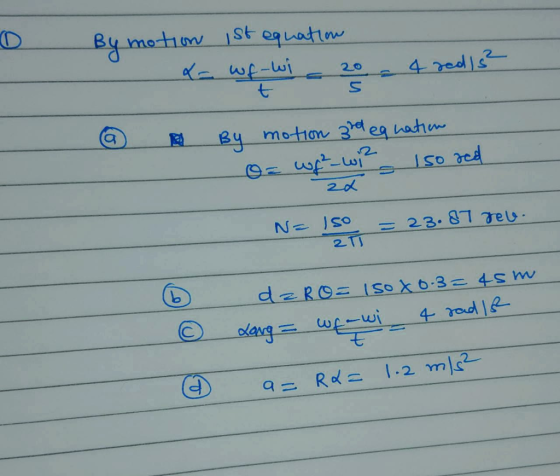
SOLUTION :
a.
Angular speed increases from 20 rad/sec to 40 rad/sec in 5 secs.
So the average angular speed = (20 + 40)/2 = 30 rad/sec
Angular distance moved = 30 * 5 = 150 rad.
So, number of revolutions done = 150/(2 * pi) = 23.87 (ANSWER).
b.
Disc travels
= no. of frevolutions * 2 pi r
= 150/(2 pi) * 2 pi * 0.3
= 45 m (ANSWER).
c.
Angiular acceleration
= incrtease in angular speed / time
= (40 - 20) / 5
= 4 rad / sec^2 (ANSWER).
d.
Linear accleration
= angular acceleration * r
= 4 * 0.3
= 1.2 m/s^2 (ANSWER).
Add Answer to:
A disk with a diameter of 0.6 m speeds up from 20 rad/s to 40 rad/s...
With the aid of a string, a gyroscope is accelerated from rest to 40 rad/s in...
With the aid of a string, a gyroscope is accelerated from rest to 40 rad/s in 0.40 s under a constant angular acceleration. (a) What is its angular acceleration in rad/s²? (b) How many revolutions does it go through in the process? a. 16 ra d.ls2 ana 0.2 rev b. 16 radls2 and 0.4 rev c. 100 rad/s2 and 0.7 rev ,d. 100 radls2 and 1.3 rev
3. A disk 6.0cm in diameter and moment of inertia of 0.015kg-m’ initially at rest at...
 3. A disk 6.0cm in diameter and moment of inertia of 0.015kg-m’ initially at rest at t = 0, is spun up to 720-rpm over 6.0s about an axis through its center of mass. Assume the angular acceleration is constant. a) Find the angular velocity (rad/s) at 6.0s b) Find the angular acceleration (rad/s) c) Find the number of revolutions the disk spins through during that interval. d) What is the mass of the disk? e) What is the change...
A disk is initialy at rest and a constant angular acceleration of 5 rad/s? is applied...
 A disk is initialy at rest and a constant angular acceleration of 5 rad/s? is applied to it counter-clockwise (about its center). After 5.8 seconds, the constant angular acceleration value switches to 10 rad/s? clockwise. How many revolutions, in total, are made before the disk is stopped again?
A solid disk with a mass of 40 kg and a radius of 0.6 m can...
 A solid disk with a mass of 40 kg and a radius of 0.6 m can
rotate around an
axis through its center, perpendicular to the disk surface. At
time t = 0 s, the
disk is not turning. It has a constant angular acceleration ↵
and by t = 20 s it
has completed 500 complete turns.
Calculate the angular acceleration ↵.
Calculate the angular velocity ! at t = 20 s.
Calculate the rotational kinetic energy at t...
A solid disk with a mass of 40 kg and a radius of 0.6 m can
rotate around an
axis through its center, perpendicular to the disk surface. At
time t = 0 s, the
disk is not turning. It has a constant angular acceleration ↵
and by t = 20 s it
has completed 500 complete turns.
Calculate the angular acceleration ↵.
Calculate the angular velocity ! at t = 20 s.
Calculate the rotational kinetic energy at t...
An optical disk drive in your computer can spin a disk up to 10,000 rpm (about...
An optical disk drive in your computer can spin a disk up to 10,000 rpm (about 1045 rad / s). If a particular disk is spun at 294.3 rad / s while it is being read, and then is allowed to come to rest over 0.234 seconds, what is the magnitude of the average angular acceleration of the disk? AND If the disk is 0.12 m in diameter, what is the magnitude of the linear acceleration of a point 1/8...
With aid of a string, a gyroscope is accelerated from rest to 40 rad/s in 0.40s....
With aid of a string, a gyroscope is accelerated from rest to 40 rad/s in 0.40s. What is its angular acceleration in rad/s^2? How many revolutions does it go through in the process? a. 16 rad/s^2 and 0.2 rev b. 16 rad/s^2 and 0.4 rev c. 100 rad/s^2 and 0.7 rev d. 100 rad/s^2 and 1.3 rev
A disk is initially rotating (about its center) at 48 rad/s counter-clockwise. After a constant angular...
A disk is initially rotating (about its center) at 48 rad/s counter-clockwise. After a constant angular acceleration is applied to it for 2.2 seconds, it is rotating at 9 rad/s counter-clockwise. How many revolutions does the disk make in that time
With the aid of a string, a gyroscope is accelerated from rest to 31 rad/s in...
 With the aid of a string, a
gyroscope is accelerated from rest to 31 rad/s in 0.39 s.
Randomized Variablesω = 31 rad/s
t = 0.39 s
Part (a) What is its angular acceleration, in
radians per square seconds?
Part
(b) How many revolutions does it go through in the
process?
With the aid of a string, a
gyroscope is accelerated from rest to 31 rad/s in 0.39 s.
Randomized Variablesω = 31 rad/s
t = 0.39 s
Part (a) What is its angular acceleration, in
radians per square seconds?
Part
(b) How many revolutions does it go through in the
process?
An optical disk drive in your computer can spin a disk up to 10,000 rpm (about...
An optical disk drive in your computer can spin a disk up to 10,000 rpm (about 1045 rad/s ). If a particular disk is spun at 910.0 rad/s while it is being read, and then is allowed to come to rest over 0.301 seconds , what is the magnitude of the average angular acceleration of the disk? average angular acceleration: rads2 If the disk is 0.12 m in diameter, what is the magnitude of the tangential acceleration of a point...
An optical disk drive in your computer can spin a disk up to 10,000 rpm (about...
An optical disk drive in your computer can spin a disk up to 10,000 rpm (about 1045 rad/s1045 rad/s). If a particular disk is spun at 763.4 rad/s763.4 rad/s while it is being read, and then is allowed to come to rest over 0.368 seconds0.368 seconds, what is the magnitude of the average angular acceleration of the disk? average angular acceleration: rads2rads2 If the disk is 0.12 m0.12 m in diameter, what is the magnitude of the tangential acceleration of...
 3. A disk 6.0cm in diameter and moment of inertia of 0.015kg-m’ initially at rest at t = 0, is spun up to 720-rpm over 6.0s about an axis through its center of mass. Assume the angular acceleration is constant. a) Find the angular velocity (rad/s) at 6.0s b) Find the angular acceleration (rad/s) c) Find the number of revolutions the disk spins through during that interval. d) What is the mass of the disk? e) What is the change...
 A disk is initialy at rest and a constant angular acceleration of 5 rad/s? is applied to it counter-clockwise (about its center). After 5.8 seconds, the constant angular acceleration value switches to 10 rad/s? clockwise. How many revolutions, in total, are made before the disk is stopped again?
 A solid disk with a mass of 40 kg and a radius of 0.6 m can
rotate around an
axis through its center, perpendicular to the disk surface. At
time t = 0 s, the
disk is not turning. It has a constant angular acceleration ↵
and by t = 20 s it
has completed 500 complete turns.
Calculate the angular acceleration ↵.
Calculate the angular velocity ! at t = 20 s.
Calculate the rotational kinetic energy at t...
A solid disk with a mass of 40 kg and a radius of 0.6 m can
rotate around an
axis through its center, perpendicular to the disk surface. At
time t = 0 s, the
disk is not turning. It has a constant angular acceleration ↵
and by t = 20 s it
has completed 500 complete turns.
Calculate the angular acceleration ↵.
Calculate the angular velocity ! at t = 20 s.
Calculate the rotational kinetic energy at t...
 With the aid of a string, a
gyroscope is accelerated from rest to 31 rad/s in 0.39 s.
Randomized Variablesω = 31 rad/s
t = 0.39 s
Part (a) What is its angular acceleration, in
radians per square seconds?
Part
(b) How many revolutions does it go through in the
process?
With the aid of a string, a
gyroscope is accelerated from rest to 31 rad/s in 0.39 s.
Randomized Variablesω = 31 rad/s
t = 0.39 s
Part (a) What is its angular acceleration, in
radians per square seconds?
Part
(b) How many revolutions does it go through in the
process?
Most questions answered within 3 hours.
-
Where is the error in this code sequence?
String s1 = "Hello";
String s2 = "ello";...
asked 11 months ago -
Financial data for Joel de Paris, Inc., for last year
follow:
Joel de Paris, Inc.
Balance...
asked 11 months ago -
Consider this reaction:
Al2(SO4)3 (aq)+ BaCl3
(aq) Al2Cl6 (aq)- +
3BaSO4(s) . What is the...
asked 11 months ago -
Suppose that Savneet is considering increasing her
recent random sample from 20 car rentals to 40...
asked 11 months ago -
Trucks arrive at an unloading terminal at an average rate of 120
per hour.
Trucks arrive...
asked 11 months ago -
Why are methanol and ethanol completely soluble in water while
octanol is not very little soluble....
asked 11 months ago -
A facilities manager at a university reads in a research report
that the mean amount of...
asked 11 months ago -
When the CuSO4 is rehydrated by adding water to the anhydrous
compound, is this an endothermic...
asked 11 months ago -
A ray of sunlight is passing from diamond into crown glass; the
angle of incidence is...
asked 11 months ago -
A block of mass 0.249 kg is placed on top of a light, vertical
spring of...
asked 11 months ago -
how do the kidneys compensate in the presences of acidosis
a) trigger hyperventilate
b) reserve acid...
asked 11 months ago -
Question 501 pts
The rental rate of capital to the firm increases. Which of the
following...
asked 11 months ago