
Homework Answers
Firstly we can calculate the double bond equivalence, for a compound CaHbNcOd type of compound it is
(if halogen is there count them with number of H)
So, here it is = 1.
- At 1718 cm-1 IR peak refers to C=O stretching frequency, so, the one double bond is detected. The 2962 cm-1 is for sp3 C-H stretching, so there are only sp3 carbons in the compound and the carbonyl is ketone.
- The overall molecular mass is 128 and the strong peak appers due to carbonyl. Now , in case of carbonyl both alpha and beta cleavage occurs. So, in the fragmentation peaks we can search for them. This will be a test for whether our predicted structure is correct or not.
- 9 H singlet is a common phenomenon for tertiary butyl system. So, we can think of a t-butyl system there. The chemical shift value suggests it is not in the vicinity of carbonyl.
- 3 H singlet is a common phenomenon for methyl having no neighbouring proton. Also its chemical shift value is quite high. So, we may think there is a CH3 group adjacent to carbonyl.
Up to this we got fragments,
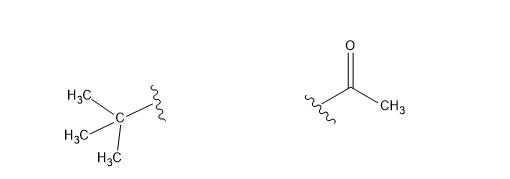
Now, we have only 2 C and 4 H left. Also, there are two 2H triplets in the 1H NMR spectrum. So, there must be a -CH2-CH2- linkage with no neighbouring H in the left or in the right. So, we can join these fragments with the linker. So, proposed molecule:
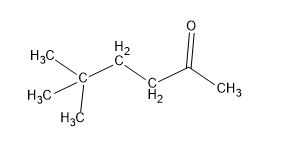
Now, compare mass spectrometry data and 13C NMR data:
- Due to alpha cleavage on the right side, -CH3 group gets lost, having mass = 15. So, we'll have a peak at 128-15=113. Due to beta cleavage the left most neopentyl group gets lost, so we'll have a peak ( for -CH2-CO-CH3) at 57.
- For 13C, the peak above 200 is due to carbonyl carbon. All other peaks are in the range of sp3 C. The alpha carbons with respect to carbonyl have a higher value near 40. Rest of the carbons come nearly at 30.
Add Answer to:
Compound Z, C5H160. Deduce its structure. IR: significant peaks at 2962 and 1718 (intense) cm! 13...
Compound Z, CaHie0. Deduce its structure. IR: significant peaks at 2962 and 1718 (intense) cm. Mass...
 Compound Z, CaHie0. Deduce its structure. IR: significant peaks at 2962 and 1718 (intense) cm. Mass spectrum: a few of the significant peaks include 128, 103, 57 m/z H-NMR: S,3H's aH's t,2t's PPM 13C-NMR 220 200 180 160 140 120 PPM 100 80 60 40 20
Use the mass spectrum and either the NMR spectrum or the IR spectrum to deduce the...
 Use the mass spectrum and either the NMR spectrum or the IR
spectrum to deduce the structure of the following compound
(c) C8HO3H NMR, 300 MHz, 6.1 ppm (singlet, 2H), 6.9 ppm (doublet, 1H), and 7.3 ppm (singlet, 1H), 7.4 ppm (doublet, 1H), 9.8 ppm (singlet, 1H); significant IR absorbances at 1687, 1602, 1449, 1264, 1038, 929, and 815 cm1. 100 149 (150) 80 60 40 121 63 20 65 91 0 15 20 25 30 35 40 45 50...
Use the mass spectrum and either the NMR spectrum or the IR
spectrum to deduce the structure of the following compound
(c) C8HO3H NMR, 300 MHz, 6.1 ppm (singlet, 2H), 6.9 ppm (doublet, 1H), and 7.3 ppm (singlet, 1H), 7.4 ppm (doublet, 1H), 9.8 ppm (singlet, 1H); significant IR absorbances at 1687, 1602, 1449, 1264, 1038, 929, and 815 cm1. 100 149 (150) 80 60 40 121 63 20 65 91 0 15 20 25 30 35 40 45 50...
Deduce the following structure of the compound given their IR, H1 NMR, 13C NMR spectra, and...
 Deduce the following structure of the compound given their IR, H1
NMR, 13C NMR spectra, and assign IR functional group absorptions
and assign the structure's protons and carbons to their respective
spectral resonances.
Compound 4 Da- U6)+20 IR Spectrum Oquid fim) 1760 800 1200 2000 1600 3000 4000 v (cm) Mass Spectrum 100 43 No significant UV absorption above 220 nm M146 (1% ) 87 20 CH1004 280 40 80 120 m/e 160 200 240 13C NMR Spectrum (1000 MHz,...
Deduce the following structure of the compound given their IR, H1
NMR, 13C NMR spectra, and assign IR functional group absorptions
and assign the structure's protons and carbons to their respective
spectral resonances.
Compound 4 Da- U6)+20 IR Spectrum Oquid fim) 1760 800 1200 2000 1600 3000 4000 v (cm) Mass Spectrum 100 43 No significant UV absorption above 220 nm M146 (1% ) 87 20 CH1004 280 40 80 120 m/e 160 200 240 13C NMR Spectrum (1000 MHz,...
Deduce the following structure of the compound given their IR, H1 NMR, 13C NMR spectra, and...
 Deduce the following structure of the compound given their IR, H1
NMR, 13C NMR spectra, and assign IR functional group absorptions
and assign the structure's protons and carbons to their respective
spectral resonances.
Compound 6 1756 IR Spectrum uid Sm) 15820 4000 3000 2000 1600 1200 800 V (cm) 100 55 Mass Spectrum 71 80 70 60 No significant UV M158 (1%) absorption above 220 nm C&H140s 40 80 120 160 200 240 280 m/e 13C NMR Spectrum (50.0 MHz,...
Deduce the following structure of the compound given their IR, H1
NMR, 13C NMR spectra, and assign IR functional group absorptions
and assign the structure's protons and carbons to their respective
spectral resonances.
Compound 6 1756 IR Spectrum uid Sm) 15820 4000 3000 2000 1600 1200 800 V (cm) 100 55 Mass Spectrum 71 80 70 60 No significant UV M158 (1%) absorption above 220 nm C&H140s 40 80 120 160 200 240 280 m/e 13C NMR Spectrum (50.0 MHz,...
IR Spectra help, question up top Use IR. proton NMR and MS data to deduce the...
 IR Spectra help, question up top
Use IR. proton NMR and MS data to deduce the correct structure Draw the structure and dide it. Indicate on the IR, NMR and MS spectra the information you got from each to deduce the structure. Problem 20 IR Spectrum 4000 3000 2000 1800 12000 00 8 Mass Spectrum 8 8 No significant UV absorption above 220 nm 8 8 CgH NO 240 280 40 80 120 180 200 13C NMR Spectrum (1000 MHE....
IR Spectra help, question up top
Use IR. proton NMR and MS data to deduce the correct structure Draw the structure and dide it. Indicate on the IR, NMR and MS spectra the information you got from each to deduce the structure. Problem 20 IR Spectrum 4000 3000 2000 1800 12000 00 8 Mass Spectrum 8 8 No significant UV absorption above 220 nm 8 8 CgH NO 240 280 40 80 120 180 200 13C NMR Spectrum (1000 MHE....
Information: Each spectra below was obtained from a pure compound. Mass Spectrum parent peaks (M) are...
 Information: Each spectra below was obtained from a pure compound. Mass Spectrum parent peaks (M) are listed for all examples. IR pea ks listed are strong (s) unless otherwise indicated for signals above 1500 cm H NMR Spectra, the integral is given in number of hydrogens (#H) or as a relative ratio. Important coupling constants (J-values) are listed next to the peaks for some examples. For some spectra, an inset (grey box) is also given showing a "zoom-in" on an...
Information: Each spectra below was obtained from a pure compound Mass Spectrum parent peaks (M) are listed for all ex...
 Information: Each spectra below was obtained from a pure compound Mass Spectrum parent peaks (M) are listed for all examples. IR peaks listed are strong (s) unless otherwise indicated for signals above 1500 cm *H NMR Spectra, the integral is given in number of hydrogens (#H) or as a relative ratio. Important coupling constants (-values) are listed next to the peaks for some examples. For some spectra, an inset (grey box) is also given showing a "zoom-in" on an important...
29. The mass spectrum of the compound shown below has significant fragmentation peaks at m/z 85,...
 29. The mass spectrum of the compound shown below has significant fragmentation peaks at m/z 85, 58, 57, 43, and 42. which two of these peaks are due to α-cleavage, and which one of therm is due to a McLafferty rearrangement? 30. Draw the expected 'H NMR spectrum for PhC02CH(CH3)2. Show correct shifts, multiplicities, and # of H-atoms. Finally, indicate which diagnostic IR absorptions you would expect to see for this compound. 6 4 2 0 PPM IR absorbances:
Information: Each spectra below was obtained from a pure compound. Mass Spectrum parent peaks (M) are...
 Information: Each spectra below was obtained from a pure compound. Mass Spectrum parent peaks (M) are listed for all examples. IR peaks listed are strong (s) unless otherwise indicated for signals above 1500 cm "H NMR Spectra, the integral is given in number of hydrogens (#H) or as a relative ratio. Important coupling constants (J-values) are listed next to the peaks for some examples. For some spectra, an inset (grey box) is also given showing a "zoom-in" on an important...
Deduce the ester compound structure with M/Z=136 on this mass spectrum; significant peaks at 51, 77,...
 Deduce the ester compound structure with M/Z=136 on this mass
spectrum; significant peaks at 51, 77, 105, 136.
Relative Abundance M(136) 25 30 35 40 45 50 55 60 65 70 75 80 85 90 95 100 105 110 115 120 125 130 135 140 mz
Deduce the ester compound structure with M/Z=136 on this mass
spectrum; significant peaks at 51, 77, 105, 136.
Relative Abundance M(136) 25 30 35 40 45 50 55 60 65 70 75 80 85 90 95 100 105 110 115 120 125 130 135 140 mz
 Compound Z, CaHie0. Deduce its structure. IR: significant peaks at 2962 and 1718 (intense) cm. Mass spectrum: a few of the significant peaks include 128, 103, 57 m/z H-NMR: S,3H's aH's t,2t's PPM 13C-NMR 220 200 180 160 140 120 PPM 100 80 60 40 20
 Use the mass spectrum and either the NMR spectrum or the IR
spectrum to deduce the structure of the following compound
(c) C8HO3H NMR, 300 MHz, 6.1 ppm (singlet, 2H), 6.9 ppm (doublet, 1H), and 7.3 ppm (singlet, 1H), 7.4 ppm (doublet, 1H), 9.8 ppm (singlet, 1H); significant IR absorbances at 1687, 1602, 1449, 1264, 1038, 929, and 815 cm1. 100 149 (150) 80 60 40 121 63 20 65 91 0 15 20 25 30 35 40 45 50...
Use the mass spectrum and either the NMR spectrum or the IR
spectrum to deduce the structure of the following compound
(c) C8HO3H NMR, 300 MHz, 6.1 ppm (singlet, 2H), 6.9 ppm (doublet, 1H), and 7.3 ppm (singlet, 1H), 7.4 ppm (doublet, 1H), 9.8 ppm (singlet, 1H); significant IR absorbances at 1687, 1602, 1449, 1264, 1038, 929, and 815 cm1. 100 149 (150) 80 60 40 121 63 20 65 91 0 15 20 25 30 35 40 45 50...
 Deduce the following structure of the compound given their IR, H1
NMR, 13C NMR spectra, and assign IR functional group absorptions
and assign the structure's protons and carbons to their respective
spectral resonances.
Compound 4 Da- U6)+20 IR Spectrum Oquid fim) 1760 800 1200 2000 1600 3000 4000 v (cm) Mass Spectrum 100 43 No significant UV absorption above 220 nm M146 (1% ) 87 20 CH1004 280 40 80 120 m/e 160 200 240 13C NMR Spectrum (1000 MHz,...
Deduce the following structure of the compound given their IR, H1
NMR, 13C NMR spectra, and assign IR functional group absorptions
and assign the structure's protons and carbons to their respective
spectral resonances.
Compound 4 Da- U6)+20 IR Spectrum Oquid fim) 1760 800 1200 2000 1600 3000 4000 v (cm) Mass Spectrum 100 43 No significant UV absorption above 220 nm M146 (1% ) 87 20 CH1004 280 40 80 120 m/e 160 200 240 13C NMR Spectrum (1000 MHz,...
 Deduce the following structure of the compound given their IR, H1
NMR, 13C NMR spectra, and assign IR functional group absorptions
and assign the structure's protons and carbons to their respective
spectral resonances.
Compound 6 1756 IR Spectrum uid Sm) 15820 4000 3000 2000 1600 1200 800 V (cm) 100 55 Mass Spectrum 71 80 70 60 No significant UV M158 (1%) absorption above 220 nm C&H140s 40 80 120 160 200 240 280 m/e 13C NMR Spectrum (50.0 MHz,...
Deduce the following structure of the compound given their IR, H1
NMR, 13C NMR spectra, and assign IR functional group absorptions
and assign the structure's protons and carbons to their respective
spectral resonances.
Compound 6 1756 IR Spectrum uid Sm) 15820 4000 3000 2000 1600 1200 800 V (cm) 100 55 Mass Spectrum 71 80 70 60 No significant UV M158 (1%) absorption above 220 nm C&H140s 40 80 120 160 200 240 280 m/e 13C NMR Spectrum (50.0 MHz,...
 IR Spectra help, question up top
Use IR. proton NMR and MS data to deduce the correct structure Draw the structure and dide it. Indicate on the IR, NMR and MS spectra the information you got from each to deduce the structure. Problem 20 IR Spectrum 4000 3000 2000 1800 12000 00 8 Mass Spectrum 8 8 No significant UV absorption above 220 nm 8 8 CgH NO 240 280 40 80 120 180 200 13C NMR Spectrum (1000 MHE....
IR Spectra help, question up top
Use IR. proton NMR and MS data to deduce the correct structure Draw the structure and dide it. Indicate on the IR, NMR and MS spectra the information you got from each to deduce the structure. Problem 20 IR Spectrum 4000 3000 2000 1800 12000 00 8 Mass Spectrum 8 8 No significant UV absorption above 220 nm 8 8 CgH NO 240 280 40 80 120 180 200 13C NMR Spectrum (1000 MHE....
 Information: Each spectra below was obtained from a pure compound. Mass Spectrum parent peaks (M) are listed for all examples. IR pea ks listed are strong (s) unless otherwise indicated for signals above 1500 cm H NMR Spectra, the integral is given in number of hydrogens (#H) or as a relative ratio. Important coupling constants (J-values) are listed next to the peaks for some examples. For some spectra, an inset (grey box) is also given showing a "zoom-in" on an...
 Information: Each spectra below was obtained from a pure compound Mass Spectrum parent peaks (M) are listed for all examples. IR peaks listed are strong (s) unless otherwise indicated for signals above 1500 cm *H NMR Spectra, the integral is given in number of hydrogens (#H) or as a relative ratio. Important coupling constants (-values) are listed next to the peaks for some examples. For some spectra, an inset (grey box) is also given showing a "zoom-in" on an important...
 29. The mass spectrum of the compound shown below has significant fragmentation peaks at m/z 85, 58, 57, 43, and 42. which two of these peaks are due to α-cleavage, and which one of therm is due to a McLafferty rearrangement? 30. Draw the expected 'H NMR spectrum for PhC02CH(CH3)2. Show correct shifts, multiplicities, and # of H-atoms. Finally, indicate which diagnostic IR absorptions you would expect to see for this compound. 6 4 2 0 PPM IR absorbances:
 Information: Each spectra below was obtained from a pure compound. Mass Spectrum parent peaks (M) are listed for all examples. IR peaks listed are strong (s) unless otherwise indicated for signals above 1500 cm "H NMR Spectra, the integral is given in number of hydrogens (#H) or as a relative ratio. Important coupling constants (J-values) are listed next to the peaks for some examples. For some spectra, an inset (grey box) is also given showing a "zoom-in" on an important...
 Deduce the ester compound structure with M/Z=136 on this mass
spectrum; significant peaks at 51, 77, 105, 136.
Relative Abundance M(136) 25 30 35 40 45 50 55 60 65 70 75 80 85 90 95 100 105 110 115 120 125 130 135 140 mz
Deduce the ester compound structure with M/Z=136 on this mass
spectrum; significant peaks at 51, 77, 105, 136.
Relative Abundance M(136) 25 30 35 40 45 50 55 60 65 70 75 80 85 90 95 100 105 110 115 120 125 130 135 140 mz
Most questions answered within 3 hours.
-
Where is the error in this code sequence?
String s1 = "Hello";
String s2 = "ello";...
asked 10 months ago -
Financial data for Joel de Paris, Inc., for last year
follow:
Joel de Paris, Inc.
Balance...
asked 10 months ago -
Consider this reaction:
Al2(SO4)3 (aq)+ BaCl3
(aq) Al2Cl6 (aq)- +
3BaSO4(s) . What is the...
asked 10 months ago -
Suppose that Savneet is considering increasing her
recent random sample from 20 car rentals to 40...
asked 10 months ago -
Trucks arrive at an unloading terminal at an average rate of 120
per hour.
Trucks arrive...
asked 10 months ago -
Why are methanol and ethanol completely soluble in water while
octanol is not very little soluble....
asked 10 months ago -
A facilities manager at a university reads in a research report
that the mean amount of...
asked 10 months ago -
When the CuSO4 is rehydrated by adding water to the anhydrous
compound, is this an endothermic...
asked 10 months ago -
A ray of sunlight is passing from diamond into crown glass; the
angle of incidence is...
asked 10 months ago -
A block of mass 0.249 kg is placed on top of a light, vertical
spring of...
asked 10 months ago -
how do the kidneys compensate in the presences of acidosis
a) trigger hyperventilate
b) reserve acid...
asked 10 months ago -
Question 501 pts
The rental rate of capital to the firm increases. Which of the
following...
asked 10 months ago