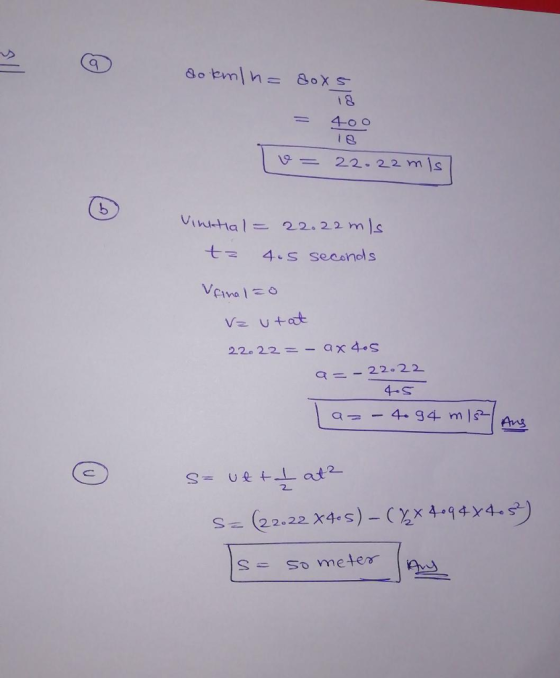
Please calculate and explain question (b).
Homework Answers
Add Answer to:
Please calculate and explain question (b).
(1 point) A car traveling at 80 km/h applies its...
d) what is its velocity when it strikes your hand? (1 point) 0 Rank in order,...
 d) what is its velocity when it strikes your hand?
(1 point) 0 Rank in order, from most positive to least positive, the accelerations at points A to C on the graph A, C > B > A O B. A> B> C D. B> A> C E. C>A> B (1 point) Two bananas have very similar shapes, but one is "twice as fat as the other How much heavier do you expect this banana to be? O B. 2...
d) what is its velocity when it strikes your hand?
(1 point) 0 Rank in order, from most positive to least positive, the accelerations at points A to C on the graph A, C > B > A O B. A> B> C D. B> A> C E. C>A> B (1 point) Two bananas have very similar shapes, but one is "twice as fat as the other How much heavier do you expect this banana to be? O B. 2...
(1 point) An elastic bone is compressed 10 μm by a student's weight. The student picks...
 (1 point) An elastic bone is compressed 10 μm by a student's weight. The student picks up a very heavy backpack and the sam e bone compressed by an extra 5 um. (a) How many times heavier or lighter is the student than her backpack? mstudent 1.5 (b) How much more potential energy is stored in the compressed bone with the backpack on than without? withPack4 mbackpack (1 point) Two bananas have very similar shapes, but one is "twice as...
A car of mass 822 kg is traveling 25.4 m/s when the driver applies the brakes,...
A car of mass 822 kg is traveling 25.4 m/s when the driver applies the brakes, which lock the wheels. The car skids for 5.67 s in the positive x-direction before coming to rest. (a)What is the car's acceleration (in m/s2)? (Indicate the direction with the sign of your answer.) m/s2 (b)What magnitude force (in N) acted on the car during this time? N (c)How far (in m) did the car travel? m
11.78 A car is traveling at a constant speed of 54 km/h when its driver sees...
 11.78 A car is traveling at a constant speed of 54 km/h when its driver sees a child run into the road. The driver applies her brakes until the child returns to the sidewalk and then accelerates to resume her original speed of 54 km/h; the acceleration record of the car is shown in the figure. Assuming x = 0) when t = 0, determine (a) the time t, at which the velocity is again 54 km/h, (b) the position...
A car of mass 772 kg is traveling 24.4 m/s when the driver applies the brakes,...
A car of mass 772 kg is traveling 24.4 m/s when the driver applies the brakes, which lock the wheels. The car skids for 5.27 s in the positive x-direction before coming to rest. a). What is the car's acceleration (in m/s2)? (Indicate the direction with the sign of your answer.) b). What magnitude force (in N) acted on the car during this time? c). How far (in m) did the car travel?
A car accelerates in a straight line from rest to a velocity of 80 km/h in...
A car accelerates in a straight line from rest to a velocity of 80 km/h in a time of 6 s. a) What was the acceleration of the car? b) How far did the car travel in this time?
A car is traveling with a constant speed when the driver suddenly applies the brakes, giving...
A car is traveling with a constant speed when the driver suddenly applies the brakes, giving the car a deceleration of 3.50m/s2. The car comes to a stop in a distance of 34.0 m. What was an initial speed of the car? How long (the time) did it take for this car to stop? What was the car's speed when it had traveled 17.0 m from the point where the brakes were applied? How long did it take for this...
A car of mass 875 kg is traveling 30.0 m/s when the driver applies the brakes,...
 A car of mass 875 kg is traveling 30.0 m/s when the driver applies the brakes, which lock the wheels. The car skids for 5.60 s in the positive -direction before coming to rest. (a) What is the car's acceleration? (b) What magnitude force acted on the car during this time? (c) How far did the car travel? [Ans: ()-536 m/s (b) 4690 N(c) 84,0 m]
A car traveling 93 km/h strikes a tree. The front end of the car compresses and...
A car traveling 93 km/h strikes a tree. The front end of the car compresses and the driver comes to rest after traveling 0.85 m . What was the magnitude of the average acceleration of the driver during the collision? Express the answer in terms of "g's," where 1.00g=9.80m/s2.
14-6. When the driver applies the brakes of a light truck traveling 40 km/h, it skids...
 14-6. When the driver applies the brakes of a light truck traveling 40 km/h, it skids 3 m before stopping. How far will the truck skid if it is traveling 80 km/h when the brakes are applied?
 d) what is its velocity when it strikes your hand?
(1 point) 0 Rank in order, from most positive to least positive, the accelerations at points A to C on the graph A, C > B > A O B. A> B> C D. B> A> C E. C>A> B (1 point) Two bananas have very similar shapes, but one is "twice as fat as the other How much heavier do you expect this banana to be? O B. 2...
d) what is its velocity when it strikes your hand?
(1 point) 0 Rank in order, from most positive to least positive, the accelerations at points A to C on the graph A, C > B > A O B. A> B> C D. B> A> C E. C>A> B (1 point) Two bananas have very similar shapes, but one is "twice as fat as the other How much heavier do you expect this banana to be? O B. 2...
 (1 point) An elastic bone is compressed 10 μm by a student's weight. The student picks up a very heavy backpack and the sam e bone compressed by an extra 5 um. (a) How many times heavier or lighter is the student than her backpack? mstudent 1.5 (b) How much more potential energy is stored in the compressed bone with the backpack on than without? withPack4 mbackpack (1 point) Two bananas have very similar shapes, but one is "twice as...
 11.78 A car is traveling at a constant speed of 54 km/h when its driver sees a child run into the road. The driver applies her brakes until the child returns to the sidewalk and then accelerates to resume her original speed of 54 km/h; the acceleration record of the car is shown in the figure. Assuming x = 0) when t = 0, determine (a) the time t, at which the velocity is again 54 km/h, (b) the position...
 A car of mass 875 kg is traveling 30.0 m/s when the driver applies the brakes, which lock the wheels. The car skids for 5.60 s in the positive -direction before coming to rest. (a) What is the car's acceleration? (b) What magnitude force acted on the car during this time? (c) How far did the car travel? [Ans: ()-536 m/s (b) 4690 N(c) 84,0 m]
 14-6. When the driver applies the brakes of a light truck traveling 40 km/h, it skids 3 m before stopping. How far will the truck skid if it is traveling 80 km/h when the brakes are applied?
Most questions answered within 3 hours.
-
Where is the error in this code sequence?
String s1 = "Hello";
String s2 = "ello";...
asked 10 months ago -
Financial data for Joel de Paris, Inc., for last year
follow:
Joel de Paris, Inc.
Balance...
asked 10 months ago -
Consider this reaction:
Al2(SO4)3 (aq)+ BaCl3
(aq) Al2Cl6 (aq)- +
3BaSO4(s) . What is the...
asked 10 months ago -
Suppose that Savneet is considering increasing her
recent random sample from 20 car rentals to 40...
asked 10 months ago -
Trucks arrive at an unloading terminal at an average rate of 120
per hour.
Trucks arrive...
asked 10 months ago -
Why are methanol and ethanol completely soluble in water while
octanol is not very little soluble....
asked 10 months ago -
A facilities manager at a university reads in a research report
that the mean amount of...
asked 10 months ago -
When the CuSO4 is rehydrated by adding water to the anhydrous
compound, is this an endothermic...
asked 10 months ago -
A ray of sunlight is passing from diamond into crown glass; the
angle of incidence is...
asked 10 months ago -
A block of mass 0.249 kg is placed on top of a light, vertical
spring of...
asked 10 months ago -
how do the kidneys compensate in the presences of acidosis
a) trigger hyperventilate
b) reserve acid...
asked 10 months ago -
Question 501 pts
The rental rate of capital to the firm increases. Which of the
following...
asked 10 months ago