We have two independent and mutually exclusive projects, A and B. Project A requires an initial...
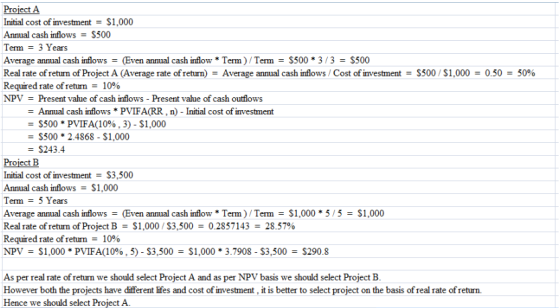
We have two independent and mutually exclusive projects, A and B. Project A requires an initial investment of $1000, and will yield $500 of cash inflows for the next three years. Project B requires an initial investment of $3,500, and will yield $1,000 of cash inflows for the next five years. The required return on both projects is 10%. (13 marks total)
a. What are the net present values of Project A and Project B? (2 marks)
b. What is the problem with using the NPV investment criterion in this case? What alternative criterion should be used? (1 mark)
c. Which project should be chosen? (2 marks)
The cash flows and required return given are all in nominal terms. Given that the inflation rate is 3%, answer the following questions:
d. What is the real rate of return based on the exact Fisher equation? (1 mark)
e. What are the real cash flows from Project A and Project B? (2 marks)
f. What are the real net present values of Project A and Project B? (Hint: The real NPV should be the same as the nominal NPV.) (2 marks)
g. Which project should be chosen based on the real cash flows and real rate of return? (3 marks)
Homework Answers
Please do Upvote if you are served. Feel free to reach out in the comments
Cheers!!!
Answer:
Add Answer to:
We have two independent and mutually
exclusive projects, A and B. Project A requires an initial...
We have two independent and mutually exclusive projects, A and B. Project A requires an initial...
We have two independent and mutually exclusive projects, A and B. Project A requires an initial investment of $1000, and will yield $500 of cash inflows for the next three years. Project B requires an initial investment of $3,500, and will yield $1,000 of cash inflows for the next five years. The required return on both projects is 10% What is the real rate of return based on the exact Fisher equation? 1 + R = (1+r)x (1+h) 1+ .10...
Please answer d - g We have two independent and mutually exclusive projects, A and B....
Please answer d - g We have two independent and mutually exclusive projects, A and B. Project A requires an initial investment of $1500, and will yield $800 of cash inflows for the next three years. Project B requires an initial investment of $5000, and will yield $1,500 of cash inflows for the next five years. The required return on each project is 10%. a. What are the net present values of Project A and Project B? b. What is...
We have two independent and mutually exclusive projects, A and B. Project A requires an initial...
We have two independent and mutually exclusive projects, A and B. Project A requires an initial investment of $1000, and will yield $500 of cash inflows for the next three years. Project B requires an initial investment of $3,500, and will yield $1,000 of cash inflows for the next five years. The required return on both projects is 10%. The NPV of Project A is 243.43 The NPV of Project B is 291.00 What is the problem with using the...
(b) A company is evaluating between two mutually exclusive projects. The required initial investments and the...
 (b) A company is evaluating between two mutually exclusive projects. The required initial investments and the expected net cash flows from the projects are as follows: Project 1 Project 2 0 -$4,000,000 - $4,000,000 1 $1,900,000 $1,100,000 2 $2,255,000 $1,900,000 3 $2,000,000 $2,000,000 The company accepts any project for which the payback period is within 3 years, Which of these projects should be chosen using the payback period as the capital budgeting measure? (3 marks) An Australian multinational company is...
Pound Industries is attempting to select the best of three mutually exclusive projects. The initial investment...
Pound Industries is attempting to select the best of three mutually exclusive projects. The initial investment and after-tax cash inflows associated with these projects are shown in the following table. Cash flows Project A Project B Project C Initial investment (CF) $60000 $100000 $110000 Cash inflows (CF), t equals1 to 5: $20000 $31500 $32500 a. Calculate the payback period for each project. b. Calculate the net present value (NPV) of each project, assuming that the firm has a cost of...
We have two mutually exclusive investments with the following cash flows: &n
We have two mutually exclusive investments with the following cash flows: (13 marks total) Year Investment A Investment B 0 –$100 –$100 1 10 50 2 30 40 3 50 30 4 70 20 a. Using a financial calculator, calculate the IRR for each of the investments. State your answers in percentages rounded to two decimal places. (2 marks) b. Calculate the NPV profile for each investment, using the discount rates of 0%, 5%, 10%, 15%, 20%, and 25%. Perform this task in an...
Choosing Between two Mutually Exclusive Projects Question 2: A company can cither invest in project A,...
 Choosing Between two Mutually Exclusive Projects Question 2: A company can cither invest in project A, project B, or neither (the projects are mutually exclusive and the company has no other investment options). Project A requires an initial investment of $1,000,000 and provides cash flows of $300,000 a year for six years. The project will also return $200,000 in capital back to the company in year six. Project B requires a $375,000 investment and will have cash flows of $200,000...
Yong Importers, an Asian import company, is evaluating two mutually exclusive projects, A and B. The...
Yong Importers, an Asian import company, is evaluating two mutually exclusive projects, A and B. The relevant cash flows for each project are given in the table below. The cost of capital for use in evaluating each of these equally risky projects is 10 percent. initial investment project a project b $350,000 $425,000 year cash inflows (cf) 1 140,000 175,000 2 165,000 150,000 3 190,000 125,000 4 100,000 5 75,000 6 50,000 Which project should be chosen on the basis of...
Cute Camel Woodcraft Company is analyzing a project that requires an initial investment of $500,000. The...
 Cute Camel Woodcraft Company is analyzing a project that requires an initial investment of $500,000. The project's expected cash flows are: Year 1 Year 2 Year 3 Year 4 $275,000 -150,000 500,000 400,000 Cute Camel Woodcraft Company's WACC is 9%, and the project has the same risk as the firm's average project. Calculate this project's modified 21.06% 18.05% 19.06% 20.06% If Cute Camel Woodcraft Company's managers select projects based on the MIRR criterion, they should this independent project. Which of...
13. Problem 12.13 (Unequal Lives) eBook Haley's Crockett Designs Inc. is considering two mutually exclusive projects....
 13. Problem 12.13 (Unequal Lives) eBook Haley's Crockett Designs Inc. is considering two mutually exclusive projects. Both projects require an initial investment of $11,000 and are typical average-risk projects for the firm. Project A has an expected life of 2 years with after-tax cash inflows of $6,000 and $10,000 at the end of Years 1 and 2, respectively. Project B has an expected life of 4 years with after-tax cash inflows of $5,000 at the end of each of the...
 (b) A company is evaluating between two mutually exclusive projects. The required initial investments and the expected net cash flows from the projects are as follows: Project 1 Project 2 0 -$4,000,000 - $4,000,000 1 $1,900,000 $1,100,000 2 $2,255,000 $1,900,000 3 $2,000,000 $2,000,000 The company accepts any project for which the payback period is within 3 years, Which of these projects should be chosen using the payback period as the capital budgeting measure? (3 marks) An Australian multinational company is...
 Choosing Between two Mutually Exclusive Projects Question 2: A company can cither invest in project A, project B, or neither (the projects are mutually exclusive and the company has no other investment options). Project A requires an initial investment of $1,000,000 and provides cash flows of $300,000 a year for six years. The project will also return $200,000 in capital back to the company in year six. Project B requires a $375,000 investment and will have cash flows of $200,000...
 Cute Camel Woodcraft Company is analyzing a project that requires an initial investment of $500,000. The project's expected cash flows are: Year 1 Year 2 Year 3 Year 4 $275,000 -150,000 500,000 400,000 Cute Camel Woodcraft Company's WACC is 9%, and the project has the same risk as the firm's average project. Calculate this project's modified 21.06% 18.05% 19.06% 20.06% If Cute Camel Woodcraft Company's managers select projects based on the MIRR criterion, they should this independent project. Which of...
 13. Problem 12.13 (Unequal Lives) eBook Haley's Crockett Designs Inc. is considering two mutually exclusive projects. Both projects require an initial investment of $11,000 and are typical average-risk projects for the firm. Project A has an expected life of 2 years with after-tax cash inflows of $6,000 and $10,000 at the end of Years 1 and 2, respectively. Project B has an expected life of 4 years with after-tax cash inflows of $5,000 at the end of each of the...
Most questions answered within 3 hours.
-
Where is the error in this code sequence?
String s1 = "Hello";
String s2 = "ello";...
asked 10 months ago -
Financial data for Joel de Paris, Inc., for last year
follow:
Joel de Paris, Inc.
Balance...
asked 10 months ago -
Consider this reaction:
Al2(SO4)3 (aq)+ BaCl3
(aq) Al2Cl6 (aq)- +
3BaSO4(s) . What is the...
asked 10 months ago -
Suppose that Savneet is considering increasing her
recent random sample from 20 car rentals to 40...
asked 10 months ago -
Trucks arrive at an unloading terminal at an average rate of 120
per hour.
Trucks arrive...
asked 10 months ago -
Why are methanol and ethanol completely soluble in water while
octanol is not very little soluble....
asked 10 months ago -
A facilities manager at a university reads in a research report
that the mean amount of...
asked 10 months ago -
When the CuSO4 is rehydrated by adding water to the anhydrous
compound, is this an endothermic...
asked 10 months ago -
A ray of sunlight is passing from diamond into crown glass; the
angle of incidence is...
asked 10 months ago -
A block of mass 0.249 kg is placed on top of a light, vertical
spring of...
asked 10 months ago -
how do the kidneys compensate in the presences of acidosis
a) trigger hyperventilate
b) reserve acid...
asked 10 months ago -
Question 501 pts
The rental rate of capital to the firm increases. Which of the
following...
asked 10 months ago