Picky Pete drags Indifferent Ian out for coffee at an upscale Italian cafe which sells only...
Picky Pete drags Indifferent Ian out for coffee at an upscale Italian cafe which sells only espresso (E) and biscotti (B). Picky Pete simply must have one biscotti for every espresso consumed, whereas Indifferent Ian views espresso and biscotti as perfect substitutes. One of their utility functions is given by U = min[E, B] and the other’s by U = E + B.
(a) Given the description, which utility function corresponds to which person?
(b) Suppose the prices of the goods are (pE, pB) = (2, 1) and Pete has allocated $12 for the outing while Ian brought only $4. Solve for each person’s utility-maximizing bundle of espresso and biscotti.
(c) Draw a fully labeled diagram illustrating Pete’s budget constraint, his optimal bundle, and an indifference curve representative of his utility at his optimal bundle. Indicate how much utility Pete obtains.
(d) Do the same for Ian
Homework Answers
a).
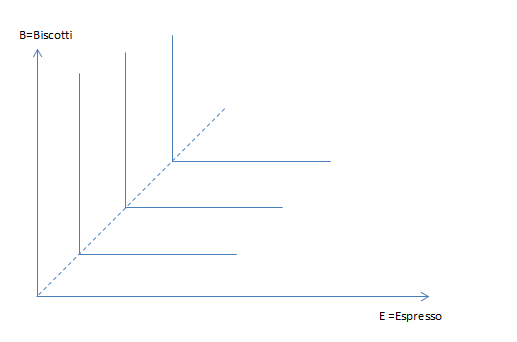
Consider the given problem here “Picky Pete” must have one “B=biscotti” for every “E=espresso”, => “Pete” want to consume both the goods with equal proportion, => addition amount of “E” or “B” will not add any additional utility. So, here the utility function will be “L-shaped”, => it’s given by “U=min(E, B)”. Consider the following fig below.
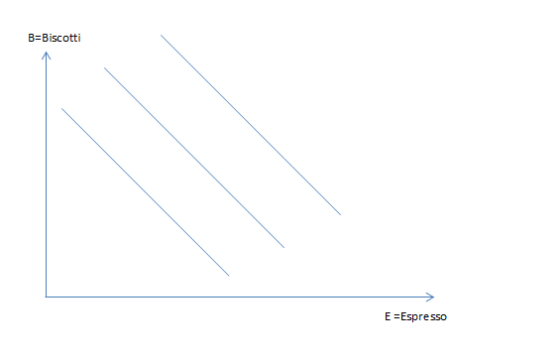
Similarly, for “Lan” is indifferent between “1 unit of E” and “1 unit of B”, => “E” and “B” are perfect substitute, => “Lan’s” indifference curve is given by “U=E+B”. Consider the following fig.
b).
Now, “Pete” has “m=$12”, => the budget constraint is given by “2*E + 1*B = 12”. Now, “Pete’s” utility function is given by “U = min(E,B)”, => at the optimum “E = B”, => “2*E + B = 12”, => “2*E + E = 3*E = 12”, => E = 12/3 = 4, => E = B = 4. So, the optimum consumption bundles are given by “E=B=4”.
Now, “Len’s” utility function is “perfect substitute” type, => the utility function is given by “U = E + B”, => here “Len” will devote his entire income on the good which is cheaper. Here “Pb < Pe”, => “Len” will only purchase “B” and will not purchase “E”. So, the optimum consumption bundle are given by “E=0, B=4” given the available income.
c).
Consider the following fig.
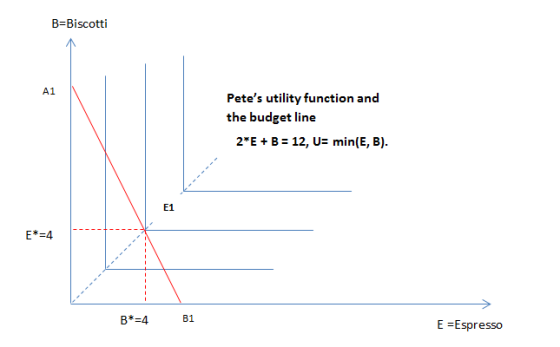
So, here “A1B1” be the budget line of “Pete”. Now, at the optimum “E=B”, => the optimum bundle is the intersection point between the budget line and the consumption ratio line. So, here “E1” be the equilibrium point of “Pete”.
d).
Consider the following fig.
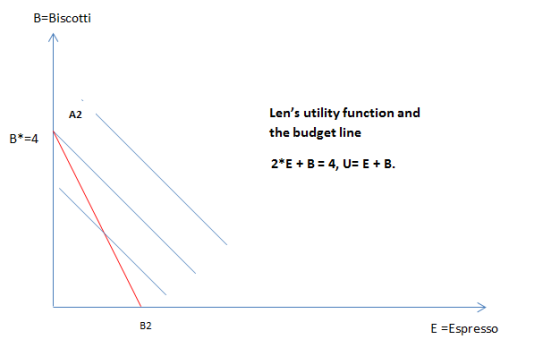
So, here “A2B2” be the budget line of “Len”. Now here “E” and “B” are perfect substitute to each other and “B” is cheaper compare to “E”, => “Len” will purchase only “B” and not “E”. So, here “A2” be the equilibrium point of “Len”.
Add Answer to:
Picky Pete drags Indifferent Ian out for coffee at an upscale
Italian cafe which sells only...
Question 4: Picky Pete drags Indifferent Ian out for coffee at an upscale Italian cafe which...
 Question 4: Picky Pete drags Indifferent Ian out for coffee at an upscale Italian cafe which sells only espresso (E) and biscotti (B). Picky Pete simply must have one biscotti for every espresso consumed, whereas Indifferent lan views espresso and biscotti as perfect substitutes. One of their utility functions is given by Umin E, B and the other's by U-E+ B (a) Given the description, which utility function corresponds to which person? (b) Suppose the prices of the goods are...
Question 1: Louis the retired Canadian lives on a fixed budget and consumes only two goods:...
 Question 1: Louis the retired Canadian lives on a fixed budget and consumes only two goods: toques (T) and maple syrup (M). Suppose Louis monthly budget is 100 and the price of the two goods are (PT,PM) (4,2). (a) Make a properly labeled diagram illustrating Louis'budget constraint with T on the hori- zontal axis and M on the vertical axis. Indicate the area corresponding to the set of bundles (M, T) that Louis can afford. (b) What is the maximum...
 Question 4: Picky Pete drags Indifferent Ian out for coffee at an upscale Italian cafe which sells only espresso (E) and biscotti (B). Picky Pete simply must have one biscotti for every espresso consumed, whereas Indifferent lan views espresso and biscotti as perfect substitutes. One of their utility functions is given by Umin E, B and the other's by U-E+ B (a) Given the description, which utility function corresponds to which person? (b) Suppose the prices of the goods are...
 Question 1: Louis the retired Canadian lives on a fixed budget and consumes only two goods: toques (T) and maple syrup (M). Suppose Louis monthly budget is 100 and the price of the two goods are (PT,PM) (4,2). (a) Make a properly labeled diagram illustrating Louis'budget constraint with T on the hori- zontal axis and M on the vertical axis. Indicate the area corresponding to the set of bundles (M, T) that Louis can afford. (b) What is the maximum...
Most questions answered within 3 hours.
-
Where is the error in this code sequence?
String s1 = "Hello";
String s2 = "ello";...
asked 10 months ago -
Financial data for Joel de Paris, Inc., for last year
follow:
Joel de Paris, Inc.
Balance...
asked 10 months ago -
Consider this reaction:
Al2(SO4)3 (aq)+ BaCl3
(aq) Al2Cl6 (aq)- +
3BaSO4(s) . What is the...
asked 10 months ago -
Suppose that Savneet is considering increasing her
recent random sample from 20 car rentals to 40...
asked 10 months ago -
Trucks arrive at an unloading terminal at an average rate of 120
per hour.
Trucks arrive...
asked 10 months ago -
Why are methanol and ethanol completely soluble in water while
octanol is not very little soluble....
asked 10 months ago -
A facilities manager at a university reads in a research report
that the mean amount of...
asked 10 months ago -
When the CuSO4 is rehydrated by adding water to the anhydrous
compound, is this an endothermic...
asked 10 months ago -
A ray of sunlight is passing from diamond into crown glass; the
angle of incidence is...
asked 10 months ago -
A block of mass 0.249 kg is placed on top of a light, vertical
spring of...
asked 10 months ago -
how do the kidneys compensate in the presences of acidosis
a) trigger hyperventilate
b) reserve acid...
asked 10 months ago -
Question 501 pts
The rental rate of capital to the firm increases. Which of the
following...
asked 10 months ago