The market value of ABC company's common stock is $20 million. It has $5 million in...
The market value of ABC company's common stock is $20 million. It has $5 million in debt with an interest rate of 6.25%. The beta of the company's common stock is 1.25, and the market risk premium is 8%. If the Treasury bill rate is 5% and the company’s tax rate is 20%, what is the company's cost of capital?
a. 13.0 percent b. 14.6 percent c. 15.0 percent d. 7.0 percent
The historical returns for the past three years for Stock B and the stock market were the following: Stock B: 2016: 24%, 2017: 0%, 2018: 24%; market return: 2016: 10%, 2017: 12%, 2018: 20%. Calculate the beta for Stock B.
a. 0.86 b. 1.00 c. 1.17 d. 1.13
Company A's historical returns for the past three years were 6%, 15%, and 15%. Similarly, the market return were 10%, 10%, and 16%. Suppose the risk-free rate of return is 4% and that investors expect the market to return 10%. What is the company’s cost of equity computed with the CAPM?
a. 14.0 percent b. 8.5 percent c. 12.0 percent d. 10.0 percent
A company’s capital structure is 4 million Euros in debt and 16 million Euros in equity
If the beta of its debt is 0.25 and the beta of its equity is 1.50, what is the company’s asset beta
a. 0.75 b. 1.25 c. 1.10 d. 1.19
The market value of DEF Company's equity is $15 million and the market value of its debt is $5 million. The required rate of return on its equity is 20% and 8% on its debt, Calculate the company's cost of capital if its tax rate is 25%
a. 20 percent b. 16.5 percent c. 14.5 percent d. 17 percent
Homework Answers
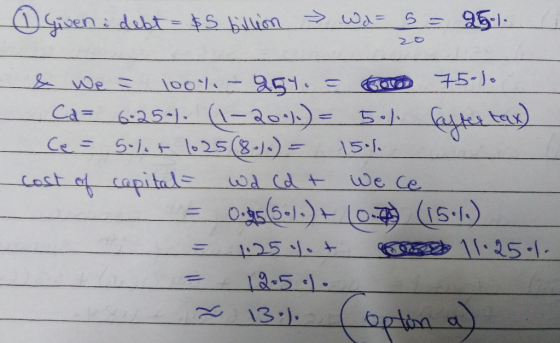
I can only answer 1 question at a time so I am solving am solving question 1. Please do rate me and mention doubts in the comments section.
Add Answer to:
The market value of ABC company's common stock is $20 million.
It has $5 million in...
The market value of DEF Company's equity is $15 million and the market value of its...
The market value of DEF Company's equity is $15 million and the market value of its debt is $5 million. The required rate of return on its equity is 20% and 8% on its debt, Calculate the company's cost of capital if its tax rate is 25% a. 20 percent b. 16.5 percent c. 14.5 percent d. 17 percent
Acetate, Inc., has equity with a market value of $24 million and debt with a market...
Acetate, Inc., has equity with a market value of $24 million and debt with a market value of $9.6 million. Treasury bills that mature in one year yield 6 percent per year, and the expected return on the market portfolio is 11 percent. The beta of the company’s equity is 1.25. The company pays no taxes. a.What is the company's debt–equity ratio? (Do not round intermediate calculations and round your answer to 2 decimal places, e.g., 32.16.) Debt–equity ratio b....
Consider a firm whole debt has a market value of $40 million and whose stock has...
Consider a firm whole debt has a market value of $40 million and whose stock has a market value of $60 million (3 million outstanding shares of stock, each selling for $20 per share). The firm pays a 5 percent rate of interest on its new debt and has a beta of 1.41. The corporate tax rate is 34 percent. (Assume that the security market line (SML) holds, that the risk premium on the market is 9.5 percent [somewhat higher...
SMU, Inc. has equity with a market value of $20 million and debt with a market...
SMU, Inc. has equity with a market value of $20 million and debt with a market value of $10 million. SMU pays 8% interest on its debt per year, and the expected return on the market portfolio over the next year is 18%. The beta of SMU’s equity is .90. The firm pays no taxes. a. What is SMU’s debt to equity ratio? What is SMU’s weighted average cost of capital? b. What is the cost of capital for an...
Hatter, Inc., has equity with a market value of $23.3 million and debt with a market...
Hatter, Inc., has equity with a market value of $23.3 million and debt with a market value of $6.99 million. The cost of debt is 9 percent per year. Treasury bills that mature in one year yield 5 percent per year, and the expected return on the market portfolio over the next year is 12 percent. The beta of the company’s equity is 1.18. The firm pays no taxes. a. What is the company’s debt?equity ratio? (Do not round intermediate...
the market value of CCC's equity is $15 million and the market value is of its...
the market value of CCC's equity is $15 million and the market value is of its debt it $5 million. If the required rates of return on the equity is 12% and that on its debt is 8%, calculate the company's cost of capital. CCC's tax rate is 20%
A firm has the following capital structure: £100 million of equity (market value) with 100 million...
A firm has the following capital structure: £100 million of equity (market value) with 100 million shares outstanding, and £100 million of debt. The beta of the firm’s stock is 1.6. The firm’s cost of equity is 10 percent, and the yield on riskless bonds is 2 percent. There is no tax. Assuming that the firm can borrow at the risk-free rate and that both CAPM (Capital Asset Pricing Model) and the Modigliani-Miller theorem hold, answer the following questions. i)...
Harris, Inc., has equity with a market value of $23.7 million and debt with a market...
 Harris, Inc., has equity with a market value of $23.7 million and debt with a market value of $9.48 million. Treasury bills that mature in one year yield 6 percent per year and the expected return on the market portfolio is 11 percent. The beta of the company's equity is 1.22. The company pays no taxes. a. What is the company's debt-equity ratio? (Do not round intermediate calculations and round your answer to 2 decimal places, e.g., 32.16.) b. What...
The historical returns for the past three years for Stock B and the stock market were...
The historical returns for the past three years for Stock B and the stock market were the following: Stock B: 2016: 24%, 2017: 0%, 2018: 24%; market return: 2016: 10%, 2017: 12%, 2018: 20%. Calculate the beta for Stock B. a. 0.86 b. 1.00 c. 1.17 d. 1.13
c) A firm has the following capital structure: £100 million of equity (market value) with 100...
c) A firm has the following capital structure: £100 million of equity (market value) with 100 million shares outstanding, and £100 million of debt. The beta of the firm’s stock is 1.6. The firm’s cost of equity is 10 percent, and the yield on riskless bonds is 2 percent. There is no tax. Assuming that the firm can borrow at the risk free rate and that both CAPM (Capital Asset Pricing Model) and the Modigliani-Miller theorem hold, answer the following...
 Harris, Inc., has equity with a market value of $23.7 million and debt with a market value of $9.48 million. Treasury bills that mature in one year yield 6 percent per year and the expected return on the market portfolio is 11 percent. The beta of the company's equity is 1.22. The company pays no taxes. a. What is the company's debt-equity ratio? (Do not round intermediate calculations and round your answer to 2 decimal places, e.g., 32.16.) b. What...
Most questions answered within 3 hours.
-
Where is the error in this code sequence?
String s1 = "Hello";
String s2 = "ello";...
asked 11 months ago -
Financial data for Joel de Paris, Inc., for last year
follow:
Joel de Paris, Inc.
Balance...
asked 11 months ago -
Consider this reaction:
Al2(SO4)3 (aq)+ BaCl3
(aq) Al2Cl6 (aq)- +
3BaSO4(s) . What is the...
asked 11 months ago -
Suppose that Savneet is considering increasing her
recent random sample from 20 car rentals to 40...
asked 11 months ago -
Trucks arrive at an unloading terminal at an average rate of 120
per hour.
Trucks arrive...
asked 11 months ago -
Why are methanol and ethanol completely soluble in water while
octanol is not very little soluble....
asked 11 months ago -
A facilities manager at a university reads in a research report
that the mean amount of...
asked 11 months ago -
When the CuSO4 is rehydrated by adding water to the anhydrous
compound, is this an endothermic...
asked 11 months ago -
A ray of sunlight is passing from diamond into crown glass; the
angle of incidence is...
asked 11 months ago -
A block of mass 0.249 kg is placed on top of a light, vertical
spring of...
asked 11 months ago -
how do the kidneys compensate in the presences of acidosis
a) trigger hyperventilate
b) reserve acid...
asked 11 months ago -
Question 501 pts
The rental rate of capital to the firm increases. Which of the
following...
asked 11 months ago