
Homework Answers
The Correct Answer is Risk and potential reward are inversely related.
Higher the risk assumed higher will be the reward. There is a direct relationship between risk and reward. If an investor assumes higher risk in relation to an investment he will be rewarded with higher profits or higher losses.
Therefore risk and reward cannot be inversely related and hence this is a false statement.
Add Answer to:
Question 12 2.5 pts Which of the following is false? Risk and potential reward are inversely...
Question 21 2.5 pts Which of the following statements is false? corporations, unlike proprietorships and partnerships,...
 Question 21 2.5 pts Which of the following statements is false? corporations, unlike proprietorships and partnerships, are subject to double taxation. bond prices will fall when lenders expect higher rates inflation in the future. the stock and bond markets are very efficient. In real life, when an individual expects the economy to expand, he should hold no nominal assets. Question 22 2.5 pts Which of the following statements is true? The relationship between risk and potential reward is inverse. Bond...
PLEASE EXPLAIN WHY ANSWER IS TRUE OR FALSE: "Risk aversion" implies that investors require higher expected...
PLEASE EXPLAIN WHY ANSWER IS TRUE OR FALSE: "Risk aversion" implies that investors require higher expected returns on riskier than on less risky securities. a. True b. False When adding a randomly chosen new stock to an existing portfolio, the higher (or more positive) the degree of correlation between the new stock and stocks already in the portfolio, the less the additional stock will reduce the portfolio's risk. a. True b. False An individual stock's diversifiable risk, which is measured...
Also, Question 23 2.5 pts Which of the following statements is true? Blue chip stocks provide...
 Also,
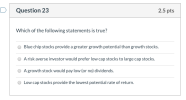
Question 23 2.5 pts Which of the following statements is true? Blue chip stocks provide a greater growth potential than growth stocks Arisk averse investor would prefer low cap stocks to large cap stocks. A growth stock would pay low (or no) dividends. Low cap stocks provide the lowest potential rate of return Question 32 2.5pts Which of the following statements is false? A 15 year mortgage would have a higher interest rate than a 30 year mortgage A...
Also,
Question 23 2.5 pts Which of the following statements is true? Blue chip stocks provide a greater growth potential than growth stocks Arisk averse investor would prefer low cap stocks to large cap stocks. A growth stock would pay low (or no) dividends. Low cap stocks provide the lowest potential rate of return Question 32 2.5pts Which of the following statements is false? A 15 year mortgage would have a higher interest rate than a 30 year mortgage A...
Question 28 2.5 pts The relationship between an investment opportunity's risk and potential rate of return...
 Question 28 2.5 pts The relationship between an investment opportunity's risk and potential rate of return is inverse (i.e., fluctuates in opposite directions). True . False
Note: Part a, b and c are not related to each other. a. Portfolio Man wants...
 Note: Part a, b and c are not related to each other. a. Portfolio Man wants to create a portfolio as risky as the market and he has $1,000,000 to invest. Given this information, fill in the three missing values of the following table: Asset Investment Beta $170,000 1.6 $140,000 1.5 $130,000 $200,000 Risk-free asset b. An asset's reward-to-risk ratio is defined as its risk premium divided by its standard deviation It is a useful statistic to summarize the asset's...
QUESTION 18 Which of the following statements is CORRECT? 1. An investor can eliminate virtually all...
 QUESTION 18
Which of the following statements is CORRECT?
1.
An investor can eliminate virtually all diversifiable risk if
he or she holds a very large, well-diversified portfolio of
stocks.
2.
Once a portfolio has about 40 stocks, adding additional stocks
will not reduce its risk by even a small amount.
3.
It is impossible to have a situation where the market risk of
a single stock is less than that of a portfolio that includes the
stock.
4.
An...
QUESTION 18
Which of the following statements is CORRECT?
1.
An investor can eliminate virtually all diversifiable risk if
he or she holds a very large, well-diversified portfolio of
stocks.
2.
Once a portfolio has about 40 stocks, adding additional stocks
will not reduce its risk by even a small amount.
3.
It is impossible to have a situation where the market risk of
a single stock is less than that of a portfolio that includes the
stock.
4.
An...
Stocks A and B have the following probability distributions of expected future returns: Probability A B...
 Stocks A and B have the following probability distributions of expected future returns: Probability A B 0.1 (11 % ) (23 %) 0.2 6 0 0.4 15. 23 0.2 23 27 0.1 39 48 a. Calculate the expected rate of return, rB, for Stock B (rA two decimal places. 14.60 % . ) Do not round intermediate calculations. Round your answer to 11 % b. Calculate the standard deviation of expected returns, aA, for Stock A (oe = 18.66 %...
Stocks A and B have the following probability distributions of expected future returns: Probability (119) (34...
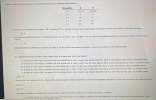 Stocks A and B have the following probability distributions of expected future returns: Probability (119) (34 ) 0.1 0.5 02 0.1 a. Calculate the expected rate of return, for Stock B (TA1440%.) Do not round intermediate calculations. Round your answer to two decimal places. 16 % b. Calculate the standard deviation of expected returns, or for Stock AO = 19.89%.) Do not round intermediate calculations. Round your answer to two decimal Now calculate the coefficient of variation for Stock B....
Stocks A and B have the following probability distributions of expected future returns: Probability A B...
Stocks A and B have the following probability distributions of expected future returns: Probability A B 0.1 (14 %) (30 %) 0.1 2 0 0.5 13 20 0.2 24 29 0.1 36 45 Calculate the expected rate of return, , for Stock B ( = 13.70%.) Do not round intermediate calculations. Round your answer to two decimal places. % Calculate the standard deviation of expected returns, σA, for Stock A (σB = 19.01%.) Do not round intermediate calculations. Round your...
Question 1 1 pts The Say Hey! Co. just issued a dividend of $2.45 per share...
 Question 1 1 pts The Say Hey! Co. just issued a dividend of $2.45 per share on its common stock. The company is expected to maintain a constant 6 percent growth rate in its dividends indefinitely. The company's tax rate is 40%. If the stock sells for $45 a share, what is the company's cost of equity? Choose the range that includes the correct solution. O Less than 10% Greater than or equal to 10%, but less than 11% Greater...
 Question 21 2.5 pts Which of the following statements is false? corporations, unlike proprietorships and partnerships, are subject to double taxation. bond prices will fall when lenders expect higher rates inflation in the future. the stock and bond markets are very efficient. In real life, when an individual expects the economy to expand, he should hold no nominal assets. Question 22 2.5 pts Which of the following statements is true? The relationship between risk and potential reward is inverse. Bond...
 Also,
Question 23 2.5 pts Which of the following statements is true? Blue chip stocks provide a greater growth potential than growth stocks Arisk averse investor would prefer low cap stocks to large cap stocks. A growth stock would pay low (or no) dividends. Low cap stocks provide the lowest potential rate of return Question 32 2.5pts Which of the following statements is false? A 15 year mortgage would have a higher interest rate than a 30 year mortgage A...
Also,
Question 23 2.5 pts Which of the following statements is true? Blue chip stocks provide a greater growth potential than growth stocks Arisk averse investor would prefer low cap stocks to large cap stocks. A growth stock would pay low (or no) dividends. Low cap stocks provide the lowest potential rate of return Question 32 2.5pts Which of the following statements is false? A 15 year mortgage would have a higher interest rate than a 30 year mortgage A...
 Question 28 2.5 pts The relationship between an investment opportunity's risk and potential rate of return is inverse (i.e., fluctuates in opposite directions). True . False
 Note: Part a, b and c are not related to each other. a. Portfolio Man wants to create a portfolio as risky as the market and he has $1,000,000 to invest. Given this information, fill in the three missing values of the following table: Asset Investment Beta $170,000 1.6 $140,000 1.5 $130,000 $200,000 Risk-free asset b. An asset's reward-to-risk ratio is defined as its risk premium divided by its standard deviation It is a useful statistic to summarize the asset's...
 QUESTION 18
Which of the following statements is CORRECT?
1.
An investor can eliminate virtually all diversifiable risk if
he or she holds a very large, well-diversified portfolio of
stocks.
2.
Once a portfolio has about 40 stocks, adding additional stocks
will not reduce its risk by even a small amount.
3.
It is impossible to have a situation where the market risk of
a single stock is less than that of a portfolio that includes the
stock.
4.
An...
QUESTION 18
Which of the following statements is CORRECT?
1.
An investor can eliminate virtually all diversifiable risk if
he or she holds a very large, well-diversified portfolio of
stocks.
2.
Once a portfolio has about 40 stocks, adding additional stocks
will not reduce its risk by even a small amount.
3.
It is impossible to have a situation where the market risk of
a single stock is less than that of a portfolio that includes the
stock.
4.
An...
 Stocks A and B have the following probability distributions of expected future returns: Probability A B 0.1 (11 % ) (23 %) 0.2 6 0 0.4 15. 23 0.2 23 27 0.1 39 48 a. Calculate the expected rate of return, rB, for Stock B (rA two decimal places. 14.60 % . ) Do not round intermediate calculations. Round your answer to 11 % b. Calculate the standard deviation of expected returns, aA, for Stock A (oe = 18.66 %...
 Stocks A and B have the following probability distributions of expected future returns: Probability (119) (34 ) 0.1 0.5 02 0.1 a. Calculate the expected rate of return, for Stock B (TA1440%.) Do not round intermediate calculations. Round your answer to two decimal places. 16 % b. Calculate the standard deviation of expected returns, or for Stock AO = 19.89%.) Do not round intermediate calculations. Round your answer to two decimal Now calculate the coefficient of variation for Stock B....
 Question 1 1 pts The Say Hey! Co. just issued a dividend of $2.45 per share on its common stock. The company is expected to maintain a constant 6 percent growth rate in its dividends indefinitely. The company's tax rate is 40%. If the stock sells for $45 a share, what is the company's cost of equity? Choose the range that includes the correct solution. O Less than 10% Greater than or equal to 10%, but less than 11% Greater...
Most questions answered within 3 hours.
-
Where is the error in this code sequence?
String s1 = "Hello";
String s2 = "ello";...
asked 11 months ago -
Financial data for Joel de Paris, Inc., for last year
follow:
Joel de Paris, Inc.
Balance...
asked 11 months ago -
Consider this reaction:
Al2(SO4)3 (aq)+ BaCl3
(aq) Al2Cl6 (aq)- +
3BaSO4(s) . What is the...
asked 11 months ago -
Suppose that Savneet is considering increasing her
recent random sample from 20 car rentals to 40...
asked 11 months ago -
Trucks arrive at an unloading terminal at an average rate of 120
per hour.
Trucks arrive...
asked 11 months ago -
Why are methanol and ethanol completely soluble in water while
octanol is not very little soluble....
asked 11 months ago -
A facilities manager at a university reads in a research report
that the mean amount of...
asked 11 months ago -
When the CuSO4 is rehydrated by adding water to the anhydrous
compound, is this an endothermic...
asked 11 months ago -
A ray of sunlight is passing from diamond into crown glass; the
angle of incidence is...
asked 11 months ago -
A block of mass 0.249 kg is placed on top of a light, vertical
spring of...
asked 11 months ago -
how do the kidneys compensate in the presences of acidosis
a) trigger hyperventilate
b) reserve acid...
asked 11 months ago -
Question 501 pts
The rental rate of capital to the firm increases. Which of the
following...
asked 11 months ago