 please show work
Homework Answers
Request Answer!
We need at least 10 more requests to produce the answer.
0 / 10 have requested this problem solution
The more requests, the faster the answer.
Add Answer to:
please show work
15. The expiration date for a product is 3 years from the current...
please show work 13. The expiration date for a product is 6 years from the current...
 please show work
13. The expiration date for a product is 6 years from the current date when stored in a refrigerator. The product has been stored for one month at room temperature. If the product is now returned to the refrigerator, what is the new expiration date?
please show work
13. The expiration date for a product is 6 years from the current date when stored in a refrigerator. The product has been stored for one month at room temperature. If the product is now returned to the refrigerator, what is the new expiration date?
please show work The ampicillin monograph states that the reconstituted suspension is stable for 14 days...
 please show work
The ampicillin monograph states that the reconstituted suspension is stable for 14 days in a refrigerator. If the product is left at room temperature for 6 h, what is the reduction in the expiration period?
please show work
The ampicillin monograph states that the reconstituted suspension is stable for 14 days in a refrigerator. If the product is left at room temperature for 6 h, what is the reduction in the expiration period?
please show work 10. Samples of a new anticancer drug in aqueous solution were stored at 45°C, 60°C and 75°C. The fi...
 please show work
10. Samples of a new anticancer drug in aqueous solution were stored at 45°C, 60°C and 75°C. The first-order rate constants for the decomposition at different temperatures were determined as follows: 45 60 75 Temperature (°C) Rate Constant (day'') 0.052 0.069 0.089 Considering that the drug expires once the concentration decreases to 90% of the original, calculate the expiration time of the anticancer drug at 25°C (room temperature).
please show work
10. Samples of a new anticancer drug in aqueous solution were stored at 45°C, 60°C and 75°C. The first-order rate constants for the decomposition at different temperatures were determined as follows: 45 60 75 Temperature (°C) Rate Constant (day'') 0.052 0.069 0.089 Considering that the drug expires once the concentration decreases to 90% of the original, calculate the expiration time of the anticancer drug at 25°C (room temperature).
In this Diels-Alder reaction, what is the limiting reagent for this reaction? Please show work In...
 In this Diels-Alder reaction, what is the limiting reagent for
this reaction? Please show work
In this experiment, a Diels-Alder reaction will be performed to generate 4-cyclohexene- 1,2-dicarboxylic anhydride. The reaction occurs when 1,3-butadiene is combined with maleic anhydride and heated as shown below. Once the product has been isolated, the IR spectrum, melting point, and experimental yield can be determined. 5.- I111NI O Due to the inherent difficulties with the handling of gaseous 1,3-butadiene, it will be generated in...
In this Diels-Alder reaction, what is the limiting reagent for
this reaction? Please show work
In this experiment, a Diels-Alder reaction will be performed to generate 4-cyclohexene- 1,2-dicarboxylic anhydride. The reaction occurs when 1,3-butadiene is combined with maleic anhydride and heated as shown below. Once the product has been isolated, the IR spectrum, melting point, and experimental yield can be determined. 5.- I111NI O Due to the inherent difficulties with the handling of gaseous 1,3-butadiene, it will be generated in...
Please show work 3. Five years ago you bought a 5% coupon bond with a 15-year...
 Please show work
3. Five years ago you bought a 5% coupon bond with a 15-year remaining maturity. At that time the bond had a yield to maturity of 6%. Today you sold the bond for $1,250. Given that the bond paid coupons semiannually, what was your effective annual rate of return on this investment? (Assume the first coupon was paid 6 months after you purchased the bond) Answer: 11.7995%
Please show work
3. Five years ago you bought a 5% coupon bond with a 15-year remaining maturity. At that time the bond had a yield to maturity of 6%. Today you sold the bond for $1,250. Given that the bond paid coupons semiannually, what was your effective annual rate of return on this investment? (Assume the first coupon was paid 6 months after you purchased the bond) Answer: 11.7995%
Please show all work! Thanks! Isothermal transformation diagram is given below. 13.8-1 Using the isothermal transformation...
 Please show all work! Thanks! Isothermal transformation diagram
is given below.
13.8-1 Using the isothermal transformation diagram for a carbon steel of eutectoid composition (obtained from the In specify the final microstructure (in terms of microstructure pres tituent present) for small sa ent and approximate percentages of each phase or con. uent present) for small samples allowed to equilibrate at 760°C (1400 F) following each of the cooling a. Cool rapidly to 700°C (1290°F), hold for 10 seconds, then quench...
Please show all work! Thanks! Isothermal transformation diagram
is given below.
13.8-1 Using the isothermal transformation diagram for a carbon steel of eutectoid composition (obtained from the In specify the final microstructure (in terms of microstructure pres tituent present) for small sa ent and approximate percentages of each phase or con. uent present) for small samples allowed to equilibrate at 760°C (1400 F) following each of the cooling a. Cool rapidly to 700°C (1290°F), hold for 10 seconds, then quench...
(Can you show work for this question please) If a 10-gram sample of a radioactive element...
(Can you show work for this question please) If a 10-gram sample of a radioactive element has been stored for 1 week and 2 days, and now only 1.25 g of the element remains, what is its half-life? A. 1 day B. 1 week C. 3 days D. 2 days
Please show work in financial calculator I own a 9% coupon bond with 15 years left...
Please show work in financial calculator I own a 9% coupon bond with 15 years left to maturity. Every year when I receive my $90 interest I invest it in an account earning 7%. A. How much money will I have in that account at the end of the 15 years? B. At the end of 15 years I will also get $1000 back from the company which issued the bond. How much total will I now have? C. If...
Please show work for both :) Questions 15-16: The paddles of a defibrillator are charged to...
 Please show work for both :)
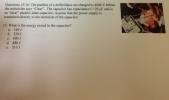
Questions 15-16: The paddles of a defibrillator are charged to 4000 V before the technician says "Clear". The capacitor has capacitance C 20 HF and is an "ideal" parallel plate capacitor. Assume that the power supply is connected directly to the terminals of the capacitor. 15. What is the energy stored in the capacitor? 160 b. 320 J c. 400 J d. 486 J e. 510 J
Please show work for both :)
Questions 15-16: The paddles of a defibrillator are charged to 4000 V before the technician says "Clear". The capacitor has capacitance C 20 HF and is an "ideal" parallel plate capacitor. Assume that the power supply is connected directly to the terminals of the capacitor. 15. What is the energy stored in the capacitor? 160 b. 320 J c. 400 J d. 486 J e. 510 J
please show work An aqueous suspension of drug X was formulated containing 100 mg of the...
 please show work
An aqueous suspension of drug X was formulated containing 100 mg of the drug per teaspoon (5 ml). When the suspension was stored at room temperature (25°C), the half-life was found to be 3.0 days. The half-life increased to 20 days when the suspension was stored in the refrigerator (5°C). Assuming pseudozero-order degradation, calculate the rate constant of drug X at each of these temperatures. (Note: drug degradation in a suspension follows pseudo zero order kinetics)
please show work
An aqueous suspension of drug X was formulated containing 100 mg of the drug per teaspoon (5 ml). When the suspension was stored at room temperature (25°C), the half-life was found to be 3.0 days. The half-life increased to 20 days when the suspension was stored in the refrigerator (5°C). Assuming pseudozero-order degradation, calculate the rate constant of drug X at each of these temperatures. (Note: drug degradation in a suspension follows pseudo zero order kinetics)
 please show work
13. The expiration date for a product is 6 years from the current date when stored in a refrigerator. The product has been stored for one month at room temperature. If the product is now returned to the refrigerator, what is the new expiration date?
please show work
13. The expiration date for a product is 6 years from the current date when stored in a refrigerator. The product has been stored for one month at room temperature. If the product is now returned to the refrigerator, what is the new expiration date?
 please show work
The ampicillin monograph states that the reconstituted suspension is stable for 14 days in a refrigerator. If the product is left at room temperature for 6 h, what is the reduction in the expiration period?
please show work
The ampicillin monograph states that the reconstituted suspension is stable for 14 days in a refrigerator. If the product is left at room temperature for 6 h, what is the reduction in the expiration period?
 please show work
10. Samples of a new anticancer drug in aqueous solution were stored at 45°C, 60°C and 75°C. The first-order rate constants for the decomposition at different temperatures were determined as follows: 45 60 75 Temperature (°C) Rate Constant (day'') 0.052 0.069 0.089 Considering that the drug expires once the concentration decreases to 90% of the original, calculate the expiration time of the anticancer drug at 25°C (room temperature).
please show work
10. Samples of a new anticancer drug in aqueous solution were stored at 45°C, 60°C and 75°C. The first-order rate constants for the decomposition at different temperatures were determined as follows: 45 60 75 Temperature (°C) Rate Constant (day'') 0.052 0.069 0.089 Considering that the drug expires once the concentration decreases to 90% of the original, calculate the expiration time of the anticancer drug at 25°C (room temperature).
 In this Diels-Alder reaction, what is the limiting reagent for
this reaction? Please show work
In this experiment, a Diels-Alder reaction will be performed to generate 4-cyclohexene- 1,2-dicarboxylic anhydride. The reaction occurs when 1,3-butadiene is combined with maleic anhydride and heated as shown below. Once the product has been isolated, the IR spectrum, melting point, and experimental yield can be determined. 5.- I111NI O Due to the inherent difficulties with the handling of gaseous 1,3-butadiene, it will be generated in...
In this Diels-Alder reaction, what is the limiting reagent for
this reaction? Please show work
In this experiment, a Diels-Alder reaction will be performed to generate 4-cyclohexene- 1,2-dicarboxylic anhydride. The reaction occurs when 1,3-butadiene is combined with maleic anhydride and heated as shown below. Once the product has been isolated, the IR spectrum, melting point, and experimental yield can be determined. 5.- I111NI O Due to the inherent difficulties with the handling of gaseous 1,3-butadiene, it will be generated in...
 Please show work
3. Five years ago you bought a 5% coupon bond with a 15-year remaining maturity. At that time the bond had a yield to maturity of 6%. Today you sold the bond for $1,250. Given that the bond paid coupons semiannually, what was your effective annual rate of return on this investment? (Assume the first coupon was paid 6 months after you purchased the bond) Answer: 11.7995%
Please show work
3. Five years ago you bought a 5% coupon bond with a 15-year remaining maturity. At that time the bond had a yield to maturity of 6%. Today you sold the bond for $1,250. Given that the bond paid coupons semiannually, what was your effective annual rate of return on this investment? (Assume the first coupon was paid 6 months after you purchased the bond) Answer: 11.7995%
 Please show all work! Thanks! Isothermal transformation diagram
is given below.
13.8-1 Using the isothermal transformation diagram for a carbon steel of eutectoid composition (obtained from the In specify the final microstructure (in terms of microstructure pres tituent present) for small sa ent and approximate percentages of each phase or con. uent present) for small samples allowed to equilibrate at 760°C (1400 F) following each of the cooling a. Cool rapidly to 700°C (1290°F), hold for 10 seconds, then quench...
Please show all work! Thanks! Isothermal transformation diagram
is given below.
13.8-1 Using the isothermal transformation diagram for a carbon steel of eutectoid composition (obtained from the In specify the final microstructure (in terms of microstructure pres tituent present) for small sa ent and approximate percentages of each phase or con. uent present) for small samples allowed to equilibrate at 760°C (1400 F) following each of the cooling a. Cool rapidly to 700°C (1290°F), hold for 10 seconds, then quench...
 Please show work for both :)
Questions 15-16: The paddles of a defibrillator are charged to 4000 V before the technician says "Clear". The capacitor has capacitance C 20 HF and is an "ideal" parallel plate capacitor. Assume that the power supply is connected directly to the terminals of the capacitor. 15. What is the energy stored in the capacitor? 160 b. 320 J c. 400 J d. 486 J e. 510 J
Please show work for both :)
Questions 15-16: The paddles of a defibrillator are charged to 4000 V before the technician says "Clear". The capacitor has capacitance C 20 HF and is an "ideal" parallel plate capacitor. Assume that the power supply is connected directly to the terminals of the capacitor. 15. What is the energy stored in the capacitor? 160 b. 320 J c. 400 J d. 486 J e. 510 J
 please show work
An aqueous suspension of drug X was formulated containing 100 mg of the drug per teaspoon (5 ml). When the suspension was stored at room temperature (25°C), the half-life was found to be 3.0 days. The half-life increased to 20 days when the suspension was stored in the refrigerator (5°C). Assuming pseudozero-order degradation, calculate the rate constant of drug X at each of these temperatures. (Note: drug degradation in a suspension follows pseudo zero order kinetics)
please show work
An aqueous suspension of drug X was formulated containing 100 mg of the drug per teaspoon (5 ml). When the suspension was stored at room temperature (25°C), the half-life was found to be 3.0 days. The half-life increased to 20 days when the suspension was stored in the refrigerator (5°C). Assuming pseudozero-order degradation, calculate the rate constant of drug X at each of these temperatures. (Note: drug degradation in a suspension follows pseudo zero order kinetics)
Most questions answered within 3 hours.
-
Where is the error in this code sequence?
String s1 = "Hello";
String s2 = "ello";...
asked 10 months ago -
Financial data for Joel de Paris, Inc., for last year
follow:
Joel de Paris, Inc.
Balance...
asked 10 months ago -
Consider this reaction:
Al2(SO4)3 (aq)+ BaCl3
(aq) Al2Cl6 (aq)- +
3BaSO4(s) . What is the...
asked 10 months ago -
Suppose that Savneet is considering increasing her
recent random sample from 20 car rentals to 40...
asked 10 months ago -
Trucks arrive at an unloading terminal at an average rate of 120
per hour.
Trucks arrive...
asked 10 months ago -
Why are methanol and ethanol completely soluble in water while
octanol is not very little soluble....
asked 10 months ago -
A facilities manager at a university reads in a research report
that the mean amount of...
asked 10 months ago -
When the CuSO4 is rehydrated by adding water to the anhydrous
compound, is this an endothermic...
asked 10 months ago -
A ray of sunlight is passing from diamond into crown glass; the
angle of incidence is...
asked 10 months ago -
A block of mass 0.249 kg is placed on top of a light, vertical
spring of...
asked 10 months ago -
how do the kidneys compensate in the presences of acidosis
a) trigger hyperventilate
b) reserve acid...
asked 10 months ago -
Question 501 pts
The rental rate of capital to the firm increases. Which of the
following...
asked 10 months ago