
Homework Answers
Add Answer to:
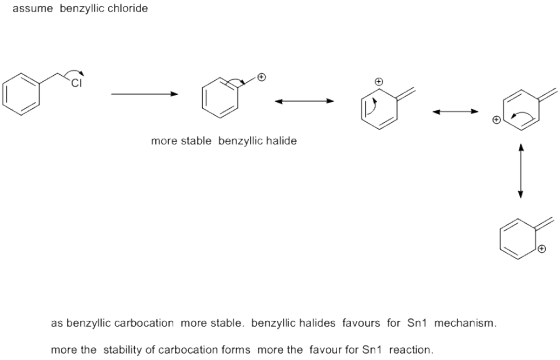
c) Draw all the resonance forms that explain why a benzylic halide is able to undergo...
3. Do primary alcohols undergo rearrangement upon conversion to the alkyl halide? Explain why or why...
 3. Do primary alcohols undergo rearrangement upon conversion to the alkyl halide? Explain why or why not. Draw a mechanism or intermediates to help explain.
3. Do tertiary alcohols undergo rearrangement upon conversion to the alkyl halide? Explain why or why...
 3. Do tertiary alcohols undergo rearrangement upon conversion to the alkyl halide? Explain why or why not. Draw a mechanism or intermediates to help explain.
please answer all of the following questions. 02 pts.] Briefly explain why the following reaction yields...
 please answer all of the following questions.
02 pts.] Briefly explain why the following reaction yields the Hofmann product exclusively even though the base is not sterically hindered: This is breause Br is a jood Ieavng Br CH,CH2ONa oup on q dcarloon. CH,CH,он [02 pts.] Draw the structure of alkyl that will undergo an E2 elimination to yield only the indicated alkene. CHyCHONa CHсH,он [04 pts.] Draw only the major product for each of the following elimination reactions. сн-сH,ON CнH-CHон...
please answer all of the following questions.
02 pts.] Briefly explain why the following reaction yields the Hofmann product exclusively even though the base is not sterically hindered: This is breause Br is a jood Ieavng Br CH,CH2ONa oup on q dcarloon. CH,CH,он [02 pts.] Draw the structure of alkyl that will undergo an E2 elimination to yield only the indicated alkene. CHyCHONa CHсH,он [04 pts.] Draw only the major product for each of the following elimination reactions. сн-сH,ON CнH-CHон...
Draw all significant resonance forms. Do not draw resonance and curved arrows. Include formal charges and...
 Draw all significant resonance
forms. Do not draw resonance and curved arrows. Include formal
charges and lone pairs in your answer.
Question 1 CH3-C-CEN
Draw all significant resonance
forms. Do not draw resonance and curved arrows. Include formal
charges and lone pairs in your answer.
Question 1 CH3-C-CEN
1. Draw all the significant resonance forms for the following structures, and indicate which are major...
 1. Draw all the significant resonance forms for the following structures, and indicate which are major and which are minor, or if you have two equally important forms, say so. The number of new forms you need to draw is shown in parentheses below the arrow. (a) N co 4. In each of the following reactions, indicate which structure is the nucleophile and which is the electrophile. Also draw the products (use the electron pair arrows to guide you). (a)...
1. You wish to substitute the bromine in the following molecules with a nucleophile. Explain whether...
1. You wish to substitute the bromine in the following molecules with a nucleophile. Explain whether the given molecule would react by the Sn1 and Sn2 mechanism and explain why. 1-methyl-1-bromo-cyclohexane, 1-bromopropane, 2-bromohexane. 1.Why does benzyl bromide react under both Sn1 conditions and Sn2 conditions? 2.Why is bromobenzene nonreactive under both Sn1 and Sn2 conditions? 5. If bromocyclohexane reacts faster than chlorocyclohexane in an Sn2 reaction, what could be the reason? 11. Account for the rapid rate of ethanolysis of...
Alkyl halides may undergo elimination reactions with BrØnstead-Lowry bases in which the halide and an adjacent...
Alkyl halides may undergo elimination reactions with BrØnstead-Lowry bases in which the halide and an adjacent proton are lost to form a new π bond. Because of the loss of a proton and a halide anion the reactions are termed ‘dehydrohalogenation’. The two most common associated mechanisms are designated as either unimolecular (E1) or bimolecular (E2) elimination reactions based on reaction rate studies. E1 reactions proceed via a two-step mechanism that involves the cleavage of the leaving group (here the...
Alkyl halides may undergo elimination reactions with BrØnstead-Lowry bases in which the halide and an adjacent...
Alkyl halides may undergo elimination reactions with BrØnstead-Lowry bases in which the halide and an adjacent proton are lost to form a new π bond. Because of the loss of a proton and a halide anion the reactions are termed ‘dehydrohalogenation’. The two most common associated mechanisms are designated as either unimolecular (E1) or bimolecular (E2) elimination reactions based on reaction rate studies. E1 reactions proceed via a two-step mechanism that involves the cleavage of the leaving group (here the...
Please draw the energy diagrams for each condition. Note that A, B, C proceed by SN2;...
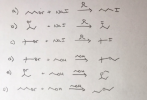 Please draw the energy diagrams for each condition. Note that A, B,
C proceed by SN2; and D, E, F proceed by SN1.
In your energy diagram please also include drawing the
intermediate/transition state STRUCTURE. thank you
[EDIT]
Yes I know it's weird that primary alkyl halide undergoes SN1,
etc. This was apart of an experiment we did in lab and tested
reaction time of each. All of the reactions did eventually take
place, although some of them took 20+...
Please draw the energy diagrams for each condition. Note that A, B,
C proceed by SN2; and D, E, F proceed by SN1.
In your energy diagram please also include drawing the
intermediate/transition state STRUCTURE. thank you
[EDIT]
Yes I know it's weird that primary alkyl halide undergoes SN1,
etc. This was apart of an experiment we did in lab and tested
reaction time of each. All of the reactions did eventually take
place, although some of them took 20+...
 3. Do primary alcohols undergo rearrangement upon conversion to the alkyl halide? Explain why or why not. Draw a mechanism or intermediates to help explain.
 3. Do tertiary alcohols undergo rearrangement upon conversion to the alkyl halide? Explain why or why not. Draw a mechanism or intermediates to help explain.
 please answer all of the following questions.
02 pts.] Briefly explain why the following reaction yields the Hofmann product exclusively even though the base is not sterically hindered: This is breause Br is a jood Ieavng Br CH,CH2ONa oup on q dcarloon. CH,CH,он [02 pts.] Draw the structure of alkyl that will undergo an E2 elimination to yield only the indicated alkene. CHyCHONa CHсH,он [04 pts.] Draw only the major product for each of the following elimination reactions. сн-сH,ON CнH-CHон...
please answer all of the following questions.
02 pts.] Briefly explain why the following reaction yields the Hofmann product exclusively even though the base is not sterically hindered: This is breause Br is a jood Ieavng Br CH,CH2ONa oup on q dcarloon. CH,CH,он [02 pts.] Draw the structure of alkyl that will undergo an E2 elimination to yield only the indicated alkene. CHyCHONa CHсH,он [04 pts.] Draw only the major product for each of the following elimination reactions. сн-сH,ON CнH-CHон...
 Draw all significant resonance
forms. Do not draw resonance and curved arrows. Include formal
charges and lone pairs in your answer.
Question 1 CH3-C-CEN
Draw all significant resonance
forms. Do not draw resonance and curved arrows. Include formal
charges and lone pairs in your answer.
Question 1 CH3-C-CEN
 1. Draw all the significant resonance forms for the following structures, and indicate which are major and which are minor, or if you have two equally important forms, say so. The number of new forms you need to draw is shown in parentheses below the arrow. (a) N co 4. In each of the following reactions, indicate which structure is the nucleophile and which is the electrophile. Also draw the products (use the electron pair arrows to guide you). (a)...
 Please draw the energy diagrams for each condition. Note that A, B,
C proceed by SN2; and D, E, F proceed by SN1.
In your energy diagram please also include drawing the
intermediate/transition state STRUCTURE. thank you
[EDIT]
Yes I know it's weird that primary alkyl halide undergoes SN1,
etc. This was apart of an experiment we did in lab and tested
reaction time of each. All of the reactions did eventually take
place, although some of them took 20+...
Please draw the energy diagrams for each condition. Note that A, B,
C proceed by SN2; and D, E, F proceed by SN1.
In your energy diagram please also include drawing the
intermediate/transition state STRUCTURE. thank you
[EDIT]
Yes I know it's weird that primary alkyl halide undergoes SN1,
etc. This was apart of an experiment we did in lab and tested
reaction time of each. All of the reactions did eventually take
place, although some of them took 20+...
Most questions answered within 3 hours.
-
Where is the error in this code sequence?
String s1 = "Hello";
String s2 = "ello";...
asked 10 months ago -
Financial data for Joel de Paris, Inc., for last year
follow:
Joel de Paris, Inc.
Balance...
asked 10 months ago -
Consider this reaction:
Al2(SO4)3 (aq)+ BaCl3
(aq) Al2Cl6 (aq)- +
3BaSO4(s) . What is the...
asked 10 months ago -
Suppose that Savneet is considering increasing her
recent random sample from 20 car rentals to 40...
asked 10 months ago -
Trucks arrive at an unloading terminal at an average rate of 120
per hour.
Trucks arrive...
asked 10 months ago -
Why are methanol and ethanol completely soluble in water while
octanol is not very little soluble....
asked 10 months ago -
A facilities manager at a university reads in a research report
that the mean amount of...
asked 10 months ago -
When the CuSO4 is rehydrated by adding water to the anhydrous
compound, is this an endothermic...
asked 10 months ago -
A ray of sunlight is passing from diamond into crown glass; the
angle of incidence is...
asked 10 months ago -
A block of mass 0.249 kg is placed on top of a light, vertical
spring of...
asked 10 months ago -
how do the kidneys compensate in the presences of acidosis
a) trigger hyperventilate
b) reserve acid...
asked 10 months ago -
Question 501 pts
The rental rate of capital to the firm increases. Which of the
following...
asked 10 months ago