Suppose a U.S. investor wishes to invest in a British firm currently selling for £40 per...
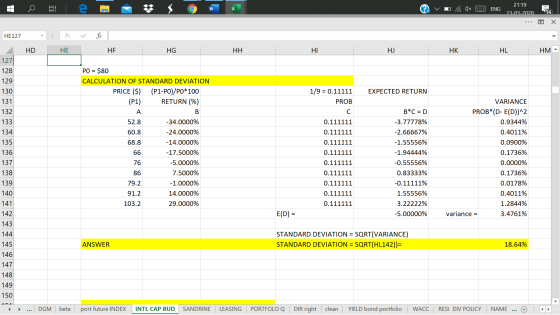
Suppose a U.S. investor wishes to invest in a British firm currently selling for £40 per share. The investor has $20,000 to invest, and the current exchange rate is $2/£. Consider three possible prices per share at £33, £38, and £43 after 1 year. Also, consider three possible exchange rates at $1.6/£, $2/£, and $2.4/£ after 1 year. Calculate the standard deviation of both the pound- and dollar-denominated rates of return if each of the nine outcomes (three possible prices per share in pounds times three possible exchange rates) is equally likely. (Do not round intermediate calculations. Round your answers to 2 decimal places.)
Homework Answers
SEE THE IMAGE. ANY DOUBTS,
FEEL FREE TO ASK. THUMBS UP PLEASE

Add Answer to:
Suppose a U.S. investor wishes to invest in a British firm
currently selling for £40 per...
Suppose a U.S. investor wishes to invest in a British firm currently selling for £80 per...
 Suppose a U.S. investor wishes to invest in a British firm currently selling for £80 per share. The investor has $16,000 to invest, and the current exchange rate is $2/S. Consider three possible prices per share at £77, £82, and £87 after 1 year. Also, consider three possible exchange rates at $1.6/6, $2/ , and $2.4/E after 1 year. Calculate the standard deviation of both the pound- and dollar-denominated rates of return if each of the nine outcomes (three possible...
Suppose a U.S. investor wishes to invest in a British firm currently selling for £25 per...
 Suppose a U.S. investor wishes to invest in a British firm currently selling for £25 per share. The investor has $14,400 to invest, and the current exchange rate is $2/£. Consider three possible prices per share at £21, £26, and £31 after 1 year. Also, consider three possible exchange rates at $1.7/£, $2/£, and $2.3/£ after 1 year. Calculate the standard deviation of both the pound- and dollar-denominated rates of return if each of the nine outcomes (three possible prices...
Standard deviation of pound- and dollar-denominated rates of return
I have this homework question: "Suppose a U.S. investor wishes to invest in a British firm currently selling for £90 per share. The investor has $36,000 to invest, and the current exchange rate is $2/£. Consider three possible prices per share at £88, £93, and £98 after 1 year. Also, consider three possible exchange rates at $1.8/£, $2/£, and $2.2/£ after 1 year. Calculate the standard deviation of both the pound- and dollar-denominated rates of return if each of the...
Suppose a U.S. Investor wishes to invest in a British firm currently selling for £30 per...
 Suppose a U.S. Investor wishes to invest in a British firm currently selling for £30 per share. The investor has $14,400 to invest, and the current exchange rate is $2/£. Suppose now the investor also sells forward £7,200 at a forward exchange rate of $2.05/£. Calculate the dollar-denominated returns for each scenario. (Round your answers to 2 decimal places. Negative amounts should be indicated by a minus sign.) Price per Share ) Rate of Return (%) at Given Exchange Rate...
Suppose a US investor wishes to invest in a British firm currently selling for £20 per...
 Suppose a US investor wishes to invest in a British firm currently selling for £20 per share. The investor has $13,600 to invest, and the current exchange rate is $2/£. Suppose now the investor also sells forward $6,800 at a forward exchange rate of $1.90/ Calculate the dollar-denominated returns for each scenario. (Round your answers to 2 decimal places. Negative amounts should be indicated by a minus sign.) Price per Share (C) Exchange Rate: Rate of Return (%) at Given...
uppose a U.S. investor wants to invest in a British firm currently selling for ₤50 per...
uppose a U.S. investor wants to invest in a British firm currently selling for ₤50 per share. The investor has $7,000 to invest, and the current exchange rate is $1.40/₤. After 1 year, the exchange rate is unchanged and the share price is ₤60. What is the pound-denominated return? A. 20% B. 10% C. 9.3% D. 7.5% C.5.8%
Suppose a U.S. investor wants to invest in a British firm currently selling for ₤50 per...
Suppose a U.S. investor wants to invest in a British firm currently selling for ₤50 per share. The investor has $7,000 to invest, and the current exchange rate is $1.40/₤. After 1 year, the exchange rate is unchanged and the share price is ₤55. What is the dollar-denominated return? A. 14% B. 10% C. 9.3% D. 7.1%
Problem 25-5 Suppose a US investor wishes to invest in a British firm currently selling for...
 Problem 25-5 Suppose a US investor wishes to invest in a British firm currently selling for £33 per share. The investor has $66,000 to invest, and the current exchange rate is $2/. Suppose now the investor also sells forward $33,000 at a forward exchange rate of $205/5 Calculate the dollar-denominated returns for each scenario (Round your answers to 2 decimal places. Negative amounts should be indicated by a minus sign.) Price per Share (E) Rate of Return (%) at Given...
Consider a Spanish investor with 5,000 euros to place in a bank deposit in either Spain...
 Consider a Spanish investor with 5,000 euros to place in a bank deposit in either Spain or Great Britain. The (one-year) interest rate on bank deposits is 3% in Britain and 4.5% in Spain. The (one-year) forward euro-pound exchange rate is 1.7 euros per pound and the spot rate is 1.6 euros per pound. Answer the following questions! a) What is the euro-denominated return (i.e. the total amount of Euros) on Spanish deposits for this investor? b) What is the...
Grant, Inc., is a well-known U.S. firm that needs to borrow 10 million British pounds to support a new business in the U...
Grant, Inc., is a well-known U.S. firm that needs to borrow 10 million British pounds to support a new business in the United Kingdom. However, it cannot obtain financing from British banks because it is not yet established within the United Kingdom. It decides to issue dollar-denominated debt (at par value) in the U.S., for which it will pay an annual coupon rate of 10%. It then will convert the dollar proceeds from the debt issue into British pounds at...
 Suppose a U.S. investor wishes to invest in a British firm currently selling for £80 per share. The investor has $16,000 to invest, and the current exchange rate is $2/S. Consider three possible prices per share at £77, £82, and £87 after 1 year. Also, consider three possible exchange rates at $1.6/6, $2/ , and $2.4/E after 1 year. Calculate the standard deviation of both the pound- and dollar-denominated rates of return if each of the nine outcomes (three possible...
 Suppose a U.S. investor wishes to invest in a British firm currently selling for £25 per share. The investor has $14,400 to invest, and the current exchange rate is $2/£. Consider three possible prices per share at £21, £26, and £31 after 1 year. Also, consider three possible exchange rates at $1.7/£, $2/£, and $2.3/£ after 1 year. Calculate the standard deviation of both the pound- and dollar-denominated rates of return if each of the nine outcomes (three possible prices...
 Suppose a U.S. Investor wishes to invest in a British firm currently selling for £30 per share. The investor has $14,400 to invest, and the current exchange rate is $2/£. Suppose now the investor also sells forward £7,200 at a forward exchange rate of $2.05/£. Calculate the dollar-denominated returns for each scenario. (Round your answers to 2 decimal places. Negative amounts should be indicated by a minus sign.) Price per Share ) Rate of Return (%) at Given Exchange Rate...
 Suppose a US investor wishes to invest in a British firm currently selling for £20 per share. The investor has $13,600 to invest, and the current exchange rate is $2/£. Suppose now the investor also sells forward $6,800 at a forward exchange rate of $1.90/ Calculate the dollar-denominated returns for each scenario. (Round your answers to 2 decimal places. Negative amounts should be indicated by a minus sign.) Price per Share (C) Exchange Rate: Rate of Return (%) at Given...
 Problem 25-5 Suppose a US investor wishes to invest in a British firm currently selling for £33 per share. The investor has $66,000 to invest, and the current exchange rate is $2/. Suppose now the investor also sells forward $33,000 at a forward exchange rate of $205/5 Calculate the dollar-denominated returns for each scenario (Round your answers to 2 decimal places. Negative amounts should be indicated by a minus sign.) Price per Share (E) Rate of Return (%) at Given...
 Consider a Spanish investor with 5,000 euros to place in a bank deposit in either Spain or Great Britain. The (one-year) interest rate on bank deposits is 3% in Britain and 4.5% in Spain. The (one-year) forward euro-pound exchange rate is 1.7 euros per pound and the spot rate is 1.6 euros per pound. Answer the following questions! a) What is the euro-denominated return (i.e. the total amount of Euros) on Spanish deposits for this investor? b) What is the...
Most questions answered within 3 hours.
-
Where is the error in this code sequence?
String s1 = "Hello";
String s2 = "ello";...
asked 11 months ago -
Financial data for Joel de Paris, Inc., for last year
follow:
Joel de Paris, Inc.
Balance...
asked 11 months ago -
Consider this reaction:
Al2(SO4)3 (aq)+ BaCl3
(aq) Al2Cl6 (aq)- +
3BaSO4(s) . What is the...
asked 11 months ago -
Suppose that Savneet is considering increasing her
recent random sample from 20 car rentals to 40...
asked 11 months ago -
Trucks arrive at an unloading terminal at an average rate of 120
per hour.
Trucks arrive...
asked 11 months ago -
Why are methanol and ethanol completely soluble in water while
octanol is not very little soluble....
asked 11 months ago -
A facilities manager at a university reads in a research report
that the mean amount of...
asked 11 months ago -
When the CuSO4 is rehydrated by adding water to the anhydrous
compound, is this an endothermic...
asked 11 months ago -
A ray of sunlight is passing from diamond into crown glass; the
angle of incidence is...
asked 11 months ago -
A block of mass 0.249 kg is placed on top of a light, vertical
spring of...
asked 11 months ago -
how do the kidneys compensate in the presences of acidosis
a) trigger hyperventilate
b) reserve acid...
asked 11 months ago -
Question 501 pts
The rental rate of capital to the firm increases. Which of the
following...
asked 11 months ago