
Homework Answers
Please rate thumbs up
Add Answer to:
the second and fourth answers are right just in need of the
first and third!
Both...
Saved Both Bond Sam and Bond Dave have 7.3 percent coupons, make semiannual payments, and are...
 Saved Both Bond Sam and Bond Dave have 7.3 percent coupons, make semiannual payments, and are priced at par value. Bond Sam has three years to maturity, whereas Bond Dave has 20 years to maturity. If interest rates suddenly rise by 2 percent, what is the percentage change in the price of Bond Sam and Bond Dave? (A negative answer should be indicated by a minus sign. Do not round intermediate calculations and enter your answers as a percent rounded...
Problem 7-16 Interest Rate Risk [LO2] Both Bond Sam and Bond Dave have 7 percent coupons,...
 Problem 7-16 Interest Rate Risk [LO2] Both Bond Sam and Bond Dave have 7 percent coupons, make semiannual payments, and are priced at par value. Bond Sam has four years to maturity, whereas Bond Dave has 15 years to maturity. If interest rates suddenly rise by 2 percent, what is the percentage change in the price of Bond Sam and Bond Dave? (Negative amounts should be indicated by a minus sign. Round your answers to 2 decimal places. (e.g., 32.16)...
Both Bond Bill and Bond Ted have 11 percent coupons, make semiannual payments, and are priced...
Both Bond Bill and Bond Ted have 11 percent coupons, make semiannual payments, and are priced at par value. Bond Bill has 3 years to maturity, whereas Bond Ted has 20 years to maturity. Both bonds have a par value of 1,000. If interest rates suddenly rise by 2 percent, what is the percentage change in the price of these bonds? (A negative answer should be indicated by a minus sign. Do not round intermediate calculations and enter your answers...
Both Bond Sam and Bond Dave have 8 percent coupons, make semiannual payments, and are priced...
Both Bond Sam and Bond Dave have 8 percent coupons, make semiannual payments, and are priced at par value. Bond Sam has 3 years to maturity, whereas Bond Dave has 19 years to maturity. (Do not round your intermediate calculations.) Requirement 1: (a) If interest rates suddenly rise by 4 percent, what is the percentage change in the price of Bond Sam? (b) If interest rates suddenly rise by 4 percent, what is the percentage change in the price of...
Both Bond Sam and Bond Dave have 7 percent coupons, make semiannual payments, and are priced...
Both Bond Sam and Bond Dave have 7 percent coupons, make semiannual payments, and are priced at par value. Bond Sam has 3 years to maturity, whereas Bond Dave has 17 years to maturity. (Do not round your intermediate calculations.) Requirement 1: (a) If interest rates suddenly rise by 5 percent, what is the percentage change in the price of Bond Sam? (b) If interest rates suddenly rise by 5 percent, what is the percentage change in the price of...
Both Bond Bill and Bond Ted have 11.2 percent coupons, make semiannual payments, and are priced...
 Both Bond Bill and Bond Ted have 11.2 percent coupons, make semiannual payments, and are priced at par value. Bond Bill has 4 years to maturity, whereas Bond Ted has 21 years to maturity. Both bonds have a par value of 1,000. a. If interest rates suddenly rise by 3 percent, what is the percentage change in the price of these bonds? (A negative answer should be indicated by a minus sign. Do not round intermediate calculations and enter your...
Both Bond Sam and Bond Dave have 8 percent coupons, make semiannual payments and are priced...
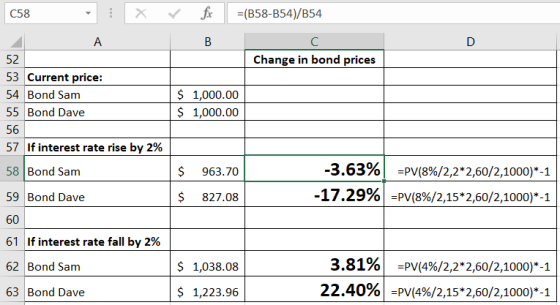
 Both Bond Sam and Bond Dave have 8 percent coupons, make semiannual payments and are priced at par value. Bond Sam has 3 years to maturity, whereas Bond Dave has 15 years to maturity. (Do not round your intermediate calculations.) Requirement 1: (a)lf interest rates suddenly rise by 2 percent, what is the percentage change in the price of Bond Sam? (b)lf interest rates suddenly rise by 2 percent, what is the percentage change in the price of Bond Dave?...
Both Bond Sam and Bond Dave have 9 percent coupons, make semiannual payments, and are priced...
Both Bond Sam and Bond Dave have 9 percent coupons, make semiannual payments, and are priced at par value. Bond Sam has 5 years to maturity, whereas Bond Dave has 19 years to maturity. Requirement 1: (a) If interest rates suddenly rise by 2 percent, what is the percentage change in the price of Bond Sam? (b) If interest rates suddenly rise by 2 percent, what is the percentage change in the price of Bond Dave? Requirement 2: (a) If...
Laurel, Inc., and Hardy Corp. both have 6 percent coupon bonds outstanding, with semiannual interest payments,...
 Laurel, Inc., and Hardy Corp. both have 6 percent coupon bonds outstanding, with semiannual interest payments, and both are currently priced at the par value of $1,000. The Laurel, Inc., bond has three years to maturity, whereas the Hardy Corp.bond has 20 years to maturity. If interest rates suddenly rise by 2 percent, what is the percentage change in the price of each bond? (Do not round intermediate calculations. A negative answer should be indicated by a minus sign. Enter...
Laurel, Inc., and Hardy Corp. both have 6 percent coupon bonds outstanding, with semiannual interest payments,...
Laurel, Inc., and Hardy Corp. both have 6 percent coupon bonds outstanding, with semiannual interest payments, and both are priced at par value. The Laurel, Inc., bond has four years to maturity, whereas the Hardy Corp. bond has 19 years to maturity. If interest rates suddenly rise by 2 percent, what is the percentage change in the price of these bonds? (A negative answer should be indicated by a minus sign. Do not round intermediate calculations and enter your answers...
 Saved Both Bond Sam and Bond Dave have 7.3 percent coupons, make semiannual payments, and are priced at par value. Bond Sam has three years to maturity, whereas Bond Dave has 20 years to maturity. If interest rates suddenly rise by 2 percent, what is the percentage change in the price of Bond Sam and Bond Dave? (A negative answer should be indicated by a minus sign. Do not round intermediate calculations and enter your answers as a percent rounded...
 Problem 7-16 Interest Rate Risk [LO2] Both Bond Sam and Bond Dave have 7 percent coupons, make semiannual payments, and are priced at par value. Bond Sam has four years to maturity, whereas Bond Dave has 15 years to maturity. If interest rates suddenly rise by 2 percent, what is the percentage change in the price of Bond Sam and Bond Dave? (Negative amounts should be indicated by a minus sign. Round your answers to 2 decimal places. (e.g., 32.16)...
 Both Bond Bill and Bond Ted have 11.2 percent coupons, make semiannual payments, and are priced at par value. Bond Bill has 4 years to maturity, whereas Bond Ted has 21 years to maturity. Both bonds have a par value of 1,000. a. If interest rates suddenly rise by 3 percent, what is the percentage change in the price of these bonds? (A negative answer should be indicated by a minus sign. Do not round intermediate calculations and enter your...
 Both Bond Sam and Bond Dave have 8 percent coupons, make semiannual payments and are priced at par value. Bond Sam has 3 years to maturity, whereas Bond Dave has 15 years to maturity. (Do not round your intermediate calculations.) Requirement 1: (a)lf interest rates suddenly rise by 2 percent, what is the percentage change in the price of Bond Sam? (b)lf interest rates suddenly rise by 2 percent, what is the percentage change in the price of Bond Dave?...
 Laurel, Inc., and Hardy Corp. both have 6 percent coupon bonds outstanding, with semiannual interest payments, and both are currently priced at the par value of $1,000. The Laurel, Inc., bond has three years to maturity, whereas the Hardy Corp.bond has 20 years to maturity. If interest rates suddenly rise by 2 percent, what is the percentage change in the price of each bond? (Do not round intermediate calculations. A negative answer should be indicated by a minus sign. Enter...
Most questions answered within 3 hours.
-
Where is the error in this code sequence?
String s1 = "Hello";
String s2 = "ello";...
asked 10 months ago -
Financial data for Joel de Paris, Inc., for last year
follow:
Joel de Paris, Inc.
Balance...
asked 10 months ago -
Consider this reaction:
Al2(SO4)3 (aq)+ BaCl3
(aq) Al2Cl6 (aq)- +
3BaSO4(s) . What is the...
asked 10 months ago -
Suppose that Savneet is considering increasing her
recent random sample from 20 car rentals to 40...
asked 10 months ago -
Trucks arrive at an unloading terminal at an average rate of 120
per hour.
Trucks arrive...
asked 10 months ago -
Why are methanol and ethanol completely soluble in water while
octanol is not very little soluble....
asked 10 months ago -
A facilities manager at a university reads in a research report
that the mean amount of...
asked 10 months ago -
When the CuSO4 is rehydrated by adding water to the anhydrous
compound, is this an endothermic...
asked 10 months ago -
A ray of sunlight is passing from diamond into crown glass; the
angle of incidence is...
asked 10 months ago -
A block of mass 0.249 kg is placed on top of a light, vertical
spring of...
asked 10 months ago -
how do the kidneys compensate in the presences of acidosis
a) trigger hyperventilate
b) reserve acid...
asked 10 months ago -
Question 501 pts
The rental rate of capital to the firm increases. Which of the
following...
asked 10 months ago