
Homework Answers
Add Answer to:
NH2 b. [1ptl Complete the reaction given below and explain why the addition of bisulfite results...
17. The following questions show the chemistry of the Fuchsin test. a. [3pts, Fuchsin (rosaniline hydrochloride) i...
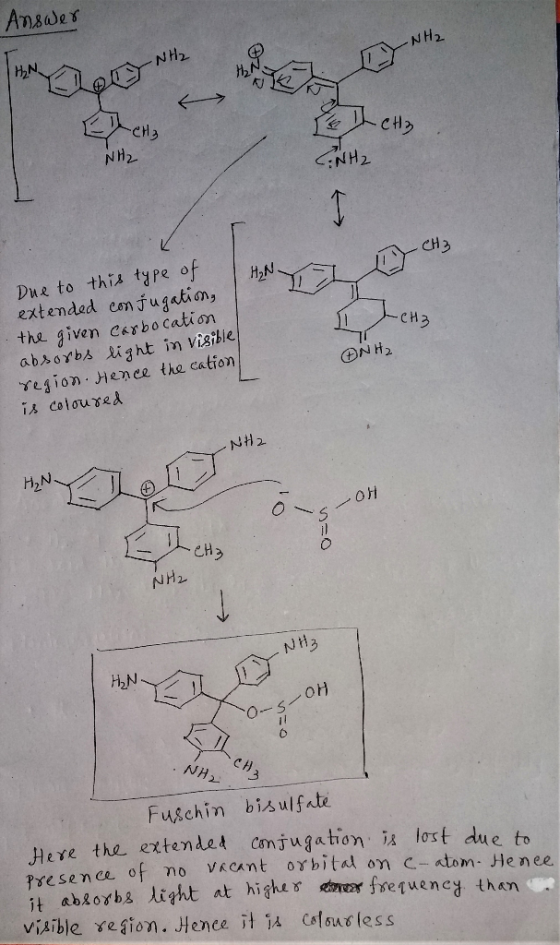
 17. The following questions show the chemistry of the Fuchsin test. a. [3pts, Fuchsin (rosaniline hydrochloride) is also known as Schiff's reagent because it reacts with aldehydes to form imines. Rosaniline hydrochloride exists as several resonance structures. Using curved arrow notation, complete the resonance structures below and explain why the reagent shows an intense magenta color. NH2 Fuchsin Explanation: b. llpt Complete the reaction given below and explain why the addition of bisulfite results in loss of color. Fuchsin bisulfate...
7. The following questions show the chemistry of the Fuchsin test. a. [3pts Fuchsin (rosaniline hydrochloride)...
 7. The following questions show the chemistry of the Fuchsin test. a. [3pts Fuchsin (rosaniline hydrochloride) is also known as Schiff's reagent because it reacts with aldehydes form imines. Rosaniline hydrochloride exists as several resonance structures. Using curved arrow notation, complete the resonance structures below and explain why the reagent shows an intense magenta color. - NH₂ Y CH3 NH2 Fuchsin Soy Explanation: lo uri bel YCH NH
5a-b 5a. Complete the reaction scheme below to show the self-aldol addition product and the self-aldol...
 5a-b
5a. Complete the reaction scheme below to show the self-aldol addition product and the self-aldol condensation product of the ketone shown: Al dol 시d'hon Aldot conunsahe b. Draw the structure of the carbanion formed which leads to the elimination of water in the condensation reaction above, and the arrow push for the loss of hydroxide ion. carbanion, and loss of OH
5a-b
5a. Complete the reaction scheme below to show the self-aldol addition product and the self-aldol condensation product of the ketone shown: Al dol 시d'hon Aldot conunsahe b. Draw the structure of the carbanion formed which leads to the elimination of water in the condensation reaction above, and the arrow push for the loss of hydroxide ion. carbanion, and loss of OH
Complete the following with the correct products, label Zaitsev and Hofmann, and explain why the reaction...
 Complete the following with the correct products, label Zaitsev and Hofmann, and explain why the reaction is either regioselective or stereoselective. (6 pts.) D -Br Nahi Complete each of the following reactions by adding the starting material, reaction conditions, or all possible product(s) - label major/minor - Sx2. Sx1, E2 or E1. (33 pts.) (CH3),COK DMF C(CH3) NaOH DMSO CH OH heat Ph H+Br NaOCH, H+CHE Ph DMF SK DMF o (only product)
Predict the product of the conjugate addition below and then complete the mechanism of the reaction....
 Predict the product of the conjugate addition below and then complete the mechanism of the reaction. Map 1) NH2 H 2) H30+ Complete the mechanism for the conjugate addition by adding the missing curved arrows, bonds, atoms, charges and nonbonding electrons. Use the skeleton provided in each subsequent box to help guide which bonds are formed/broken. Map I I : -- O: I O. T - 1 → 16 12 11 I T - O: o: V २४० click to...
Which of the below reaction sequences will complete the transformation given? OH NH2 Ph1 PhV2 03...
 Which of the below reaction sequences will complete the transformation given? OH NH2 Ph1 PhV2 03 NaCN 1. LiAIH4 DMS HCN 2. H2O MCPBA NaN3 H2 Pt (111) 1. Oso PCC NH3, H2SO4 (cat.) 2. NaHSO3 NaBH3CN H2O (A) I, II only (B) I, III only (C) I only Question 14 An unknown compound exhibits the following is in the NMR spectrum 1.34ppm 3 405 om 2 7.17 om det 787 pom p om inget they the own compound (A)...
9) 18 points total. A) Please explain why the reaction below will not work. We will...
 9) 18 points total. A) Please explain why the reaction below will not work. We will take points off if you use more than 2 sentences in your explanation! (3 points). Y Br NH2 NH3 B) Please propose a synthesis of the above product amine that will work (4 points).
Q3. Explain why the reaction of aldehydes & ketones is. nucleophilic addition. Use pka values in...
 Q3. Explain why the reaction of aldehydes & ketones is. nucleophilic addition. Use pka values in your explanation- (not nucleophilic substution.
Map C Predict the product of the conjugate addition below and then complete the mechanism of...
 Map C Predict the product of the conjugate addition below and then complete the mechanism of the reaction. NH2 1) Н. 2) H307 Complete the mechanism for the conjugate addition by adding the missing curved arrows, bonds, atoms, charges and nonbonding electrons. Use the skeleton provided in each subsequent box to help guide which bonds are formed/broken. M. :0 H-ÖEH الا H 1L -:07H NH2 H 11 H. -Н -H :0—H H H ܠܢ :NH H N: H :0—H H-...
Which of the acid-base reactions below favor the products? Can you explain why this is the...
 Which of the acid-base reactions below
favor the products? Can you explain why this is the case?
5. Put a circle around the acid-base reactions below that should favor the products: - V + HO® + HO + H2O HO° + H-C=C-CH2 + H2O + O C=C-CH3 NH2 + NH3 + O CEC-CH3 H-C=C-CH3 I н ✓ • H-C=CCHE - + H-CECCH3 B + CEC-CH3 H I H
Which of the acid-base reactions below
favor the products? Can you explain why this is the case?
5. Put a circle around the acid-base reactions below that should favor the products: - V + HO® + HO + H2O HO° + H-C=C-CH2 + H2O + O C=C-CH3 NH2 + NH3 + O CEC-CH3 H-C=C-CH3 I н ✓ • H-C=CCHE - + H-CECCH3 B + CEC-CH3 H I H
 17. The following questions show the chemistry of the Fuchsin test. a. [3pts, Fuchsin (rosaniline hydrochloride) is also known as Schiff's reagent because it reacts with aldehydes to form imines. Rosaniline hydrochloride exists as several resonance structures. Using curved arrow notation, complete the resonance structures below and explain why the reagent shows an intense magenta color. NH2 Fuchsin Explanation: b. llpt Complete the reaction given below and explain why the addition of bisulfite results in loss of color. Fuchsin bisulfate...
 7. The following questions show the chemistry of the Fuchsin test. a. [3pts Fuchsin (rosaniline hydrochloride) is also known as Schiff's reagent because it reacts with aldehydes form imines. Rosaniline hydrochloride exists as several resonance structures. Using curved arrow notation, complete the resonance structures below and explain why the reagent shows an intense magenta color. - NH₂ Y CH3 NH2 Fuchsin Soy Explanation: lo uri bel YCH NH
 5a-b
5a. Complete the reaction scheme below to show the self-aldol addition product and the self-aldol condensation product of the ketone shown: Al dol 시d'hon Aldot conunsahe b. Draw the structure of the carbanion formed which leads to the elimination of water in the condensation reaction above, and the arrow push for the loss of hydroxide ion. carbanion, and loss of OH
5a-b
5a. Complete the reaction scheme below to show the self-aldol addition product and the self-aldol condensation product of the ketone shown: Al dol 시d'hon Aldot conunsahe b. Draw the structure of the carbanion formed which leads to the elimination of water in the condensation reaction above, and the arrow push for the loss of hydroxide ion. carbanion, and loss of OH
 Complete the following with the correct products, label Zaitsev and Hofmann, and explain why the reaction is either regioselective or stereoselective. (6 pts.) D -Br Nahi Complete each of the following reactions by adding the starting material, reaction conditions, or all possible product(s) - label major/minor - Sx2. Sx1, E2 or E1. (33 pts.) (CH3),COK DMF C(CH3) NaOH DMSO CH OH heat Ph H+Br NaOCH, H+CHE Ph DMF SK DMF o (only product)
 Predict the product of the conjugate addition below and then complete the mechanism of the reaction. Map 1) NH2 H 2) H30+ Complete the mechanism for the conjugate addition by adding the missing curved arrows, bonds, atoms, charges and nonbonding electrons. Use the skeleton provided in each subsequent box to help guide which bonds are formed/broken. Map I I : -- O: I O. T - 1 → 16 12 11 I T - O: o: V २४० click to...
 Which of the below reaction sequences will complete the transformation given? OH NH2 Ph1 PhV2 03 NaCN 1. LiAIH4 DMS HCN 2. H2O MCPBA NaN3 H2 Pt (111) 1. Oso PCC NH3, H2SO4 (cat.) 2. NaHSO3 NaBH3CN H2O (A) I, II only (B) I, III only (C) I only Question 14 An unknown compound exhibits the following is in the NMR spectrum 1.34ppm 3 405 om 2 7.17 om det 787 pom p om inget they the own compound (A)...
 9) 18 points total. A) Please explain why the reaction below will not work. We will take points off if you use more than 2 sentences in your explanation! (3 points). Y Br NH2 NH3 B) Please propose a synthesis of the above product amine that will work (4 points).
 Q3. Explain why the reaction of aldehydes & ketones is. nucleophilic addition. Use pka values in your explanation- (not nucleophilic substution.
 Map C Predict the product of the conjugate addition below and then complete the mechanism of the reaction. NH2 1) Н. 2) H307 Complete the mechanism for the conjugate addition by adding the missing curved arrows, bonds, atoms, charges and nonbonding electrons. Use the skeleton provided in each subsequent box to help guide which bonds are formed/broken. M. :0 H-ÖEH الا H 1L -:07H NH2 H 11 H. -Н -H :0—H H H ܠܢ :NH H N: H :0—H H-...
 Which of the acid-base reactions below
favor the products? Can you explain why this is the case?
5. Put a circle around the acid-base reactions below that should favor the products: - V + HO® + HO + H2O HO° + H-C=C-CH2 + H2O + O C=C-CH3 NH2 + NH3 + O CEC-CH3 H-C=C-CH3 I н ✓ • H-C=CCHE - + H-CECCH3 B + CEC-CH3 H I H
Which of the acid-base reactions below
favor the products? Can you explain why this is the case?
5. Put a circle around the acid-base reactions below that should favor the products: - V + HO® + HO + H2O HO° + H-C=C-CH2 + H2O + O C=C-CH3 NH2 + NH3 + O CEC-CH3 H-C=C-CH3 I н ✓ • H-C=CCHE - + H-CECCH3 B + CEC-CH3 H I H
Most questions answered within 3 hours.
-
Where is the error in this code sequence?
String s1 = "Hello";
String s2 = "ello";...
asked 11 months ago -
Financial data for Joel de Paris, Inc., for last year
follow:
Joel de Paris, Inc.
Balance...
asked 11 months ago -
Consider this reaction:
Al2(SO4)3 (aq)+ BaCl3
(aq) Al2Cl6 (aq)- +
3BaSO4(s) . What is the...
asked 11 months ago -
Suppose that Savneet is considering increasing her
recent random sample from 20 car rentals to 40...
asked 11 months ago -
Trucks arrive at an unloading terminal at an average rate of 120
per hour.
Trucks arrive...
asked 11 months ago -
Why are methanol and ethanol completely soluble in water while
octanol is not very little soluble....
asked 11 months ago -
A facilities manager at a university reads in a research report
that the mean amount of...
asked 11 months ago -
When the CuSO4 is rehydrated by adding water to the anhydrous
compound, is this an endothermic...
asked 11 months ago -
A ray of sunlight is passing from diamond into crown glass; the
angle of incidence is...
asked 11 months ago -
A block of mass 0.249 kg is placed on top of a light, vertical
spring of...
asked 11 months ago -
how do the kidneys compensate in the presences of acidosis
a) trigger hyperventilate
b) reserve acid...
asked 11 months ago -
Question 501 pts
The rental rate of capital to the firm increases. Which of the
following...
asked 11 months ago