


Homework Answers
Add Answer to:
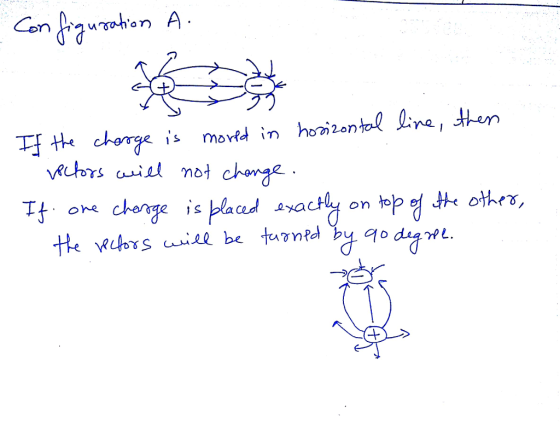
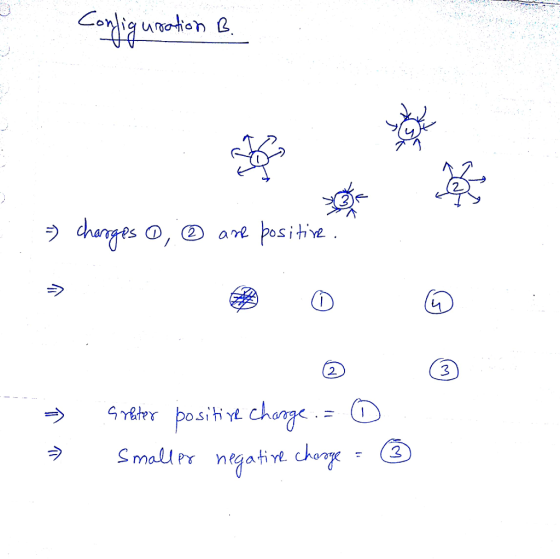
To explore the vector field proprieties of E open this applet. Select configuration A, moves around...
You have two charges +4q and one charge -q. (a) How would you place them along...
You have two charges +4q and one charge -q. (a) How would you place them along a line so there's no net force on any of the three? Options: One positive charge must be at the midpoint between the other two charges. The negative charge must be at the midpoint between the two positive charges. One positive charge must be four times the distance from the negative charge as it is from the other positive charge. There is no way...
Page #4 Physics Il caline lab: Electric Field & Elecric Potential Part I: Electric Field Open...
 Page #4 Physics Il caline lab: Electric Field & Elecric Potential Part I: Electric Field Open the PHET simulation "Charges and Fields". Add positive and negative charges as shown in the diagram below. Draw appropriate electric field lines around and in between the two charges. Use the tools available in the software and then draw manually. Where is the electric field the largest? (label the point #1 in your diagram) 2. Where is the electric field equal to zero? (label...
3.1 Pre-lab In the lab on electric potential and electric field lines, you noted that charged...
 3.1 Pre-lab In the lab on electric potential and electric field lines, you noted that charged par- ticles produce electric fields and these electric fields, in turn, act on charged par- ticles. However, you then proceeded to produce an electric field geometry using conductors held at a particular electric potential. What happened to the electric charges? Electric charge and electric potential are closely related to each other. Putting charge on a conductor raises its electric potential. It is usually much...
IV. Analysis ntrod A. Arrows indicate the directions of the electric field lines. Why are there...
 IV. Analysis ntrod A. Arrows indicate the directions of the electric field lines. Why are there no directions an d indicated on the equipotential lines? They are perpendhculo to the eectric field. They are difpenit to mer sue onf the B. For the dipole configuration (i.e., two oppositely charged point charges), in what region(s) does the electric field have the greatest intensity? Explain how you know this from your drawing and justify your answer. C. Comment on the nature of...
Which of the following statements about electric field lines are true? (choose all that are true)...
Which of the following statements about electric field lines are true? (choose all that are true) a) They are only defined for positive charges. b) They are always tangent to electric field vectors. c) They are always perpendicular to charged surfaces. d) They are a simple way to visualize the electric field vectors. e) None of the above. If a negative charge is placed in an electric field, what direction will it be accelerated? a) In the direction of the...
How to solve Part 4c? Sketches of electric field lines and equipotentials Sketch and answer 4...
 How to solve Part 4c?
Sketches of electric field lines and equipotentials Sketch and answer 4 - A through 4 - D in your answer book. Consider different charge configurations as shown: 4 - A : Suppose you are a test charge and you start at some distance from the charge q = +1 below, such as at the point X. Starting at point X, what path could you move along without doing any work? i.e. which Ē. ds is...
How to solve Part 4c?
Sketches of electric field lines and equipotentials Sketch and answer 4 - A through 4 - D in your answer book. Consider different charge configurations as shown: 4 - A : Suppose you are a test charge and you start at some distance from the charge q = +1 below, such as at the point X. Starting at point X, what path could you move along without doing any work? i.e. which Ē. ds is...
E X P E RIM ENT 2 2 Fields and Equipotentials TV Laboratory Report Atlach graphs...
 E X P E RIM ENT 2 2 Fields and Equipotentials TV Laboratory Report Atlach graphs to Laboratory Report lal ib) ic) Figure 22.5 See Procedure Section B QUESTIONS 1. Directions of the fields are indicated on field lines. Why are no directions indicated on equipotential lines? greatest 2、 For the dipole configuration, in what region(s) does the electric field have the intensity? Explain how you know from your map, and justify. Don't forget units (ce EXPERIMEN T 2 2Fields...
Chapter 3 Capacitors Learning Objectives By working through this lab, you will . examine how capacitance...
 Chapter 3 Capacitors Learning Objectives By working through this lab, you will . examine how capacitance depends on parameters such as area, and dis- tance between plates for a parallel plate capacitor, examine how dielectric materials affect the capacitance of a capacitor, determine the dielectric constant of unknown dielectric materials. 3.1 Pre-lab In the lab on electric potential and electric field lines, you noted that charged par ticles produce electric fields and these electric fields, in turn, act on charged...
VERSIUN -B- nen a positive charge moves opposite to the direction of the electric field, A)...
 VERSIUN -B- nen a positive charge moves opposite to the direction of the electric field, A) the field does positive work on it and the potential energy increases. B) the field does positive work on it and the potential energy decreases. C) the field does negative work on it and the potential energy increases. Motion D) the field does negative work on it and the potential energy decreases. 2) A strong lightning bort transfers about 40 C to Earth. How...
would appreciate a detailed explanation!! thank you :) PHYS208 Week 3 DO NOT WRITE ON THIS...
 would appreciate a detailed explanation!! thank you :)
PHYS208 Week 3 DO NOT WRITE ON THIS FORM RETURN THIS FORM AT THE END OF YOUR CLASS Chapter 23 - Electric Potential 1. Three charges are configured as seen below: a. Find the electric potential at the origin. b. Find the electric potential at the arbitrary point (Xo Yo). You do not need to simplify. -34 (V2a, V2a) + 2. A charge of magnitude +2q is fixed at the origin. A...
would appreciate a detailed explanation!! thank you :)
PHYS208 Week 3 DO NOT WRITE ON THIS FORM RETURN THIS FORM AT THE END OF YOUR CLASS Chapter 23 - Electric Potential 1. Three charges are configured as seen below: a. Find the electric potential at the origin. b. Find the electric potential at the arbitrary point (Xo Yo). You do not need to simplify. -34 (V2a, V2a) + 2. A charge of magnitude +2q is fixed at the origin. A...
 Page #4 Physics Il caline lab: Electric Field & Elecric Potential Part I: Electric Field Open the PHET simulation "Charges and Fields". Add positive and negative charges as shown in the diagram below. Draw appropriate electric field lines around and in between the two charges. Use the tools available in the software and then draw manually. Where is the electric field the largest? (label the point #1 in your diagram) 2. Where is the electric field equal to zero? (label...
 3.1 Pre-lab In the lab on electric potential and electric field lines, you noted that charged par- ticles produce electric fields and these electric fields, in turn, act on charged par- ticles. However, you then proceeded to produce an electric field geometry using conductors held at a particular electric potential. What happened to the electric charges? Electric charge and electric potential are closely related to each other. Putting charge on a conductor raises its electric potential. It is usually much...
 IV. Analysis ntrod A. Arrows indicate the directions of the electric field lines. Why are there no directions an d indicated on the equipotential lines? They are perpendhculo to the eectric field. They are difpenit to mer sue onf the B. For the dipole configuration (i.e., two oppositely charged point charges), in what region(s) does the electric field have the greatest intensity? Explain how you know this from your drawing and justify your answer. C. Comment on the nature of...
 How to solve Part 4c?
Sketches of electric field lines and equipotentials Sketch and answer 4 - A through 4 - D in your answer book. Consider different charge configurations as shown: 4 - A : Suppose you are a test charge and you start at some distance from the charge q = +1 below, such as at the point X. Starting at point X, what path could you move along without doing any work? i.e. which Ē. ds is...
How to solve Part 4c?
Sketches of electric field lines and equipotentials Sketch and answer 4 - A through 4 - D in your answer book. Consider different charge configurations as shown: 4 - A : Suppose you are a test charge and you start at some distance from the charge q = +1 below, such as at the point X. Starting at point X, what path could you move along without doing any work? i.e. which Ē. ds is...
 E X P E RIM ENT 2 2 Fields and Equipotentials TV Laboratory Report Atlach graphs to Laboratory Report lal ib) ic) Figure 22.5 See Procedure Section B QUESTIONS 1. Directions of the fields are indicated on field lines. Why are no directions indicated on equipotential lines? greatest 2、 For the dipole configuration, in what region(s) does the electric field have the intensity? Explain how you know from your map, and justify. Don't forget units (ce EXPERIMEN T 2 2Fields...
 Chapter 3 Capacitors Learning Objectives By working through this lab, you will . examine how capacitance depends on parameters such as area, and dis- tance between plates for a parallel plate capacitor, examine how dielectric materials affect the capacitance of a capacitor, determine the dielectric constant of unknown dielectric materials. 3.1 Pre-lab In the lab on electric potential and electric field lines, you noted that charged par ticles produce electric fields and these electric fields, in turn, act on charged...
 VERSIUN -B- nen a positive charge moves opposite to the direction of the electric field, A) the field does positive work on it and the potential energy increases. B) the field does positive work on it and the potential energy decreases. C) the field does negative work on it and the potential energy increases. Motion D) the field does negative work on it and the potential energy decreases. 2) A strong lightning bort transfers about 40 C to Earth. How...
 would appreciate a detailed explanation!! thank you :)
PHYS208 Week 3 DO NOT WRITE ON THIS FORM RETURN THIS FORM AT THE END OF YOUR CLASS Chapter 23 - Electric Potential 1. Three charges are configured as seen below: a. Find the electric potential at the origin. b. Find the electric potential at the arbitrary point (Xo Yo). You do not need to simplify. -34 (V2a, V2a) + 2. A charge of magnitude +2q is fixed at the origin. A...
would appreciate a detailed explanation!! thank you :)
PHYS208 Week 3 DO NOT WRITE ON THIS FORM RETURN THIS FORM AT THE END OF YOUR CLASS Chapter 23 - Electric Potential 1. Three charges are configured as seen below: a. Find the electric potential at the origin. b. Find the electric potential at the arbitrary point (Xo Yo). You do not need to simplify. -34 (V2a, V2a) + 2. A charge of magnitude +2q is fixed at the origin. A...
Most questions answered within 3 hours.
-
Where is the error in this code sequence?
String s1 = "Hello";
String s2 = "ello";...
asked 10 months ago -
Financial data for Joel de Paris, Inc., for last year
follow:
Joel de Paris, Inc.
Balance...
asked 10 months ago -
Consider this reaction:
Al2(SO4)3 (aq)+ BaCl3
(aq) Al2Cl6 (aq)- +
3BaSO4(s) . What is the...
asked 10 months ago -
Suppose that Savneet is considering increasing her
recent random sample from 20 car rentals to 40...
asked 10 months ago -
Trucks arrive at an unloading terminal at an average rate of 120
per hour.
Trucks arrive...
asked 10 months ago -
Why are methanol and ethanol completely soluble in water while
octanol is not very little soluble....
asked 10 months ago -
A facilities manager at a university reads in a research report
that the mean amount of...
asked 10 months ago -
When the CuSO4 is rehydrated by adding water to the anhydrous
compound, is this an endothermic...
asked 10 months ago -
A ray of sunlight is passing from diamond into crown glass; the
angle of incidence is...
asked 10 months ago -
A block of mass 0.249 kg is placed on top of a light, vertical
spring of...
asked 10 months ago -
how do the kidneys compensate in the presences of acidosis
a) trigger hyperventilate
b) reserve acid...
asked 10 months ago -
Question 501 pts
The rental rate of capital to the firm increases. Which of the
following...
asked 10 months ago