
Homework Answers
Option B.
Consumer surplus can be defined as the maximum price a consumer is able and willing to pay against the actual price set by the market.
It can be calculated as the difference between the maximum price
a consumer is willing to pay and the actual market price of
that
product.
Here it is given that sara is willing to pay $3 for that liter of soda while its actual market price is $2 per liter.
Thus her consumer surplus is $3 - $2 = $1//
Add Answer to:
Suppose the price of a liter of soda is $2. If Sara is willing to pay...
The table to the right lists the highest prices five consumers are willing to pay for a theater ticket. If the price of...
 The table to the right lists the highest prices five consumers are willing to pay for a theater ticket. If the price of one of the tickets is $10 Willingness to Pay $24 O A. Celeste's consumer surplus is $25. OB. the total consumer surplus from the purchase of tickets will be $61. O C. everyone will buy a ticket except for Esther OD. only Anya and Basil will buy tickets. Consumer Anya Basil Celeste Dralon Esther 17
Producer Sis O A. the difference between the lowest price a firm would be willing to...
 Producer Sis O A. the difference between the lowest price a firm would be willing to accept and marginal cost O B. the difference between the lowest price a firm would be willing to accept and the price it actually receives OC. the market price multiplied by the number of units sold by a firm OD. the difference between the highest price a consumer is willing to pay and the lowest price film would be willing to accept O E...
Suppose Connor is willing to pay $400 for a new suit for his graduation but is...
 Suppose Connor is willing to pay $400 for a new suit for his graduation but is able to buy the suit for $350. What is his consumer surplus? O $150 $400 OO $350 $50
Suppose that you're willing to pay up to $5 for an item priced at $3. If...
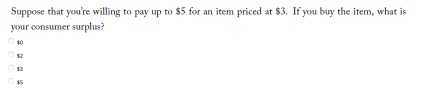 Suppose that you're willing to pay up to $5 for an item priced at $3. If you buy the item, what is your consumer surplus? ООО
show work D(x)is the price, in dollars per unit, that consumers are willing to pay for...
 show work
D(x)is the price, in dollars per unit, that consumers are willing to pay for x units of an item, and S(x) is the price, in dollars per unit, that producers are willing to accept for x units. 1 D(x) = 5 6 3 + 12, and S(x) = ş« +5 a)Find the equilibrium point. b) Find the consumer surplus at the equilibrium point. c) Find the producer surplus at the equilibrium point.
show work
D(x)is the price, in dollars per unit, that consumers are willing to pay for x units of an item, and S(x) is the price, in dollars per unit, that producers are willing to accept for x units. 1 D(x) = 5 6 3 + 12, and S(x) = ş« +5 a)Find the equilibrium point. b) Find the consumer surplus at the equilibrium point. c) Find the producer surplus at the equilibrium point.
D(x) is the? price, in dollars per? unit, that consumers are willing to pay for x...
 D(x) is the? price, in dollars per? unit, that consumers are
willing to pay for x units of an? item, and? S(x) is the? price, in
dollars per? unit, that producers are willing to accept for x
units. Find
?(a?) the equilibrium? point, ?(b?)the consumer surplus at the
equilibrium? point, and ?(c?) the producer surplus at the
equilibrium point.
D(x)=
D(x) is the? price, in dollars per? unit, that consumers are
willing to pay for x units of an? item, and? S(x) is the? price, in
dollars per? unit, that producers are willing to accept for x
units. Find
?(a?) the equilibrium? point, ?(b?)the consumer surplus at the
equilibrium? point, and ?(c?) the producer surplus at the
equilibrium point.
D(x)=
The graph shows the demand curve for DVDs. Price (dollars per DVD) Suppose the price of...
 The graph shows the demand curve for DVDs. Price (dollars per DVD) Suppose the price of a DVD is $30. Draw an arrow that shows the consumer surplus on the 1 millionth DVD bought. Consumer surplus is Market price O A. equal to the amount that we pay for a good or service O B. measured as the marginal benefit (or value) of a good minus the price paid for it, summed over the quantity bought OC. the value that...
D(x) is the price, in dollars per unit, that consumers are willing to pay for x...
 D(x) is the price, in dollars per unit, that consumers are willing to pay for x units of an item, and S(x) is the price, in dollars per unit, that producers are willing to accept for x units. Find (a) the equilibrium point, (b) the consumer surplus at the equilibrium point, and (c) the producer surplus at the equilibrium point. D(x)=(x-912, S(x)=x2 + 2x + 21
Adam is willing to pay $100 for his 1st pack of toilet paper, $25 for his...
Adam is willing to pay $100 for his 1st pack of toilet paper, $25 for his 2nd, and $10 for his 3rd. Bella is willing to pay $80 for her 1st pack of toilet paper, $70 for her 2nd, and $15 for her 3rd. Chas is willing to pay $30 each for as many packs of toilet paper as he can get. The store currently only has 3 packs left, and only these 3 customers will be at the store...
Click on the icon to read the news dip, then answer the following questions Price bollars...
 Click on the icon to read the news dip, then answer the following questions Price bollars per gallon) The graph shows the market for milk in Venezuela when a price control is in effect Draw a shape that represents: 1) consumer surplus Labelit CS 2) producer surplus, Labelit PS, 3) the deadweight loss. Label DWL. Also draw a shape that show the resources lost from time spend in line Labelit Loss Moving from a milk market with no price controls...
 The table to the right lists the highest prices five consumers are willing to pay for a theater ticket. If the price of one of the tickets is $10 Willingness to Pay $24 O A. Celeste's consumer surplus is $25. OB. the total consumer surplus from the purchase of tickets will be $61. O C. everyone will buy a ticket except for Esther OD. only Anya and Basil will buy tickets. Consumer Anya Basil Celeste Dralon Esther 17
 Producer Sis O A. the difference between the lowest price a firm would be willing to accept and marginal cost O B. the difference between the lowest price a firm would be willing to accept and the price it actually receives OC. the market price multiplied by the number of units sold by a firm OD. the difference between the highest price a consumer is willing to pay and the lowest price film would be willing to accept O E...
 Suppose Connor is willing to pay $400 for a new suit for his graduation but is able to buy the suit for $350. What is his consumer surplus? O $150 $400 OO $350 $50
 Suppose that you're willing to pay up to $5 for an item priced at $3. If you buy the item, what is your consumer surplus? ООО
 show work
D(x)is the price, in dollars per unit, that consumers are willing to pay for x units of an item, and S(x) is the price, in dollars per unit, that producers are willing to accept for x units. 1 D(x) = 5 6 3 + 12, and S(x) = ş« +5 a)Find the equilibrium point. b) Find the consumer surplus at the equilibrium point. c) Find the producer surplus at the equilibrium point.
show work
D(x)is the price, in dollars per unit, that consumers are willing to pay for x units of an item, and S(x) is the price, in dollars per unit, that producers are willing to accept for x units. 1 D(x) = 5 6 3 + 12, and S(x) = ş« +5 a)Find the equilibrium point. b) Find the consumer surplus at the equilibrium point. c) Find the producer surplus at the equilibrium point.
 D(x) is the? price, in dollars per? unit, that consumers are
willing to pay for x units of an? item, and? S(x) is the? price, in
dollars per? unit, that producers are willing to accept for x
units. Find
?(a?) the equilibrium? point, ?(b?)the consumer surplus at the
equilibrium? point, and ?(c?) the producer surplus at the
equilibrium point.
D(x)=
D(x) is the? price, in dollars per? unit, that consumers are
willing to pay for x units of an? item, and? S(x) is the? price, in
dollars per? unit, that producers are willing to accept for x
units. Find
?(a?) the equilibrium? point, ?(b?)the consumer surplus at the
equilibrium? point, and ?(c?) the producer surplus at the
equilibrium point.
D(x)=
 The graph shows the demand curve for DVDs. Price (dollars per DVD) Suppose the price of a DVD is $30. Draw an arrow that shows the consumer surplus on the 1 millionth DVD bought. Consumer surplus is Market price O A. equal to the amount that we pay for a good or service O B. measured as the marginal benefit (or value) of a good minus the price paid for it, summed over the quantity bought OC. the value that...
 D(x) is the price, in dollars per unit, that consumers are willing to pay for x units of an item, and S(x) is the price, in dollars per unit, that producers are willing to accept for x units. Find (a) the equilibrium point, (b) the consumer surplus at the equilibrium point, and (c) the producer surplus at the equilibrium point. D(x)=(x-912, S(x)=x2 + 2x + 21
 Click on the icon to read the news dip, then answer the following questions Price bollars per gallon) The graph shows the market for milk in Venezuela when a price control is in effect Draw a shape that represents: 1) consumer surplus Labelit CS 2) producer surplus, Labelit PS, 3) the deadweight loss. Label DWL. Also draw a shape that show the resources lost from time spend in line Labelit Loss Moving from a milk market with no price controls...
Most questions answered within 3 hours.
-
Where is the error in this code sequence?
String s1 = "Hello";
String s2 = "ello";...
asked 11 months ago -
Financial data for Joel de Paris, Inc., for last year
follow:
Joel de Paris, Inc.
Balance...
asked 11 months ago -
Consider this reaction:
Al2(SO4)3 (aq)+ BaCl3
(aq) Al2Cl6 (aq)- +
3BaSO4(s) . What is the...
asked 11 months ago -
Suppose that Savneet is considering increasing her
recent random sample from 20 car rentals to 40...
asked 11 months ago -
Trucks arrive at an unloading terminal at an average rate of 120
per hour.
Trucks arrive...
asked 11 months ago -
Why are methanol and ethanol completely soluble in water while
octanol is not very little soluble....
asked 11 months ago -
A facilities manager at a university reads in a research report
that the mean amount of...
asked 11 months ago -
When the CuSO4 is rehydrated by adding water to the anhydrous
compound, is this an endothermic...
asked 11 months ago -
A ray of sunlight is passing from diamond into crown glass; the
angle of incidence is...
asked 11 months ago -
A block of mass 0.249 kg is placed on top of a light, vertical
spring of...
asked 11 months ago -
how do the kidneys compensate in the presences of acidosis
a) trigger hyperventilate
b) reserve acid...
asked 11 months ago -
Question 501 pts
The rental rate of capital to the firm increases. Which of the
following...
asked 11 months ago