
Homework Answers
If it is expected that interest rate will increase, purchase a short-term bond or a bond with low duration. This is because, when interest increases, price of the bond are expected to go down more for a higher duration bond.
So, option A is correct.
Add Answer to:
If you anticipate interest rates will increase, which of the following bonds will you purchase? Note:...
Which of the following bonds will have the largest decrease in price if interest rates increase...
Which of the following bonds will have the largest decrease in price if interest rates increase in Year 1 of the life of the bonds? A. An option free 11-year 9% coupon bond selling at a discount. B. A 10-year 5% coupon bond that is callable at 104 in three years. C. A 7-year 4% coupon bond that is puttable after two years. D. A 10-year zero coupon bond.
Suppose the term structure of interest rates for U.S. government bonds is “flat” meaning that short...
Suppose the term structure of interest rates for U.S. government bonds is “flat” meaning that short (1-year maturity) and long (20-year maturity) term rates have the same expected actual return, say 3 percent. What would that mean about the market’s expectations for interest rate changes? Calculate the percentage change in price on a 10 percent coupon (annual coupons), $1,000 face value 3-year bond if the discount rate rises from 5 percent to 10 percent. Calculate the percentage change in price...
When interest rates shift, the price of zero coupon bonds are volatile Multiple Choice more; if...
 When interest rates shift, the price of zero coupon bonds are volatile Multiple Choice more; if they have a short maturity rather than a long maturity not; because their duration always matches their maturity equally; regardless of their maturity. less; than coupon bonds of the same maturity. more; than coupon bonds of the same maturity. What is the duration of a bond with four years to maturity and a coupon of 9.5 percent paid annuallyif the bond sells at par?...
You are considering the purchase of a bond and have two investment options as follows: Purchase...
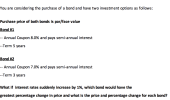 You are considering the purchase of a bond and have two investment options as follows: Purchase price of both bonds is par/face value Bond #1 -- Annual Coupon 8.0% and pays semi-annual interest --Term 5 years Bond #2 -- Annual Coupon 7.0% and pays semi-annual interest --Term 3 years What if interest rates suddenly increase by 1%, which bond would have the greatest percentage change in price and what is the price and percentage change for each bond?
You are considering the purchase of a bond and have two investment options as follows: Purchase...
 You are considering the purchase of a bond and have two investment options as follows: Purchase price of both bonds is par/face value Bond #1 -- Annual Coupon 8.0% and pays semi-annual interest --Term 5 years Bond #2 -- Annual Coupon 7.0% and pays semi-annual interest --Term 3 years What if interest rates suddenly increase by 1%, which bond would have the greatest percentage change in price and what is the price and percentage change for each bond?
Now suppose market interest rates have risen over the course of the year. Specifically, the bonds...
 Now suppose market interest rates have risen over the course of the year. Specifically, the bonds in your portfolio experienced the following changes. Interest Rate a Year Ago (96) Interest Rate Now (96) 12 10 5.5 3. Calculate the approximate change in the price of each bond in your portfolio. (Hint) You may want to use the Equation (2) in the Web Appendix to Cho4. %A in P Portfolio Weight %) Suppose you are holding a portfolio of bonds that...
Which of the following is likely to have the greatest price increase if interest rates decrease....
 Which of the following is likely to have the greatest price increase if interest rates decrease. O A A 10-year zero coupon bond with a yield of 8%. O B A 10-year coupon-paying bond with a yield of 8% A perpetuity with a yield of 8%. (The duration of perpetuity is equal to (1+y)/y)
4. Interest rates and their effect on corporate profits and investment prices Interest rates affect corporate...
 4. Interest rates and their effect on corporate profits and investment prices Interest rates affect corporate profits and security prices. Based on your understanding of the relationship between interest rates and corporate profits and security prices, identify which of the following statements is true and which are false. True False Ststements The higher the interest rate on a firm's debt, the lower will be the firm's profits, all other considerations remaining constant. An increase in the interest rate paid by...
You own a bond that has a duration of 6 years. Interest rates are currently 7%,...
You own a bond that has a duration of 6 years. Interest rates are currently 7%, but you believe the Fed is about to increase interest rates by 22 basis points. Your predicted price change on this bond is ________.
13. If the Fed conducts Open Market Purchase, then: a. price of bonds increase, interest rates decrease and money supply...
13. If the Fed conducts Open Market Purchase, then: a. price of bonds increase, interest rates decrease and money supply decreases. b. price of bonds decrease, interest rates increase and money supply decreases. c. price of bonds increase, interest rates decrease and money supply increases. d. price of bonds decrease, interest rates decrease and money supply increases.
 When interest rates shift, the price of zero coupon bonds are volatile Multiple Choice more; if they have a short maturity rather than a long maturity not; because their duration always matches their maturity equally; regardless of their maturity. less; than coupon bonds of the same maturity. more; than coupon bonds of the same maturity. What is the duration of a bond with four years to maturity and a coupon of 9.5 percent paid annuallyif the bond sells at par?...
 You are considering the purchase of a bond and have two investment options as follows: Purchase price of both bonds is par/face value Bond #1 -- Annual Coupon 8.0% and pays semi-annual interest --Term 5 years Bond #2 -- Annual Coupon 7.0% and pays semi-annual interest --Term 3 years What if interest rates suddenly increase by 1%, which bond would have the greatest percentage change in price and what is the price and percentage change for each bond?
 You are considering the purchase of a bond and have two investment options as follows: Purchase price of both bonds is par/face value Bond #1 -- Annual Coupon 8.0% and pays semi-annual interest --Term 5 years Bond #2 -- Annual Coupon 7.0% and pays semi-annual interest --Term 3 years What if interest rates suddenly increase by 1%, which bond would have the greatest percentage change in price and what is the price and percentage change for each bond?
 Now suppose market interest rates have risen over the course of the year. Specifically, the bonds in your portfolio experienced the following changes. Interest Rate a Year Ago (96) Interest Rate Now (96) 12 10 5.5 3. Calculate the approximate change in the price of each bond in your portfolio. (Hint) You may want to use the Equation (2) in the Web Appendix to Cho4. %A in P Portfolio Weight %) Suppose you are holding a portfolio of bonds that...
 Which of the following is likely to have the greatest price increase if interest rates decrease. O A A 10-year zero coupon bond with a yield of 8%. O B A 10-year coupon-paying bond with a yield of 8% A perpetuity with a yield of 8%. (The duration of perpetuity is equal to (1+y)/y)
 4. Interest rates and their effect on corporate profits and investment prices Interest rates affect corporate profits and security prices. Based on your understanding of the relationship between interest rates and corporate profits and security prices, identify which of the following statements is true and which are false. True False Ststements The higher the interest rate on a firm's debt, the lower will be the firm's profits, all other considerations remaining constant. An increase in the interest rate paid by...
Most questions answered within 3 hours.
-
Where is the error in this code sequence?
String s1 = "Hello";
String s2 = "ello";...
asked 10 months ago -
Financial data for Joel de Paris, Inc., for last year
follow:
Joel de Paris, Inc.
Balance...
asked 10 months ago -
Consider this reaction:
Al2(SO4)3 (aq)+ BaCl3
(aq) Al2Cl6 (aq)- +
3BaSO4(s) . What is the...
asked 10 months ago -
Suppose that Savneet is considering increasing her
recent random sample from 20 car rentals to 40...
asked 10 months ago -
Trucks arrive at an unloading terminal at an average rate of 120
per hour.
Trucks arrive...
asked 10 months ago -
Why are methanol and ethanol completely soluble in water while
octanol is not very little soluble....
asked 10 months ago -
A facilities manager at a university reads in a research report
that the mean amount of...
asked 10 months ago -
When the CuSO4 is rehydrated by adding water to the anhydrous
compound, is this an endothermic...
asked 10 months ago -
A ray of sunlight is passing from diamond into crown glass; the
angle of incidence is...
asked 10 months ago -
A block of mass 0.249 kg is placed on top of a light, vertical
spring of...
asked 10 months ago -
how do the kidneys compensate in the presences of acidosis
a) trigger hyperventilate
b) reserve acid...
asked 10 months ago -
Question 501 pts
The rental rate of capital to the firm increases. Which of the
following...
asked 10 months ago