
Homework Answers
Add Answer to:
3. The redox pairs below all The values are the Was below all participate in the...
biochemistry a,b,c please. 3. The redox pairs below all participate in the ETC. (This is not an exhaustive list.) Th...
 biochemistry a,b,c please.
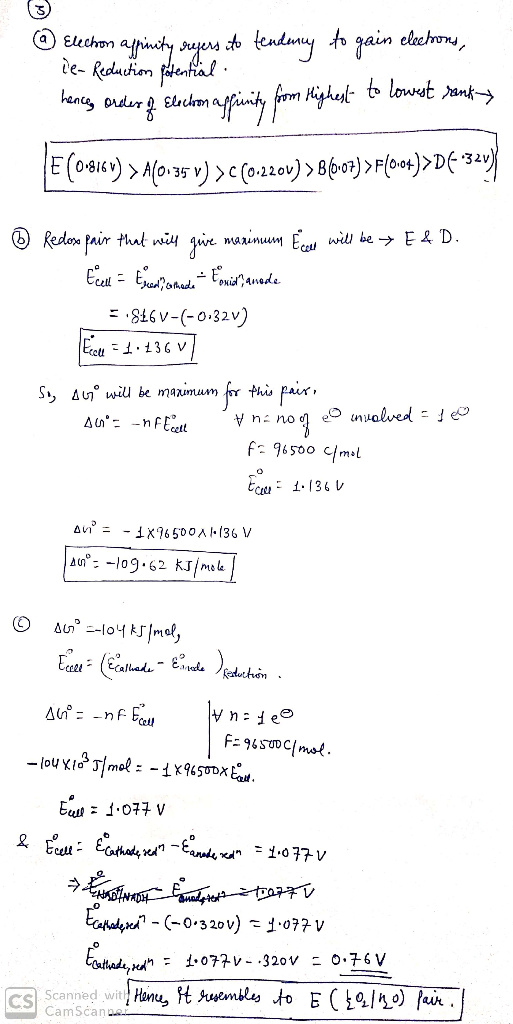
3. The redox pairs below all participate in the ETC. (This is not an exhaustive list.) The values are the standard biochemical reduction potentials (E') for the pairs. A. cytochrome az (Fe3+/Fe2+) +0.350 V B. cytochrome b (Fe3+/Fe2+) + 0.077 V C. cytochrome c (Fe3+/Fe2+) + 0.220 V D. NAD+/NADH -0.320 V E. 202/H20 +0.816 V F. ubiquinone/ubiquinol + 0.045 V a. Use the reduction potentials to order these pairs from highest to lowest electron affinity. In...
biochemistry a,b,c please.
3. The redox pairs below all participate in the ETC. (This is not an exhaustive list.) The values are the standard biochemical reduction potentials (E') for the pairs. A. cytochrome az (Fe3+/Fe2+) +0.350 V B. cytochrome b (Fe3+/Fe2+) + 0.077 V C. cytochrome c (Fe3+/Fe2+) + 0.220 V D. NAD+/NADH -0.320 V E. 202/H20 +0.816 V F. ubiquinone/ubiquinol + 0.045 V a. Use the reduction potentials to order these pairs from highest to lowest electron affinity. In...
I'm not sur if part A is correct. It wants the order F > R >...
 I'm
not sur if part A is correct. It wants the order F > R >
where my answer is B < D < ....
3. The redox pairs below all participate in the ETC. (This is not an exhaustive list.) The values are the standard biochemical reduction potentials (E) for the pairs. A. cytochrome a, (Fe/Fe2+)+0.350 V B. cytochrome b (Fe/Fe*)+ 0.077 V C. cytochrome c, (Fe/Fe2) +0.220 V D. NAD/NADH 0.320 V E. ½02/H20 + 0.816 V F....
I'm
not sur if part A is correct. It wants the order F > R >
where my answer is B < D < ....
3. The redox pairs below all participate in the ETC. (This is not an exhaustive list.) The values are the standard biochemical reduction potentials (E) for the pairs. A. cytochrome a, (Fe/Fe2+)+0.350 V B. cytochrome b (Fe/Fe*)+ 0.077 V C. cytochrome c, (Fe/Fe2) +0.220 V D. NAD/NADH 0.320 V E. ½02/H20 + 0.816 V F....
place in order drom lowest to highest electron affinity The redox pairs below all participate in...
 place in order drom lowest to highest electron affinity
The redox pairs below all participate in the transfer of electrons from FADHS to oxygen. (This is not an exhaustive list. The values of the standard blochemical reduction potentials (E") are provided. Use the reduction potentials to order these pairs from west to highest electron affinity, which translates from initial donor to final acceptor ubiquinone/ubiquinol +0.045 V FAD FADH2 -0.040 V cytochrome 1 (FeFe?) +0.220 V 1/02H₂O 0 816 V Initial...
place in order drom lowest to highest electron affinity
The redox pairs below all participate in the transfer of electrons from FADHS to oxygen. (This is not an exhaustive list. The values of the standard blochemical reduction potentials (E") are provided. Use the reduction potentials to order these pairs from west to highest electron affinity, which translates from initial donor to final acceptor ubiquinone/ubiquinol +0.045 V FAD FADH2 -0.040 V cytochrome 1 (FeFe?) +0.220 V 1/02H₂O 0 816 V Initial...
CICERE nuose your answer... V and transporting choose your answer Trom the Choose your answer to...
 CICERE nuose your answer... V and transporting choose your answer Trom the Choose your answer to the choose your answer... 6 1 point The redox pairs below all participate in the transfer of electrons from NADH to Oxygen. (This is not an exhaustive list. The values of the standard blochemical reduction potentials (E") are provided. Use the reduction potentials to order these pairs from lowest to highest electron affinity, which translates from initial donor to final acceptor ubiquinone/ubiquinol +0.045 V...
biochemistry help The standard free energy change for the transfer of electrons from NADH to one...
 biochemistry help
The standard free energy change for the transfer of electrons from NADH to one of the participants below is -70.4 kJ/mol. What is the identity of this acceptor? Redox pair Standard reduction potential ubiquinone/ubiquinol +0.045 V NAD+/NADH 0.320 V cytochome b (Fe/Fe2) +0.077V 1/202/H20 +0.816V cytochrome (Fe3+/Fe2) +0.220 V cytochrome as (Fe3/Fe2) +0.350 V cytochrome Cic O cytochrome b (Fe) 3/202 OOOO cytochrome as (Fe3+) ubiquinone
biochemistry help
The standard free energy change for the transfer of electrons from NADH to one of the participants below is -70.4 kJ/mol. What is the identity of this acceptor? Redox pair Standard reduction potential ubiquinone/ubiquinol +0.045 V NAD+/NADH 0.320 V cytochome b (Fe/Fe2) +0.077V 1/202/H20 +0.816V cytochrome (Fe3+/Fe2) +0.220 V cytochrome as (Fe3/Fe2) +0.350 V cytochrome Cic O cytochrome b (Fe) 3/202 OOOO cytochrome as (Fe3+) ubiquinone
Question 2a (1 pt): Alcohol dehydrogenase catalyzes the reversible reaction shown. In the space below, write...
 Question 2a (1 pt): Alcohol dehydrogenase catalyzes the reversible reaction shown. In the space below, write the two half-reactions for the redox reaction. Then, determine the cell potential (AE) and standard Gibbs free energy change (AG) for the reaction. (Hint: Use Tables 13.7a/b in "Metabolism Overview") Acetaldehyde + NADH+H→ Ethanol + NAD Question 2b (1 pt): Under physiological conditions, the reaction actually proceeds in the direction that has a positive AG. What would be the minimum value of the reaction...
In one step of glycolysis, glyceraldehyde 3-phosphate is oxidized by NAD+ to yield 3-phosphoglycerate and NADH....
 In one step of glycolysis, glyceraldehyde 3-phosphate is oxidized by NAD+ to yield 3-phosphoglycerate and NADH. 1) Consider that reaction, in the direction written. Which chemicals) is(are) losing electrons, and which chemical(s) is(are) gaining electrons? It's best to answer this in a clear complete sentence. 2 2 2 Table 10-2 Standard Reduction Potentials for Redox Pairs of Biological Relevance* Redox Pair Number of (oxidized form → reduced form) Electrons E.(V) acetate pyruvate 2 -0.70 succinate → a-ketoglutarate 2 -0.67 acetate...
Q7) Using Table 9.1 (page 294) in your textbook and/or in the slides of chapter 9...
 Q7) Using Table 9.1 (page 294) in your textbook and/or in the slides of chapter 9 (online material), determine the standard free energy (AG) for the following reaction in kJ/mol. [Faraday constant = 96.5 kJ/V] [10 points) FADH2 + 1/202 - FAD + 2H+ + H:0 Show detailed calculation. Final answer without clear work will not be considered. TABLE 9.1 Standard Reduction Potentials Redox Half-Reaction 2H+ + 2e" - H a-Ketoglutarate + CO, + 2H+ 2e isocitrate NADP+ + H+...
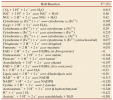
Using the values listed in the table provided, determine the deltaG associated with teh reaction listed...
 Using the values listed in the table provided, determine the
deltaG associated with teh reaction listed below:
NADPH + 1/2O2 + H+ --> NADP+ +H2O
(V) Half-Reaction 0.815 O, 2 H 2 e H3O SO 2 H+ 2 e SO H2O 0.48 NO3 2 H 2 e NO3 0.42 Cytochrome a3 (Fe3+) e cytochrome a (Fe2+) 0.385 O2 (g) 2 H+ 2 e 2O2. 0.295 Cytochrome a (Fes e cytochrome a (Fe2+) 0.29 Cytochrome c (Fe3+) e cytochrome c (Fe...
Using the values listed in the table provided, determine the
deltaG associated with teh reaction listed below:
NADPH + 1/2O2 + H+ --> NADP+ +H2O
(V) Half-Reaction 0.815 O, 2 H 2 e H3O SO 2 H+ 2 e SO H2O 0.48 NO3 2 H 2 e NO3 0.42 Cytochrome a3 (Fe3+) e cytochrome a (Fe2+) 0.385 O2 (g) 2 H+ 2 e 2O2. 0.295 Cytochrome a (Fes e cytochrome a (Fe2+) 0.29 Cytochrome c (Fe3+) e cytochrome c (Fe...
Use the chart to answer the questions. Please be correct and careful In one step of...
 Use the chart to answer the questions. Please be correct and
careful
In one step of glycolysis, glyceraldehyde 3-phosphate is oxidized by NAD+ to yield 3-phosphoglycerate and NADH. 2 2 2 Table 10-2 Standard Reduction Potentials for Redox Pairs of Biological Relevance* Redox Pair Number of (oxidized form → reduced form) Electrons E.(V) acetate pyruvate 2 -0.70 succinate → a-ketoglutarate 2 -0.67 acetate acetaldehyde 2 -0.60 3-phosphoglycerate → glyceraldehyde-3-P 2 -0.55 a-ketoglutarate isocitrate -0.38 NAD+ → NADH 2 -0.32 FMN-FMNH2...
Use the chart to answer the questions. Please be correct and
careful
In one step of glycolysis, glyceraldehyde 3-phosphate is oxidized by NAD+ to yield 3-phosphoglycerate and NADH. 2 2 2 Table 10-2 Standard Reduction Potentials for Redox Pairs of Biological Relevance* Redox Pair Number of (oxidized form → reduced form) Electrons E.(V) acetate pyruvate 2 -0.70 succinate → a-ketoglutarate 2 -0.67 acetate acetaldehyde 2 -0.60 3-phosphoglycerate → glyceraldehyde-3-P 2 -0.55 a-ketoglutarate isocitrate -0.38 NAD+ → NADH 2 -0.32 FMN-FMNH2...
 biochemistry a,b,c please.
3. The redox pairs below all participate in the ETC. (This is not an exhaustive list.) The values are the standard biochemical reduction potentials (E') for the pairs. A. cytochrome az (Fe3+/Fe2+) +0.350 V B. cytochrome b (Fe3+/Fe2+) + 0.077 V C. cytochrome c (Fe3+/Fe2+) + 0.220 V D. NAD+/NADH -0.320 V E. 202/H20 +0.816 V F. ubiquinone/ubiquinol + 0.045 V a. Use the reduction potentials to order these pairs from highest to lowest electron affinity. In...
biochemistry a,b,c please.
3. The redox pairs below all participate in the ETC. (This is not an exhaustive list.) The values are the standard biochemical reduction potentials (E') for the pairs. A. cytochrome az (Fe3+/Fe2+) +0.350 V B. cytochrome b (Fe3+/Fe2+) + 0.077 V C. cytochrome c (Fe3+/Fe2+) + 0.220 V D. NAD+/NADH -0.320 V E. 202/H20 +0.816 V F. ubiquinone/ubiquinol + 0.045 V a. Use the reduction potentials to order these pairs from highest to lowest electron affinity. In...
 I'm
not sur if part A is correct. It wants the order F > R >
where my answer is B < D < ....
3. The redox pairs below all participate in the ETC. (This is not an exhaustive list.) The values are the standard biochemical reduction potentials (E) for the pairs. A. cytochrome a, (Fe/Fe2+)+0.350 V B. cytochrome b (Fe/Fe*)+ 0.077 V C. cytochrome c, (Fe/Fe2) +0.220 V D. NAD/NADH 0.320 V E. ½02/H20 + 0.816 V F....
I'm
not sur if part A is correct. It wants the order F > R >
where my answer is B < D < ....
3. The redox pairs below all participate in the ETC. (This is not an exhaustive list.) The values are the standard biochemical reduction potentials (E) for the pairs. A. cytochrome a, (Fe/Fe2+)+0.350 V B. cytochrome b (Fe/Fe*)+ 0.077 V C. cytochrome c, (Fe/Fe2) +0.220 V D. NAD/NADH 0.320 V E. ½02/H20 + 0.816 V F....
 place in order drom lowest to highest electron affinity
The redox pairs below all participate in the transfer of electrons from FADHS to oxygen. (This is not an exhaustive list. The values of the standard blochemical reduction potentials (E") are provided. Use the reduction potentials to order these pairs from west to highest electron affinity, which translates from initial donor to final acceptor ubiquinone/ubiquinol +0.045 V FAD FADH2 -0.040 V cytochrome 1 (FeFe?) +0.220 V 1/02H₂O 0 816 V Initial...
place in order drom lowest to highest electron affinity
The redox pairs below all participate in the transfer of electrons from FADHS to oxygen. (This is not an exhaustive list. The values of the standard blochemical reduction potentials (E") are provided. Use the reduction potentials to order these pairs from west to highest electron affinity, which translates from initial donor to final acceptor ubiquinone/ubiquinol +0.045 V FAD FADH2 -0.040 V cytochrome 1 (FeFe?) +0.220 V 1/02H₂O 0 816 V Initial...
 CICERE nuose your answer... V and transporting choose your answer Trom the Choose your answer to the choose your answer... 6 1 point The redox pairs below all participate in the transfer of electrons from NADH to Oxygen. (This is not an exhaustive list. The values of the standard blochemical reduction potentials (E") are provided. Use the reduction potentials to order these pairs from lowest to highest electron affinity, which translates from initial donor to final acceptor ubiquinone/ubiquinol +0.045 V...
 biochemistry help
The standard free energy change for the transfer of electrons from NADH to one of the participants below is -70.4 kJ/mol. What is the identity of this acceptor? Redox pair Standard reduction potential ubiquinone/ubiquinol +0.045 V NAD+/NADH 0.320 V cytochome b (Fe/Fe2) +0.077V 1/202/H20 +0.816V cytochrome (Fe3+/Fe2) +0.220 V cytochrome as (Fe3/Fe2) +0.350 V cytochrome Cic O cytochrome b (Fe) 3/202 OOOO cytochrome as (Fe3+) ubiquinone
biochemistry help
The standard free energy change for the transfer of electrons from NADH to one of the participants below is -70.4 kJ/mol. What is the identity of this acceptor? Redox pair Standard reduction potential ubiquinone/ubiquinol +0.045 V NAD+/NADH 0.320 V cytochome b (Fe/Fe2) +0.077V 1/202/H20 +0.816V cytochrome (Fe3+/Fe2) +0.220 V cytochrome as (Fe3/Fe2) +0.350 V cytochrome Cic O cytochrome b (Fe) 3/202 OOOO cytochrome as (Fe3+) ubiquinone
 Question 2a (1 pt): Alcohol dehydrogenase catalyzes the reversible reaction shown. In the space below, write the two half-reactions for the redox reaction. Then, determine the cell potential (AE) and standard Gibbs free energy change (AG) for the reaction. (Hint: Use Tables 13.7a/b in "Metabolism Overview") Acetaldehyde + NADH+H→ Ethanol + NAD Question 2b (1 pt): Under physiological conditions, the reaction actually proceeds in the direction that has a positive AG. What would be the minimum value of the reaction...
 In one step of glycolysis, glyceraldehyde 3-phosphate is oxidized by NAD+ to yield 3-phosphoglycerate and NADH. 1) Consider that reaction, in the direction written. Which chemicals) is(are) losing electrons, and which chemical(s) is(are) gaining electrons? It's best to answer this in a clear complete sentence. 2 2 2 Table 10-2 Standard Reduction Potentials for Redox Pairs of Biological Relevance* Redox Pair Number of (oxidized form → reduced form) Electrons E.(V) acetate pyruvate 2 -0.70 succinate → a-ketoglutarate 2 -0.67 acetate...
 Q7) Using Table 9.1 (page 294) in your textbook and/or in the slides of chapter 9 (online material), determine the standard free energy (AG) for the following reaction in kJ/mol. [Faraday constant = 96.5 kJ/V] [10 points) FADH2 + 1/202 - FAD + 2H+ + H:0 Show detailed calculation. Final answer without clear work will not be considered. TABLE 9.1 Standard Reduction Potentials Redox Half-Reaction 2H+ + 2e" - H a-Ketoglutarate + CO, + 2H+ 2e isocitrate NADP+ + H+...
 Using the values listed in the table provided, determine the
deltaG associated with teh reaction listed below:
NADPH + 1/2O2 + H+ --> NADP+ +H2O
(V) Half-Reaction 0.815 O, 2 H 2 e H3O SO 2 H+ 2 e SO H2O 0.48 NO3 2 H 2 e NO3 0.42 Cytochrome a3 (Fe3+) e cytochrome a (Fe2+) 0.385 O2 (g) 2 H+ 2 e 2O2. 0.295 Cytochrome a (Fes e cytochrome a (Fe2+) 0.29 Cytochrome c (Fe3+) e cytochrome c (Fe...
Using the values listed in the table provided, determine the
deltaG associated with teh reaction listed below:
NADPH + 1/2O2 + H+ --> NADP+ +H2O
(V) Half-Reaction 0.815 O, 2 H 2 e H3O SO 2 H+ 2 e SO H2O 0.48 NO3 2 H 2 e NO3 0.42 Cytochrome a3 (Fe3+) e cytochrome a (Fe2+) 0.385 O2 (g) 2 H+ 2 e 2O2. 0.295 Cytochrome a (Fes e cytochrome a (Fe2+) 0.29 Cytochrome c (Fe3+) e cytochrome c (Fe...
 Use the chart to answer the questions. Please be correct and
careful
In one step of glycolysis, glyceraldehyde 3-phosphate is oxidized by NAD+ to yield 3-phosphoglycerate and NADH. 2 2 2 Table 10-2 Standard Reduction Potentials for Redox Pairs of Biological Relevance* Redox Pair Number of (oxidized form → reduced form) Electrons E.(V) acetate pyruvate 2 -0.70 succinate → a-ketoglutarate 2 -0.67 acetate acetaldehyde 2 -0.60 3-phosphoglycerate → glyceraldehyde-3-P 2 -0.55 a-ketoglutarate isocitrate -0.38 NAD+ → NADH 2 -0.32 FMN-FMNH2...
Use the chart to answer the questions. Please be correct and
careful
In one step of glycolysis, glyceraldehyde 3-phosphate is oxidized by NAD+ to yield 3-phosphoglycerate and NADH. 2 2 2 Table 10-2 Standard Reduction Potentials for Redox Pairs of Biological Relevance* Redox Pair Number of (oxidized form → reduced form) Electrons E.(V) acetate pyruvate 2 -0.70 succinate → a-ketoglutarate 2 -0.67 acetate acetaldehyde 2 -0.60 3-phosphoglycerate → glyceraldehyde-3-P 2 -0.55 a-ketoglutarate isocitrate -0.38 NAD+ → NADH 2 -0.32 FMN-FMNH2...
Most questions answered within 3 hours.
-
Where is the error in this code sequence?
String s1 = "Hello";
String s2 = "ello";...
asked 10 months ago -
Financial data for Joel de Paris, Inc., for last year
follow:
Joel de Paris, Inc.
Balance...
asked 10 months ago -
Consider this reaction:
Al2(SO4)3 (aq)+ BaCl3
(aq) Al2Cl6 (aq)- +
3BaSO4(s) . What is the...
asked 10 months ago -
Suppose that Savneet is considering increasing her
recent random sample from 20 car rentals to 40...
asked 10 months ago -
Trucks arrive at an unloading terminal at an average rate of 120
per hour.
Trucks arrive...
asked 10 months ago -
Why are methanol and ethanol completely soluble in water while
octanol is not very little soluble....
asked 10 months ago -
A facilities manager at a university reads in a research report
that the mean amount of...
asked 10 months ago -
When the CuSO4 is rehydrated by adding water to the anhydrous
compound, is this an endothermic...
asked 10 months ago -
A ray of sunlight is passing from diamond into crown glass; the
angle of incidence is...
asked 10 months ago -
A block of mass 0.249 kg is placed on top of a light, vertical
spring of...
asked 10 months ago -
how do the kidneys compensate in the presences of acidosis
a) trigger hyperventilate
b) reserve acid...
asked 10 months ago -
Question 501 pts
The rental rate of capital to the firm increases. Which of the
following...
asked 10 months ago