
Homework Answers
Add Answer to:
Please solve this question
Questions 1. The other possible product from this reaction is cyclohexanol. Show...
2. Draw reaction mechanism using arrows. Please indicate nucleophile, electrophile, product intermediate structure and name (please...
 2. Draw reaction mechanism using arrows. Please indicate nucleophile, electrophile, product intermediate structure and name (please show which carbon carriers charges if possible)," chemistry is involved, please indicate "anti" or "syn" at the end of the reaction equation. Please name the product. Please indicate "follow Markovnikov's rule or not follow Markovnikov's rule". (If hydride shift is possible, please consider it and show it in your reaction) 1-1) Reaction of the following with HBr in electrophilic addition reactions H3PO4 2) pent-1-ene...
This is the IR for CYclohexanol and acid This is the NMR of product for the...
 This is the IR for CYclohexanol and acid
This is the NMR of product for the acid-catalyzed elimination
from the cyclohexanol
Saturation results
Assume, that when bromine is added to the product, the resulting
mixture is colorless. If potassium permanganate is added to the
product, the formation of a brown precipitate is observed.
starting material info: product and reactants
HERE ARE TWO MORE QUESTIONS:
5. Discussion: Explain how your data gives evidence of correct product identity and purity. Include: a....
This is the IR for CYclohexanol and acid
This is the NMR of product for the acid-catalyzed elimination
from the cyclohexanol
Saturation results
Assume, that when bromine is added to the product, the resulting
mixture is colorless. If potassium permanganate is added to the
product, the formation of a brown precipitate is observed.
starting material info: product and reactants
HERE ARE TWO MORE QUESTIONS:
5. Discussion: Explain how your data gives evidence of correct product identity and purity. Include: a....
Draw reaction mechanism using arrows. Please indicate nucleophile, electrophile, products, show intermediate structure a...
Draw reaction mechanism using arrows. Please indicate nucleophile, electrophile, products, show intermediate structure and name (please show which carbon carriers charges if possible), if anti/syn chemistry is involved, please indicate “anti” or “syn” at the end of the reaction equation. Please name the product. Please indicate “follow Markovnikov’s rule” or “not follow Markovnikov’s rule”. (If hydride shift is possible, please consider it and show it in your reaction) 1) pent-1-ene ( or 1-methylcyclohexene) reacts with Br2
PLEASE ANSWER ALL QUESTIONS Question 5 The reaction below occurs via SN2 and E2 reaction mechanisms....
 PLEASE ANSWER ALL QUESTIONS
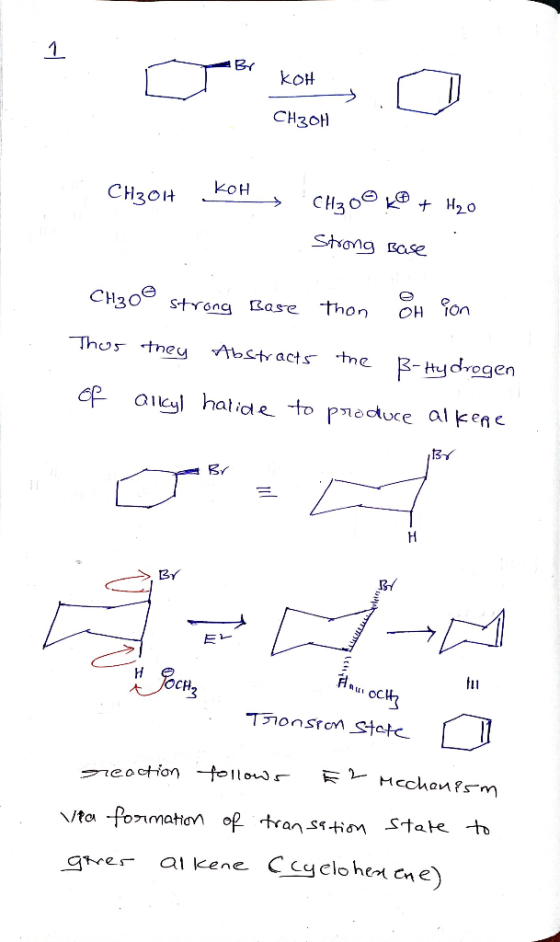
Question 5 The reaction below occurs via SN2 and E2 reaction mechanisms. The question only requires you to address the E2 reaction only. For the E2 reaction: Use Newman projections to show the relationship between the leaving group and the beta-hydrogen on the carbon labeled with the asterisk ("). 1. If the leaving group and the beta-hydrogen on the carbon labeled with the asterisk (1) are not in the correct orientation, show the result of the...
PLEASE ANSWER ALL QUESTIONS
Question 5 The reaction below occurs via SN2 and E2 reaction mechanisms. The question only requires you to address the E2 reaction only. For the E2 reaction: Use Newman projections to show the relationship between the leaving group and the beta-hydrogen on the carbon labeled with the asterisk ("). 1. If the leaving group and the beta-hydrogen on the carbon labeled with the asterisk (1) are not in the correct orientation, show the result of the...
Question: hydration of 2,3-Dimethyl-2-butene in presence of H2SO4 or H3PO4. Draw reaction mechanism using arrows. Please...
Question: hydration of 2,3-Dimethyl-2-butene in presence of H2SO4 or H3PO4. Draw reaction mechanism using arrows. Please indicate nucleophile, electrophile, products, show intermediate structure and name (please show which carbon carriers charges if possible), if anti/syn chemistry is involved, please indicate “anti” or “syn” at the end of the reaction equation. Please name the product. Please indicate “follow Markovnikov’s rule” or “not follow Markovnikov’s rule”. (If hydride shift is possible, please consider it and show it in your reaction)
Draw reaction mechanism using arrows. Please indicate nucleophile, electrophile, products, show intermediate structure a...
 Draw reaction mechanism using arrows.
Please indicate nucleophile, electrophile, products, show
intermediate structure and name (please show which carbon carriers
charges if possible), if anti/syn chemistry is involved
please indicate “anti” or “syn” at the end of the reaction
equation.
Please name the product.
53) Reaction of the following with HBr in electrophilic addition
reactions
Please indicate “follow Markovnikov’s rule” or “not follow
Markovnikov’s rule”. (If hydride shift is possible, please consider
it and show it in your reaction)
yo...
Draw reaction mechanism using arrows.
Please indicate nucleophile, electrophile, products, show
intermediate structure and name (please show which carbon carriers
charges if possible), if anti/syn chemistry is involved
please indicate “anti” or “syn” at the end of the reaction
equation.
Please name the product.
53) Reaction of the following with HBr in electrophilic addition
reactions
Please indicate “follow Markovnikov’s rule” or “not follow
Markovnikov’s rule”. (If hydride shift is possible, please consider
it and show it in your reaction)
yo...
Question: 1-Methylcyclohexene reacts with NBS and water (additional question for this question: what the full name...
Question: 1-Methylcyclohexene reacts with NBS and water (additional question for this question: what the full name of NBS is, draw the structure of NBS) Draw reaction mechanism using arrows. Please indicate nucleophile, electrophile, products, show intermediate structure and name (please show which carbon carriers charges if possible), if anti/syn chemistry is involved, please indicate “anti” or “syn” at the end of the reaction equation. Please name the product. Please indicate “follow Markovnikov’s rule” or “not follow Markovnikov’s rule”. (If hydride...
please show all steps 3. For the reaction shown below, only product A was obtained, whereas...
 please show all steps
3. For the reaction shown below, only product A was obtained, whereas compound B was not formed. Write the reaction mechanism for the formation of product A and compare its mechanism to the mechanism for the formation of compound B. What conclusion can you draw from your comparison of the mechanisms that would explain why only A and not B is formed? Ph CO E Eto, Ph7 Ph L CO,E! CO,Et 1) NaOET, ETOH 2) HCI...
please show all steps
3. For the reaction shown below, only product A was obtained, whereas compound B was not formed. Write the reaction mechanism for the formation of product A and compare its mechanism to the mechanism for the formation of compound B. What conclusion can you draw from your comparison of the mechanisms that would explain why only A and not B is formed? Ph CO E Eto, Ph7 Ph L CO,E! CO,Et 1) NaOET, ETOH 2) HCI...
please answer question number Questions: 1. Show, by equations, how you would prepare phenylbenzyl ether by...
 please answer question number
Questions: 1. Show, by equations, how you would prepare phenylbenzyl ether by the familiar Williamson synthesis. 2. In the preparation of methyl-2-napthoxy ether: A. What substances are present after the final reflux period? B. What serves as the nucleophile? C. How is the product purified? 3. In your preparation of 2,4-dinitrophenyl-p-tolylamine: In A. How is excess amine removed from the product? B. What serves as the nucleophile?
please answer question number
Questions: 1. Show, by equations, how you would prepare phenylbenzyl ether by the familiar Williamson synthesis. 2. In the preparation of methyl-2-napthoxy ether: A. What substances are present after the final reflux period? B. What serves as the nucleophile? C. How is the product purified? 3. In your preparation of 2,4-dinitrophenyl-p-tolylamine: In A. How is excess amine removed from the product? B. What serves as the nucleophile?
please help solve question 23, question 24 and question 25. thank you THE FOLLOWING SCHEME APPLIES...
 please help solve question 23, question 24 and question 25.
thank you
THE FOLLOWING SCHEME APPLIES TO QUESTIONS 23, 24 AND 25 12 CH HECH CH3 HyCCHE (1) H, SO H2O (2) MCPBA CH2Cl2 (3) NaBH Ethanol OH OH QUESTION 23 [2] What, if at all, is wrong with step (1)? A B The product suggests acid catalyzed anti-Markovnikov addition of water to an alkene, which is not possible The reaction needs concentrated sulfuric acid, not its dilute water solution...
please help solve question 23, question 24 and question 25.
thank you
THE FOLLOWING SCHEME APPLIES TO QUESTIONS 23, 24 AND 25 12 CH HECH CH3 HyCCHE (1) H, SO H2O (2) MCPBA CH2Cl2 (3) NaBH Ethanol OH OH QUESTION 23 [2] What, if at all, is wrong with step (1)? A B The product suggests acid catalyzed anti-Markovnikov addition of water to an alkene, which is not possible The reaction needs concentrated sulfuric acid, not its dilute water solution...
 2. Draw reaction mechanism using arrows. Please indicate nucleophile, electrophile, product intermediate structure and name (please show which carbon carriers charges if possible)," chemistry is involved, please indicate "anti" or "syn" at the end of the reaction equation. Please name the product. Please indicate "follow Markovnikov's rule or not follow Markovnikov's rule". (If hydride shift is possible, please consider it and show it in your reaction) 1-1) Reaction of the following with HBr in electrophilic addition reactions H3PO4 2) pent-1-ene...
 This is the IR for CYclohexanol and acid
This is the NMR of product for the acid-catalyzed elimination
from the cyclohexanol
Saturation results
Assume, that when bromine is added to the product, the resulting
mixture is colorless. If potassium permanganate is added to the
product, the formation of a brown precipitate is observed.
starting material info: product and reactants
HERE ARE TWO MORE QUESTIONS:
5. Discussion: Explain how your data gives evidence of correct product identity and purity. Include: a....
This is the IR for CYclohexanol and acid
This is the NMR of product for the acid-catalyzed elimination
from the cyclohexanol
Saturation results
Assume, that when bromine is added to the product, the resulting
mixture is colorless. If potassium permanganate is added to the
product, the formation of a brown precipitate is observed.
starting material info: product and reactants
HERE ARE TWO MORE QUESTIONS:
5. Discussion: Explain how your data gives evidence of correct product identity and purity. Include: a....
 PLEASE ANSWER ALL QUESTIONS
Question 5 The reaction below occurs via SN2 and E2 reaction mechanisms. The question only requires you to address the E2 reaction only. For the E2 reaction: Use Newman projections to show the relationship between the leaving group and the beta-hydrogen on the carbon labeled with the asterisk ("). 1. If the leaving group and the beta-hydrogen on the carbon labeled with the asterisk (1) are not in the correct orientation, show the result of the...
PLEASE ANSWER ALL QUESTIONS
Question 5 The reaction below occurs via SN2 and E2 reaction mechanisms. The question only requires you to address the E2 reaction only. For the E2 reaction: Use Newman projections to show the relationship between the leaving group and the beta-hydrogen on the carbon labeled with the asterisk ("). 1. If the leaving group and the beta-hydrogen on the carbon labeled with the asterisk (1) are not in the correct orientation, show the result of the...
 Draw reaction mechanism using arrows.
Please indicate nucleophile, electrophile, products, show
intermediate structure and name (please show which carbon carriers
charges if possible), if anti/syn chemistry is involved
please indicate “anti” or “syn” at the end of the reaction
equation.
Please name the product.
53) Reaction of the following with HBr in electrophilic addition
reactions
Please indicate “follow Markovnikov’s rule” or “not follow
Markovnikov’s rule”. (If hydride shift is possible, please consider
it and show it in your reaction)
yo...
Draw reaction mechanism using arrows.
Please indicate nucleophile, electrophile, products, show
intermediate structure and name (please show which carbon carriers
charges if possible), if anti/syn chemistry is involved
please indicate “anti” or “syn” at the end of the reaction
equation.
Please name the product.
53) Reaction of the following with HBr in electrophilic addition
reactions
Please indicate “follow Markovnikov’s rule” or “not follow
Markovnikov’s rule”. (If hydride shift is possible, please consider
it and show it in your reaction)
yo...
 please show all steps
3. For the reaction shown below, only product A was obtained, whereas compound B was not formed. Write the reaction mechanism for the formation of product A and compare its mechanism to the mechanism for the formation of compound B. What conclusion can you draw from your comparison of the mechanisms that would explain why only A and not B is formed? Ph CO E Eto, Ph7 Ph L CO,E! CO,Et 1) NaOET, ETOH 2) HCI...
please show all steps
3. For the reaction shown below, only product A was obtained, whereas compound B was not formed. Write the reaction mechanism for the formation of product A and compare its mechanism to the mechanism for the formation of compound B. What conclusion can you draw from your comparison of the mechanisms that would explain why only A and not B is formed? Ph CO E Eto, Ph7 Ph L CO,E! CO,Et 1) NaOET, ETOH 2) HCI...
 please answer question number
Questions: 1. Show, by equations, how you would prepare phenylbenzyl ether by the familiar Williamson synthesis. 2. In the preparation of methyl-2-napthoxy ether: A. What substances are present after the final reflux period? B. What serves as the nucleophile? C. How is the product purified? 3. In your preparation of 2,4-dinitrophenyl-p-tolylamine: In A. How is excess amine removed from the product? B. What serves as the nucleophile?
please answer question number
Questions: 1. Show, by equations, how you would prepare phenylbenzyl ether by the familiar Williamson synthesis. 2. In the preparation of methyl-2-napthoxy ether: A. What substances are present after the final reflux period? B. What serves as the nucleophile? C. How is the product purified? 3. In your preparation of 2,4-dinitrophenyl-p-tolylamine: In A. How is excess amine removed from the product? B. What serves as the nucleophile?
 please help solve question 23, question 24 and question 25.
thank you
THE FOLLOWING SCHEME APPLIES TO QUESTIONS 23, 24 AND 25 12 CH HECH CH3 HyCCHE (1) H, SO H2O (2) MCPBA CH2Cl2 (3) NaBH Ethanol OH OH QUESTION 23 [2] What, if at all, is wrong with step (1)? A B The product suggests acid catalyzed anti-Markovnikov addition of water to an alkene, which is not possible The reaction needs concentrated sulfuric acid, not its dilute water solution...
please help solve question 23, question 24 and question 25.
thank you
THE FOLLOWING SCHEME APPLIES TO QUESTIONS 23, 24 AND 25 12 CH HECH CH3 HyCCHE (1) H, SO H2O (2) MCPBA CH2Cl2 (3) NaBH Ethanol OH OH QUESTION 23 [2] What, if at all, is wrong with step (1)? A B The product suggests acid catalyzed anti-Markovnikov addition of water to an alkene, which is not possible The reaction needs concentrated sulfuric acid, not its dilute water solution...
Most questions answered within 3 hours.
-
Where is the error in this code sequence?
String s1 = "Hello";
String s2 = "ello";...
asked 10 months ago -
Financial data for Joel de Paris, Inc., for last year
follow:
Joel de Paris, Inc.
Balance...
asked 10 months ago -
Consider this reaction:
Al2(SO4)3 (aq)+ BaCl3
(aq) Al2Cl6 (aq)- +
3BaSO4(s) . What is the...
asked 10 months ago -
Suppose that Savneet is considering increasing her
recent random sample from 20 car rentals to 40...
asked 10 months ago -
Trucks arrive at an unloading terminal at an average rate of 120
per hour.
Trucks arrive...
asked 10 months ago -
Why are methanol and ethanol completely soluble in water while
octanol is not very little soluble....
asked 10 months ago -
A facilities manager at a university reads in a research report
that the mean amount of...
asked 10 months ago -
When the CuSO4 is rehydrated by adding water to the anhydrous
compound, is this an endothermic...
asked 10 months ago -
A ray of sunlight is passing from diamond into crown glass; the
angle of incidence is...
asked 10 months ago -
A block of mass 0.249 kg is placed on top of a light, vertical
spring of...
asked 10 months ago -
how do the kidneys compensate in the presences of acidosis
a) trigger hyperventilate
b) reserve acid...
asked 10 months ago -
Question 501 pts
The rental rate of capital to the firm increases. Which of the
following...
asked 10 months ago