
Homework Answers
A. 20 units
Explanation :
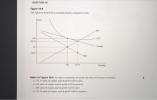
Monopolistic competitive firm can maximise its profit by producing where the MR =MC. So here in above diagram MR intersects the MC at 20 quantity.here firm will charge 80 for 20 quantity.
Figure 16-3 This figure depicts a situation in a monopolistically competitive market. BE 9. Refer to Figure 16-3. W...
 Figure 16-3 This figure depicts a situation in a monopolistically competitive market. BE 9. Refer to Figure 16-3. What price will the monopolistically competitive firm charge in this market? a $70 b. $80 c. $60 d. 575 10. Refer to Figure 16-3. How much profit will the monopolistically competitive firm earn in this situation? a. So b. $80 c. $400 d. $200 11. Refer to Figure 16-3. How much output will the monopolistically competitive firm produce in this situation ..40...
Price Quantity TFC TVC $25 $10 25 20 25 50 25 60 $5 10 15 20...
 Price Quantity TFC TVC $25 $10 25 20 25 50 25 60 $5 10 15 20 5 16. Refer to the table above: At what output on the table would the perfectly competitive firm cover all of its costs and earn only normal profits? 17. The following table applies to the questions below: Output Total cost Total Variable Cost Total Fix cost Marginal Cost 0 $400 200 2 $900 a. When nothing is produced, the firm's total fixed cost and...
$20 ATC 15 10 5 0 10 20 30 40 50 Quantity 60 70 80 Refer...
 $20 ATC 15 10 5 0 10 20 30 40 50 Quantity 60 70 80 Refer to the diagram showing the average total cost curve for a purely competitive firm. At the long-run equilibrium level of output, this firm's economic profit: is zero is $400 O is $200 cannot be determined from the information provided.
Exhibit 24-7 Price Quantity Total Cost $10 10 $80 9 15 85 8 20 95 7...
 Exhibit 24-7 Price Quantity Total Cost $10 10 $80 9 15 85 8 20 95 7 25 110 6 30 140 5 35 175 4 40 215 Refer to Exhibit 24-7. A monopolistic competitive firm earns a total profit of when it produces and sells 20 units of its good. a. $80. b. $40. c. $200 O d. 550. O e. $65.
MR Demand 10 20 30 40 50 60 70 80 Duantity Refer to Figure 15-20. The...
 MR Demand 10 20 30 40 50 60 70 80 Duantity Refer to Figure 15-20. The deadweight loss caused by a profit-maximizing monopoly amounts to a. $900. b. $225. c. $1,350. d. $450 Price MC 4+ F + 1 + 2 + 4 Demand 10 11 12 3 5 6 7 8 9 Quantity Refer to Figure 15-11. Which area represents the deadweight loss from monopoly? a. H b. A+B+C+D+F+I+J+H O c. S+H d. J Price MC Demand iMR: 10...
QUESTION 16 Figure 16-9 The figure is drawn for a monopolistically competitive firm. ATC Demand 56.67...
 QUESTION 16 Figure 16-9 The figure is drawn for a monopolistically competitive firm. ATC Demand 56.67 Quantity Refer to Figure 16-9. In order to maximize its profit, the firm will choose to produce a. 133.33 units of output, and its profit will be zero. b. 100 units of output, and its profit will be positive. c. 100 units of output, and its profit will be zero. d. 133.33 units of output, and its profit will be negative.
QUESTION 15 Figure 5-5 11 Price - Demand 5 10 15 20 25 30 35 40...
 QUESTION 15 Figure 5-5 11 Price - Demand 5 10 15 20 25 30 35 40 45 50 55 Quantity Refer to Figure 5-5. Using the midpoint method, demand is unit elastic between prices of O a. $20 and $40. b.$50 and $70 c. $40 and $60 d. $40 and $50.
18. (Figure: Increasing Costs) Price $40 Firm 1 30 MC AC 20 18 15 10 5...
 18. (Figure: Increasing Costs) Price $40 Firm 1 30 MC AC 20 18 15 10 5 10 15 20 25 30 35 40 45 50 Quantity Firm 2 Price $40 30 MC AC 20 18 15 10 2 4 6 8 10 12 14 16 18 20 Quantity Refer to the figure. If an industry consists of two firms, Firm l and Firm 2, as shown in the diagram, the industry's quantity supplied at a price of S15 is industry's...
QUESTION 1 1 points Let L represent the number of workers hired by a firm, and...
 QUESTION 1 1 points Let L represent the number of workers hired by a firm, and let Q represent that firm's quantity of output. Assume two points on the firm's production function are (1.8,Q-97) and (L·9,Qo1433. Then the marginal product of h worker is a 46 units of output. b. 143 units of output c1 unit of output. d. 59 units of output. 1 points QUESTION 2 Table t Bob's Bulldozers Cost Table Quantity able Margina erage age Average otal...
5) Use the figure below to answer the following question. Price and cost (dollars per unit)...
 5) Use the figure below to answer the following question. Price and cost (dollars per unit) MC 80 60 ATC 40 20 D MR 0 20 40 60 80 100 Quantity (units per week) Figure 2 a) Refer to Figure 2 If this firm is in monopolistic competition, what is its output? b) Refer to Figure 2 If this firm is in monopolistic competition, what is the price it will charge? c) Refer to Figure 2. In the short term,...
 Figure 16-3 This figure depicts a situation in a monopolistically competitive market. BE 9. Refer to Figure 16-3. What price will the monopolistically competitive firm charge in this market? a $70 b. $80 c. $60 d. 575 10. Refer to Figure 16-3. How much profit will the monopolistically competitive firm earn in this situation? a. So b. $80 c. $400 d. $200 11. Refer to Figure 16-3. How much output will the monopolistically competitive firm produce in this situation ..40...
 Price Quantity TFC TVC $25 $10 25 20 25 50 25 60 $5 10 15 20 5 16. Refer to the table above: At what output on the table would the perfectly competitive firm cover all of its costs and earn only normal profits? 17. The following table applies to the questions below: Output Total cost Total Variable Cost Total Fix cost Marginal Cost 0 $400 200 2 $900 a. When nothing is produced, the firm's total fixed cost and...
 $20 ATC 15 10 5 0 10 20 30 40 50 Quantity 60 70 80 Refer to the diagram showing the average total cost curve for a purely competitive firm. At the long-run equilibrium level of output, this firm's economic profit: is zero is $400 O is $200 cannot be determined from the information provided.
 Exhibit 24-7 Price Quantity Total Cost $10 10 $80 9 15 85 8 20 95 7 25 110 6 30 140 5 35 175 4 40 215 Refer to Exhibit 24-7. A monopolistic competitive firm earns a total profit of when it produces and sells 20 units of its good. a. $80. b. $40. c. $200 O d. 550. O e. $65.
 MR Demand 10 20 30 40 50 60 70 80 Duantity Refer to Figure 15-20. The deadweight loss caused by a profit-maximizing monopoly amounts to a. $900. b. $225. c. $1,350. d. $450 Price MC 4+ F + 1 + 2 + 4 Demand 10 11 12 3 5 6 7 8 9 Quantity Refer to Figure 15-11. Which area represents the deadweight loss from monopoly? a. H b. A+B+C+D+F+I+J+H O c. S+H d. J Price MC Demand iMR: 10...
 QUESTION 16 Figure 16-9 The figure is drawn for a monopolistically competitive firm. ATC Demand 56.67 Quantity Refer to Figure 16-9. In order to maximize its profit, the firm will choose to produce a. 133.33 units of output, and its profit will be zero. b. 100 units of output, and its profit will be positive. c. 100 units of output, and its profit will be zero. d. 133.33 units of output, and its profit will be negative.
 QUESTION 15 Figure 5-5 11 Price - Demand 5 10 15 20 25 30 35 40 45 50 55 Quantity Refer to Figure 5-5. Using the midpoint method, demand is unit elastic between prices of O a. $20 and $40. b.$50 and $70 c. $40 and $60 d. $40 and $50.
 18. (Figure: Increasing Costs) Price $40 Firm 1 30 MC AC 20 18 15 10 5 10 15 20 25 30 35 40 45 50 Quantity Firm 2 Price $40 30 MC AC 20 18 15 10 2 4 6 8 10 12 14 16 18 20 Quantity Refer to the figure. If an industry consists of two firms, Firm l and Firm 2, as shown in the diagram, the industry's quantity supplied at a price of S15 is industry's...
 QUESTION 1 1 points Let L represent the number of workers hired by a firm, and let Q represent that firm's quantity of output. Assume two points on the firm's production function are (1.8,Q-97) and (L·9,Qo1433. Then the marginal product of h worker is a 46 units of output. b. 143 units of output c1 unit of output. d. 59 units of output. 1 points QUESTION 2 Table t Bob's Bulldozers Cost Table Quantity able Margina erage age Average otal...
 5) Use the figure below to answer the following question. Price and cost (dollars per unit) MC 80 60 ATC 40 20 D MR 0 20 40 60 80 100 Quantity (units per week) Figure 2 a) Refer to Figure 2 If this firm is in monopolistic competition, what is its output? b) Refer to Figure 2 If this firm is in monopolistic competition, what is the price it will charge? c) Refer to Figure 2. In the short term,...
Most questions answered within 3 hours.
-
Where is the error in this code sequence?
String s1 = "Hello";
String s2 = "ello";...
asked 10 months ago -
Financial data for Joel de Paris, Inc., for last year
follow:
Joel de Paris, Inc.
Balance...
asked 10 months ago -
Consider this reaction:
Al2(SO4)3 (aq)+ BaCl3
(aq) Al2Cl6 (aq)- +
3BaSO4(s) . What is the...
asked 10 months ago -
Suppose that Savneet is considering increasing her
recent random sample from 20 car rentals to 40...
asked 10 months ago -
Trucks arrive at an unloading terminal at an average rate of 120
per hour.
Trucks arrive...
asked 10 months ago -
Why are methanol and ethanol completely soluble in water while
octanol is not very little soluble....
asked 10 months ago -
A facilities manager at a university reads in a research report
that the mean amount of...
asked 10 months ago -
When the CuSO4 is rehydrated by adding water to the anhydrous
compound, is this an endothermic...
asked 10 months ago -
A ray of sunlight is passing from diamond into crown glass; the
angle of incidence is...
asked 10 months ago -
A block of mass 0.249 kg is placed on top of a light, vertical
spring of...
asked 10 months ago -
how do the kidneys compensate in the presences of acidosis
a) trigger hyperventilate
b) reserve acid...
asked 10 months ago -
Question 501 pts
The rental rate of capital to the firm increases. Which of the
following...
asked 10 months ago