
Homework Answers
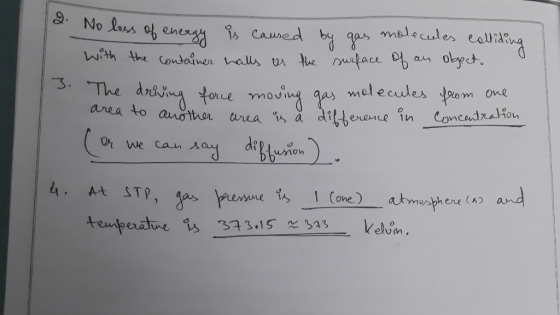
Use Postulates of Kinetic Theory Gases .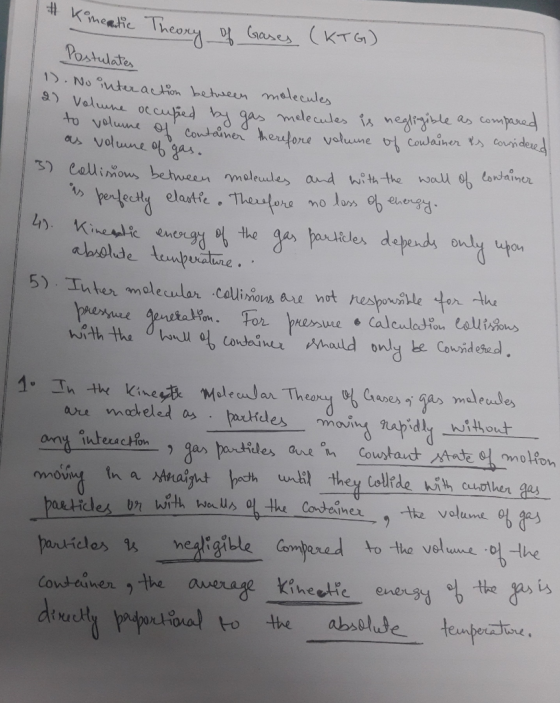
Add Answer to:
Chem 3A Ch 11 In-class Problems Name: 1. In the Kinetic Molecular Theory of Gases, gas...
Question 3 Which is not an assumption in the kinetic molecular theory for gases? The collision...
 Question 3 Which is not an assumption in the kinetic molecular theory for gases? The collision of one gas molecule with another (or with the walls) is completely elastic. The volume occupied the gas molecules is negligible compared to the volume of the container. Gas molecules attract each other The average kinetic energy of gas molecules is proportional to the Kelvin temperature Previous
According to the kinetic molecular theory, which of the following is NOT true this is the...
 According to the kinetic molecular theory, which of the following
is NOT true
this is the question options
n it any temperature the vapor pressure of acetic acid is lower than that of water. (O) Acetic acid is more volatile than water. ( Both A and B are correct. O Neither A nor B is correct. n Gas particles are in constant random motion and move in straight lines until they collide with another gas particle. The volume of gas...
According to the kinetic molecular theory, which of the following
is NOT true
this is the question options
n it any temperature the vapor pressure of acetic acid is lower than that of water. (O) Acetic acid is more volatile than water. ( Both A and B are correct. O Neither A nor B is correct. n Gas particles are in constant random motion and move in straight lines until they collide with another gas particle. The volume of gas...
Question 2 of 16 According to the Kinetic Molecular Theory A) The volume of the gas...
 Question 2 of 16 According to the Kinetic Molecular Theory A) The volume of the gas particles will impact the volume available to the gas. B) Gas particles exert pressure by colliding with one another C) The gas particles are moving in circular motions throughout the container. D) The average kinetic energy is proportional to the temperature of the system. MacBook Air 000
Which assumption is not part of the kinetic-molecular theory of gases? A. The kinetic energy of...
Which assumption is not part of the kinetic-molecular theory of gases? A. The kinetic energy of gas particles change with change in temperature. B. Because the space between gas particles is large, gas particles exert no attractive forces on each other. C. When gas particles collide with each other, they rebound and travel in new directions D. The size of gas particles is small compared to the space between the particles. E. Gas consists of particles that move randomly and...
The kinetic molecular theory of gases predicts pressure to increase as the temperature of a gas...
The kinetic molecular theory of gases predicts pressure to increase as the temperature of a gas increases because: I. the average kinetic energy of the gas molecules increases. II. gas molecules collide more frequently with the container walls. III. there are more molecules per unit volume after raising the temperature. IV. the elasticity of the molecules increases. V. there are less molecules per unit volume after raising the temperature. a. I and II b. I and III c. II and...
8:15 Question 2 of 16 Submit According to the Kinetic Molecular Theory A) The volume of...
 8:15 Question 2 of 16 Submit According to the Kinetic Molecular Theory A) The volume of the gas particles will impact the volume available to the gas. B) Gas particles exert pressure by colliding with one another C) The gas particles are moving in circular motions throughout the container. D) The average kinetic energy is proportional to the temperature of the system.
Which of the following is not part of the kinetic-molecular theory? a) The volume occupied by all of the gas molecules...
Which of the following is not part of the kinetic-molecular theory? a) The volume occupied by all of the gas molecules in a container is negligible compared to the volume of the container. b) Collisions between gas molecules do not result in the loss of energy. c) Attractive and repulsive forces between gas molecules are negligible. d) Gases consist of molecules in continuous, random motion. Atoms are neither created nor destroyed by ordinary chemical reactions
QUESTION 16 Which of the following is NOT an assumption made by the kinetic molecular theory?...
 QUESTION 16 Which of the following is NOT an assumption made by the kinetic molecular theory? A gas is a collection of particles (molecules or atoms) in constant motion. This motion is straight-line motion The average kinetic energy (energy due to motion) of the gas particles is proportional to the temperature measured in kelvin. As temperature increases, the particles move faster and have more energy There is no attraction or repulsion between the gas particles, another wards, they not interact....
QUESTION 16 According to the kinetic theory of gases, the average kinetic energy of the gas...
 QUESTION 16 According to the kinetic theory of gases, the average kinetic energy of the gas particles in a gas sample is directly proportional to the O pressure. O volume O temperature O molar mass O number of moles of gas
Which assumption is part of the kinetic molecular theory? A) the particles in a gas have...
Which assumption is part of the kinetic molecular theory? A) the particles in a gas have a distinct volume measured in mL B) the particles in a gas attract one another via intermolecular forces C) the particles in a gas collide and emit energy to the surroundings D) the speed of the particles in a gas is directly proportional to the Kelvin temperature E) the particles in a gas can be compressed
 Question 3 Which is not an assumption in the kinetic molecular theory for gases? The collision of one gas molecule with another (or with the walls) is completely elastic. The volume occupied the gas molecules is negligible compared to the volume of the container. Gas molecules attract each other The average kinetic energy of gas molecules is proportional to the Kelvin temperature Previous
 According to the kinetic molecular theory, which of the following
is NOT true
this is the question options
n it any temperature the vapor pressure of acetic acid is lower than that of water. (O) Acetic acid is more volatile than water. ( Both A and B are correct. O Neither A nor B is correct. n Gas particles are in constant random motion and move in straight lines until they collide with another gas particle. The volume of gas...
According to the kinetic molecular theory, which of the following
is NOT true
this is the question options
n it any temperature the vapor pressure of acetic acid is lower than that of water. (O) Acetic acid is more volatile than water. ( Both A and B are correct. O Neither A nor B is correct. n Gas particles are in constant random motion and move in straight lines until they collide with another gas particle. The volume of gas...
 Question 2 of 16 According to the Kinetic Molecular Theory A) The volume of the gas particles will impact the volume available to the gas. B) Gas particles exert pressure by colliding with one another C) The gas particles are moving in circular motions throughout the container. D) The average kinetic energy is proportional to the temperature of the system. MacBook Air 000
 8:15 Question 2 of 16 Submit According to the Kinetic Molecular Theory A) The volume of the gas particles will impact the volume available to the gas. B) Gas particles exert pressure by colliding with one another C) The gas particles are moving in circular motions throughout the container. D) The average kinetic energy is proportional to the temperature of the system.
 QUESTION 16 Which of the following is NOT an assumption made by the kinetic molecular theory? A gas is a collection of particles (molecules or atoms) in constant motion. This motion is straight-line motion The average kinetic energy (energy due to motion) of the gas particles is proportional to the temperature measured in kelvin. As temperature increases, the particles move faster and have more energy There is no attraction or repulsion between the gas particles, another wards, they not interact....
 QUESTION 16 According to the kinetic theory of gases, the average kinetic energy of the gas particles in a gas sample is directly proportional to the O pressure. O volume O temperature O molar mass O number of moles of gas
Most questions answered within 3 hours.
-
Where is the error in this code sequence?
String s1 = "Hello";
String s2 = "ello";...
asked 10 months ago -
Financial data for Joel de Paris, Inc., for last year
follow:
Joel de Paris, Inc.
Balance...
asked 10 months ago -
Consider this reaction:
Al2(SO4)3 (aq)+ BaCl3
(aq) Al2Cl6 (aq)- +
3BaSO4(s) . What is the...
asked 10 months ago -
Suppose that Savneet is considering increasing her
recent random sample from 20 car rentals to 40...
asked 10 months ago -
Trucks arrive at an unloading terminal at an average rate of 120
per hour.
Trucks arrive...
asked 10 months ago -
Why are methanol and ethanol completely soluble in water while
octanol is not very little soluble....
asked 10 months ago -
A facilities manager at a university reads in a research report
that the mean amount of...
asked 10 months ago -
When the CuSO4 is rehydrated by adding water to the anhydrous
compound, is this an endothermic...
asked 10 months ago -
A ray of sunlight is passing from diamond into crown glass; the
angle of incidence is...
asked 10 months ago -
A block of mass 0.249 kg is placed on top of a light, vertical
spring of...
asked 10 months ago -
how do the kidneys compensate in the presences of acidosis
a) trigger hyperventilate
b) reserve acid...
asked 10 months ago -
Question 501 pts
The rental rate of capital to the firm increases. Which of the
following...
asked 10 months ago