please answer all questions..thanks,
Homework Answers


Add Answer to:
please answer all questions..thanks,
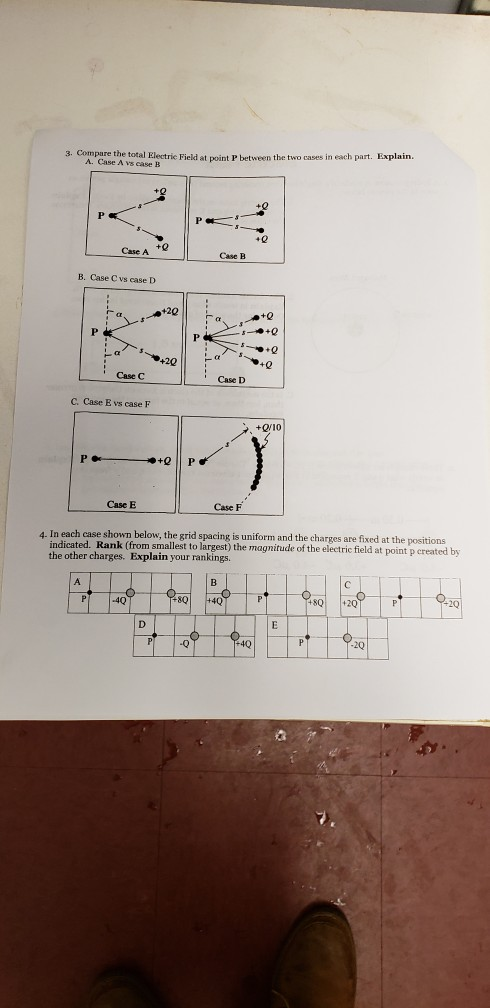
a are the total Electrie Field at point P between the two...
please answer all questions..thanks rwo identical positive charges are placed as shown in the diagram. A....
 please answer all questions..thanks
rwo identical positive charges are placed as shown in the diagram. A. Sketch the direction of the total electric field at each of the points (A, B, a B. Rank, from smallest to largest, the magnitude of the field at each point. 6. Draw, label, and describe a diagram that would accompany the following equation: Nm (8.99 × 10분)(2x10-°C) (2 x 10 *c) (8.9xx10-*c) (8.9910 (1.5 x 10*m)2 (8.99 x 10豐2)(4x10⁻⁶C)-(8.99 x 10" 9 x 10*c)...
please answer all questions..thanks
rwo identical positive charges are placed as shown in the diagram. A. Sketch the direction of the total electric field at each of the points (A, B, a B. Rank, from smallest to largest, the magnitude of the field at each point. 6. Draw, label, and describe a diagram that would accompany the following equation: Nm (8.99 × 10분)(2x10-°C) (2 x 10 *c) (8.9xx10-*c) (8.9910 (1.5 x 10*m)2 (8.99 x 10豐2)(4x10⁻⁶C)-(8.99 x 10" 9 x 10*c)...
Please rank these...i dont get these at all. thanks As shown below, a beam is subjected...
 Please rank these...i dont get these at all. thanks
As shown below, a beam is subjected to six different distributed loads. Describe each of these distributed loads. Let FR,A, FR,B, FR,C, FR,D, and FR, F be the magnitudes of the equivalent resultant loads for each of the six cases. Rank the magnitudes of the resultant forces for the six cases. Rank the items from smallest to largest. To rank items as equivalent, overlap them. When measuring from the left side...
Please rank these...i dont get these at all. thanks
As shown below, a beam is subjected to six different distributed loads. Describe each of these distributed loads. Let FR,A, FR,B, FR,C, FR,D, and FR, F be the magnitudes of the equivalent resultant loads for each of the six cases. Rank the magnitudes of the resultant forces for the six cases. Rank the items from smallest to largest. To rank items as equivalent, overlap them. When measuring from the left side...
please Help all questions..thanks, Electric Field een ino fen aicom is made of a single electron...
 please Help all questions..thanks,
Electric Field een ino fen aicom is made of a single electron revoling around (-5 agE-u m) a single proton as the picture below A. The electric force on the electron is given by F-qE. Explain in words what q and E represent in that equation. Determine the value of q and E. Hydrogen Atom B. The electric force on the proton is also given by F-qE Derelainin rdy what q and E represent in this...
please Help all questions..thanks,
Electric Field een ino fen aicom is made of a single electron revoling around (-5 agE-u m) a single proton as the picture below A. The electric force on the electron is given by F-qE. Explain in words what q and E represent in that equation. Determine the value of q and E. Hydrogen Atom B. The electric force on the proton is also given by F-qE Derelainin rdy what q and E represent in this...
Please show work for all parts of the question. Thanks! The four cases below all show...
 Please show work for all parts of the question. Thanks!
The four cases below all show a ball with a charge of-3q at the top right corner of a square. Then there is either one, two, or three additional charged balls, each ball located at a different corner of the square. For parts (b) and (c), use q = 5.90 × 10⁻⁶ C, and L = 20.0 cm, as well as k = 9.00 x 10⁹ N·m2/C2. 2q (a) Rank...
Please show work for all parts of the question. Thanks!
The four cases below all show a ball with a charge of-3q at the top right corner of a square. Then there is either one, two, or three additional charged balls, each ball located at a different corner of the square. For parts (b) and (c), use q = 5.90 × 10⁻⁶ C, and L = 20.0 cm, as well as k = 9.00 x 10⁹ N·m2/C2. 2q (a) Rank...
**Please answer ALL parts. Thanks A point charge gives rise to an electric field with magnitude...
 **Please answer ALL parts. Thanks
A point charge gives rise to an electric field with magnitude 4 N/C at a distance of 6 m. If the distance is increased to 24 m, then what will be the new magnitude of the electric field? N/C Submit Answer Tries 0/2 Point charges of 54 Q are placed at each corner of an equilateral triangle, which has sides of length 6 L. What is the magnitude of the electric field at the mid-point...
**Please answer ALL parts. Thanks
A point charge gives rise to an electric field with magnitude 4 N/C at a distance of 6 m. If the distance is increased to 24 m, then what will be the new magnitude of the electric field? N/C Submit Answer Tries 0/2 Point charges of 54 Q are placed at each corner of an equilateral triangle, which has sides of length 6 L. What is the magnitude of the electric field at the mid-point...
Please answer both questions. Determine magnitude of the electric field at the point P shown in...
 Please answer both questions.
Determine magnitude of the electric field at the point P shown in the figure(Figure 1). The two charges are separated by a distance of 2a. Point P is on the perpendicular bisector of the line joining the charges, a distance from the midpoint between them. Express your answer in terms of Q, z, a, and k. E= Submit Request Answer Part B Determine the direction of the electric field. Assume that the positive x and y...
Please answer both questions.
Determine magnitude of the electric field at the point P shown in the figure(Figure 1). The two charges are separated by a distance of 2a. Point P is on the perpendicular bisector of the line joining the charges, a distance from the midpoint between them. Express your answer in terms of Q, z, a, and k. E= Submit Request Answer Part B Determine the direction of the electric field. Assume that the positive x and y...
I need help with all these please! Thanks! 1. Two identical metal balls are suspended by...
 I need help with all these please! Thanks!
1. Two identical metal balls are suspended by insulating threads. Both balls have the same net charge. In this problem, do not assume the balls are point charges Ball 2 a. Draw a separate free-body diagram for each ball. Label the forces to indicate: . the object exerting the force, the object on which the force is exerted, • the type of force (gravitational, normal etc.), and • whether the force is...
I need help with all these please! Thanks!
1. Two identical metal balls are suspended by insulating threads. Both balls have the same net charge. In this problem, do not assume the balls are point charges Ball 2 a. Draw a separate free-body diagram for each ball. Label the forces to indicate: . the object exerting the force, the object on which the force is exerted, • the type of force (gravitational, normal etc.), and • whether the force is...
1-5 please Questions 1.2 T The figure above shows two particles, each with a charge of...
 1-5 please
Questions 1.2 T The figure above shows two particles, each with a charge of +Q, that are located at the opposite corners of a square of side d. 1. What is the direction of the net electric field at point P? (D) 1 (E) 2. What is the potential energy of a particle of charge +2q that is held at point P? (A) Zero (B) 2 kgQcc) kq (D) 2kqQ (6) 2,2 kgQ d d d d q=3.0...
1-5 please
Questions 1.2 T The figure above shows two particles, each with a charge of +Q, that are located at the opposite corners of a square of side d. 1. What is the direction of the net electric field at point P? (D) 1 (E) 2. What is the potential energy of a particle of charge +2q that is held at point P? (A) Zero (B) 2 kgQcc) kq (D) 2kqQ (6) 2,2 kgQ d d d d q=3.0...
Please explain how you are achieving these answers so that I can figure out how to...
 Please explain how you are achieving these answers so that I can
figure out how to do this on my own as well
Part a In cases A and B shown in Figure 3 there are two positive point charges +Q each a distance s away from a third positive point charge +q Is the net electric force on the +q charge in case A greater than, less than, or equal to the net electric force on the +q charge...
Please explain how you are achieving these answers so that I can
figure out how to do this on my own as well
Part a In cases A and B shown in Figure 3 there are two positive point charges +Q each a distance s away from a third positive point charge +q Is the net electric force on the +q charge in case A greater than, less than, or equal to the net electric force on the +q charge...
Please show as much work as possible thanks you! 1. Consider the following distribution of point...
 Please show as much work as
possible thanks you!
1. Consider the following distribution of point charges, with d 1 cm, and a point P, on the i-axis, at a distance x 50 cm from the origin. Assume that lal-le-Igal 1Q4|-10 pC T1 d 94 42 93 (a) Find the electric potential V at the point F (b) Find the electric field E (including magnitude and direction) at the point P (c) Find the total electric force Fe (including magnitude...
Please show as much work as
possible thanks you!
1. Consider the following distribution of point charges, with d 1 cm, and a point P, on the i-axis, at a distance x 50 cm from the origin. Assume that lal-le-Igal 1Q4|-10 pC T1 d 94 42 93 (a) Find the electric potential V at the point F (b) Find the electric field E (including magnitude and direction) at the point P (c) Find the total electric force Fe (including magnitude...
 please answer all questions..thanks
rwo identical positive charges are placed as shown in the diagram. A. Sketch the direction of the total electric field at each of the points (A, B, a B. Rank, from smallest to largest, the magnitude of the field at each point. 6. Draw, label, and describe a diagram that would accompany the following equation: Nm (8.99 × 10분)(2x10-°C) (2 x 10 *c) (8.9xx10-*c) (8.9910 (1.5 x 10*m)2 (8.99 x 10豐2)(4x10⁻⁶C)-(8.99 x 10" 9 x 10*c)...
please answer all questions..thanks
rwo identical positive charges are placed as shown in the diagram. A. Sketch the direction of the total electric field at each of the points (A, B, a B. Rank, from smallest to largest, the magnitude of the field at each point. 6. Draw, label, and describe a diagram that would accompany the following equation: Nm (8.99 × 10분)(2x10-°C) (2 x 10 *c) (8.9xx10-*c) (8.9910 (1.5 x 10*m)2 (8.99 x 10豐2)(4x10⁻⁶C)-(8.99 x 10" 9 x 10*c)...
 Please rank these...i dont get these at all. thanks
As shown below, a beam is subjected to six different distributed loads. Describe each of these distributed loads. Let FR,A, FR,B, FR,C, FR,D, and FR, F be the magnitudes of the equivalent resultant loads for each of the six cases. Rank the magnitudes of the resultant forces for the six cases. Rank the items from smallest to largest. To rank items as equivalent, overlap them. When measuring from the left side...
Please rank these...i dont get these at all. thanks
As shown below, a beam is subjected to six different distributed loads. Describe each of these distributed loads. Let FR,A, FR,B, FR,C, FR,D, and FR, F be the magnitudes of the equivalent resultant loads for each of the six cases. Rank the magnitudes of the resultant forces for the six cases. Rank the items from smallest to largest. To rank items as equivalent, overlap them. When measuring from the left side...
 please Help all questions..thanks,
Electric Field een ino fen aicom is made of a single electron revoling around (-5 agE-u m) a single proton as the picture below A. The electric force on the electron is given by F-qE. Explain in words what q and E represent in that equation. Determine the value of q and E. Hydrogen Atom B. The electric force on the proton is also given by F-qE Derelainin rdy what q and E represent in this...
please Help all questions..thanks,
Electric Field een ino fen aicom is made of a single electron revoling around (-5 agE-u m) a single proton as the picture below A. The electric force on the electron is given by F-qE. Explain in words what q and E represent in that equation. Determine the value of q and E. Hydrogen Atom B. The electric force on the proton is also given by F-qE Derelainin rdy what q and E represent in this...
 Please show work for all parts of the question. Thanks!
The four cases below all show a ball with a charge of-3q at the top right corner of a square. Then there is either one, two, or three additional charged balls, each ball located at a different corner of the square. For parts (b) and (c), use q = 5.90 × 10⁻⁶ C, and L = 20.0 cm, as well as k = 9.00 x 10⁹ N·m2/C2. 2q (a) Rank...
Please show work for all parts of the question. Thanks!
The four cases below all show a ball with a charge of-3q at the top right corner of a square. Then there is either one, two, or three additional charged balls, each ball located at a different corner of the square. For parts (b) and (c), use q = 5.90 × 10⁻⁶ C, and L = 20.0 cm, as well as k = 9.00 x 10⁹ N·m2/C2. 2q (a) Rank...
 **Please answer ALL parts. Thanks
A point charge gives rise to an electric field with magnitude 4 N/C at a distance of 6 m. If the distance is increased to 24 m, then what will be the new magnitude of the electric field? N/C Submit Answer Tries 0/2 Point charges of 54 Q are placed at each corner of an equilateral triangle, which has sides of length 6 L. What is the magnitude of the electric field at the mid-point...
**Please answer ALL parts. Thanks
A point charge gives rise to an electric field with magnitude 4 N/C at a distance of 6 m. If the distance is increased to 24 m, then what will be the new magnitude of the electric field? N/C Submit Answer Tries 0/2 Point charges of 54 Q are placed at each corner of an equilateral triangle, which has sides of length 6 L. What is the magnitude of the electric field at the mid-point...
 Please answer both questions.
Determine magnitude of the electric field at the point P shown in the figure(Figure 1). The two charges are separated by a distance of 2a. Point P is on the perpendicular bisector of the line joining the charges, a distance from the midpoint between them. Express your answer in terms of Q, z, a, and k. E= Submit Request Answer Part B Determine the direction of the electric field. Assume that the positive x and y...
Please answer both questions.
Determine magnitude of the electric field at the point P shown in the figure(Figure 1). The two charges are separated by a distance of 2a. Point P is on the perpendicular bisector of the line joining the charges, a distance from the midpoint between them. Express your answer in terms of Q, z, a, and k. E= Submit Request Answer Part B Determine the direction of the electric field. Assume that the positive x and y...
 I need help with all these please! Thanks!
1. Two identical metal balls are suspended by insulating threads. Both balls have the same net charge. In this problem, do not assume the balls are point charges Ball 2 a. Draw a separate free-body diagram for each ball. Label the forces to indicate: . the object exerting the force, the object on which the force is exerted, • the type of force (gravitational, normal etc.), and • whether the force is...
I need help with all these please! Thanks!
1. Two identical metal balls are suspended by insulating threads. Both balls have the same net charge. In this problem, do not assume the balls are point charges Ball 2 a. Draw a separate free-body diagram for each ball. Label the forces to indicate: . the object exerting the force, the object on which the force is exerted, • the type of force (gravitational, normal etc.), and • whether the force is...
 1-5 please
Questions 1.2 T The figure above shows two particles, each with a charge of +Q, that are located at the opposite corners of a square of side d. 1. What is the direction of the net electric field at point P? (D) 1 (E) 2. What is the potential energy of a particle of charge +2q that is held at point P? (A) Zero (B) 2 kgQcc) kq (D) 2kqQ (6) 2,2 kgQ d d d d q=3.0...
1-5 please
Questions 1.2 T The figure above shows two particles, each with a charge of +Q, that are located at the opposite corners of a square of side d. 1. What is the direction of the net electric field at point P? (D) 1 (E) 2. What is the potential energy of a particle of charge +2q that is held at point P? (A) Zero (B) 2 kgQcc) kq (D) 2kqQ (6) 2,2 kgQ d d d d q=3.0...
 Please explain how you are achieving these answers so that I can
figure out how to do this on my own as well
Part a In cases A and B shown in Figure 3 there are two positive point charges +Q each a distance s away from a third positive point charge +q Is the net electric force on the +q charge in case A greater than, less than, or equal to the net electric force on the +q charge...
Please explain how you are achieving these answers so that I can
figure out how to do this on my own as well
Part a In cases A and B shown in Figure 3 there are two positive point charges +Q each a distance s away from a third positive point charge +q Is the net electric force on the +q charge in case A greater than, less than, or equal to the net electric force on the +q charge...
 Please show as much work as
possible thanks you!
1. Consider the following distribution of point charges, with d 1 cm, and a point P, on the i-axis, at a distance x 50 cm from the origin. Assume that lal-le-Igal 1Q4|-10 pC T1 d 94 42 93 (a) Find the electric potential V at the point F (b) Find the electric field E (including magnitude and direction) at the point P (c) Find the total electric force Fe (including magnitude...
Please show as much work as
possible thanks you!
1. Consider the following distribution of point charges, with d 1 cm, and a point P, on the i-axis, at a distance x 50 cm from the origin. Assume that lal-le-Igal 1Q4|-10 pC T1 d 94 42 93 (a) Find the electric potential V at the point F (b) Find the electric field E (including magnitude and direction) at the point P (c) Find the total electric force Fe (including magnitude...
Most questions answered within 3 hours.
-
Where is the error in this code sequence?
String s1 = "Hello";
String s2 = "ello";...
asked 10 months ago -
Financial data for Joel de Paris, Inc., for last year
follow:
Joel de Paris, Inc.
Balance...
asked 10 months ago -
Consider this reaction:
Al2(SO4)3 (aq)+ BaCl3
(aq) Al2Cl6 (aq)- +
3BaSO4(s) . What is the...
asked 10 months ago -
Suppose that Savneet is considering increasing her
recent random sample from 20 car rentals to 40...
asked 10 months ago -
Trucks arrive at an unloading terminal at an average rate of 120
per hour.
Trucks arrive...
asked 10 months ago -
Why are methanol and ethanol completely soluble in water while
octanol is not very little soluble....
asked 10 months ago -
A facilities manager at a university reads in a research report
that the mean amount of...
asked 10 months ago -
When the CuSO4 is rehydrated by adding water to the anhydrous
compound, is this an endothermic...
asked 10 months ago -
A ray of sunlight is passing from diamond into crown glass; the
angle of incidence is...
asked 10 months ago -
A block of mass 0.249 kg is placed on top of a light, vertical
spring of...
asked 10 months ago -
how do the kidneys compensate in the presences of acidosis
a) trigger hyperventilate
b) reserve acid...
asked 10 months ago -
Question 501 pts
The rental rate of capital to the firm increases. Which of the
following...
asked 10 months ago