Given:
1) NaOH
Na+(aq) + OH- (aq)
2) NaOH + H+ Cl-(aq) H2O(l) +
Na+(aq) + Cl-(aq)
3) Na+(aq) + OH-(aq) + H+(aq)
+ Cl-(aq) H2O(l) +
Na+(aq) + Cl-(aq)
Show that equations 1 and 3 can be added algebraically to give equation 2.
Homework Answers
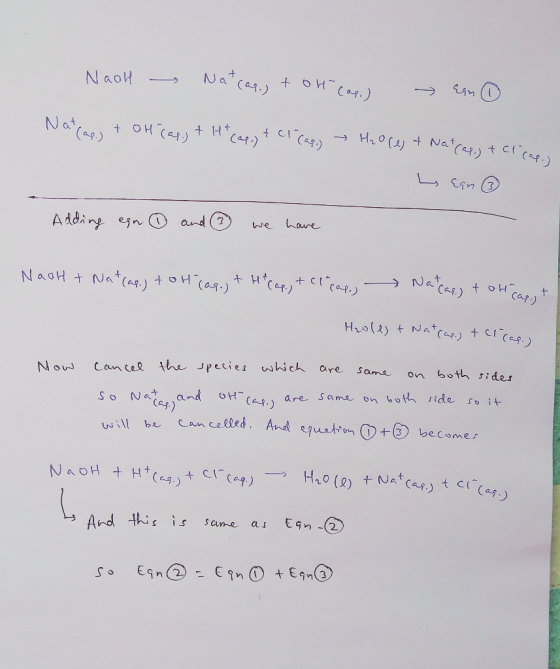
Add Answer to:
Given:
1) NaOH
Na+(aq) + OH- (aq)
2) NaOH + H+ Cl-(aq) H2O(l) +
Na+(aq) +...
1- For the following reaction, Na+(aq) + OH-(aq) + H+(aq) + Cl- (aq) à Na+(aq) + Cl-...
1- For the following reaction, Na+(aq) + OH-(aq) + H+(aq) + Cl- (aq) à Na+(aq) + Cl- (aq) + H2O (l) Na+(aq) + Cl- (aq), ions not involved in the reaction, are called _________________ions. 2- For the following reaction, Na+(aq) + OH-(aq) + H+(aq) + Cl- (aq) à Na+(aq) + Cl- (aq) + H2O (l) What type of reaction is taking place? ____________________ 3- What is the mass in grams of 1.73 mol of MgBr2? __________ 4- What is the percentage composition...
NaOH(s) +H*(aq) + Cl(aq) → H2O(1) + Na*(aq) + Cl(aq) a. Determine the literature enthalpy of...
 NaOH(s) +H*(aq) + Cl(aq) → H2O(1) + Na*(aq) + Cl(aq) a. Determine the literature enthalpy of reaction (AH,xn) based on the tables found in Appendix J of your book.
QUESTION 14 What is the net ionic equation for: HCl(aq) + NaOH(aq) → NaCl(aq) + H2O(1)...
 QUESTION 14 What is the net ionic equation for: HCl(aq) + NaOH(aq) → NaCl(aq) + H2O(1) Option A: HCl(aq) + NaOH(aq) → NaCl(aq) + H2O(1) Option B: Option C: Option D: H*(aq) + Cl(aq) + Nat(aq) + OH (aq) → Na*(aq) + Cl (aq) + H2O(1) H*(aq) + OH (aq) → H20(1) Na (aq) + Cl(aq) → Na*(aq) + Cl(aq) O Option A O Option B Optionc O Option D
Combine 2 equations to obtain the third reaction equation
Reaction 1: Solid sodium hydroxide dissolves in water to form an aqueous solution of ions.NaOH(s) → Na+(aq) + OH–(aq) ΔH1 = ? Reaction 2: Solid sodium hydroxide reacts with aqueous hydrochloric acid to form water and an aqueous solution of sodium chloride.NaOH(s) + H+(aq) + Cl–(aq) → H2O(l) + Na+(aq) + Cl–(aq) ΔH2 = ? Reaction 3: Solutions of aqueous sodium hydroxide and hydrochloric acid react to form water and aqueous sodium chloride.Na+(aq) + OH–(aq) + H+(aq) + Cl–(aq) → H2O(l) + Na+(aq) +...
Given this balanced chemical reaction, 4 HCl(g) + O(g) →2 HO(l) + 2 Cl(g) H = -202.4 kJ (give answer in decimal notati...
Given this balanced chemical reaction, 4 HCl(g) + O(g) →2 HO(l) + 2 Cl(g) H = -202.4 kJ (give answer in decimal notation, i.e. 234,000) a. How many J (joules) of heat are released when 2.50 moles of HCl react with excess oxygen gas? We were unable to transcribe this imageWe were unable to transcribe this imageWe were unable to transcribe this imageWe were unable to transcribe this imageWe were unable to transcribe this image
Calculate ∆H and ∆U for the reaction 2 Na(s) + 2 H2O(l) → 2 NaOH(aq) +...
Calculate ∆H and ∆U for the reaction 2 Na(s) + 2 H2O(l) → 2 NaOH(aq) + H2(g) Assume standard state conditions (T = 25◦C, p = 1 atm) and ideal gas behavior. Why do ∆H and ∆U differ? (Hint: In this case, ∆H is ∆Hrxn.)
1. Fe^3+(aq) + 4Cl^-(aq) ⇌ [FeCl4]^-(aq) 2. NaF(s) + H2O(l) → Na^+(aq) + F^-(aq) 3. Fe^+(aq)...
1. Fe^3+(aq) + 4Cl^-(aq) ⇌ [FeCl4]^-(aq) 2. NaF(s) + H2O(l) → Na^+(aq) + F^-(aq) 3. Fe^+(aq) + 6F^-(aq) ⇌ [FeF6]^3-(aq) Describe on the how the concentrations of Fe3+, Cl-, and [FeCl4]- changed when NaF is added (Refer to equations provided above). How did [Fe3+] change upon addition of NaF? _________________________________ How did [Cl-] change upon addition of NaF? _________________________________ How did [FeCl4-] change upon the addition of NaF? _____________________________
1 Part A: The net ionic hydrolysis equation for aqueous ammonium chloride is: a.H2O(l)⇄H+(aq)+OH-(aq) b.NH4+(aq)+H2O(l)⇄NH4OH(aq)+H+(aq) c....
1 Part A: The net ionic hydrolysis equation for aqueous ammonium chloride is: a.H2O(l)⇄H+(aq)+OH-(aq) b.NH4+(aq)+H2O(l)⇄NH4OH(aq)+H+(aq) c. NH4OH(aq)+HCl(aq)⇄NH4Cl(aq)+H2O(l) d. NH4Cl(aq)⇄NH4+(aq)+Cl-(aq) Part B: Adding acid to the buffer, NH3-NH4+, will produce this (net ionic) reaction: a. H+(aq)+OH-(aq)⇄H2O(l) b. H+(aq)+NH4+(aq)⇄NH3(aq)+H2(g) c. H+(aq)+NH4+(aq)⇄NH52+(aq) d. H+(aq)+NH3(aq)⇄NH4+(aq)
HF(aq) + H2O() H0"(aq) + F (aq) EC. 2 H2O() H3O* (aq) + OH(aq) if [HFJinitial 0.05M, then K,=[H,O" ][A]/[HA...
 HF(aq) + H2O() H0"(aq) + F (aq) EC. 2 H2O() H3O* (aq) + OH(aq) if [HFJinitial 0.05M, then K,=[H,O" ][A]/[HA] Kw=[HO"][OH] 0.05M [HF] +[F] equilibria (1) (2) mass balance (3) charge balance al+LHol L0H] (4) Given the setup above, manipulate the equations so you are left with this equation: Ka [H3O'1{[H,o'j-K[H3O']} / {0.05-[H20*1-K.//H2O]} ( you do not have to distribute the negative in the denominator)
HF(aq) + H2O() H0"(aq) + F (aq) EC. 2 H2O() H3O* (aq) + OH(aq) if...
HF(aq) + H2O() H0"(aq) + F (aq) EC. 2 H2O() H3O* (aq) + OH(aq) if [HFJinitial 0.05M, then K,=[H,O" ][A]/[HA] Kw=[HO"][OH] 0.05M [HF] +[F] equilibria (1) (2) mass balance (3) charge balance al+LHol L0H] (4) Given the setup above, manipulate the equations so you are left with this equation: Ka [H3O'1{[H,o'j-K[H3O']} / {0.05-[H20*1-K.//H2O]} ( you do not have to distribute the negative in the denominator)
HF(aq) + H2O() H0"(aq) + F (aq) EC. 2 H2O() H3O* (aq) + OH(aq) if...
HF(aq) + H2O() H0"(aq) + F (aq) EC. 2 H2O() H3O* (aq) + OH(aq) if [HFJinitial 0.05M, then K,=[H,O" ][A]/[HA...
 HF(aq) + H2O() H0"(aq) + F (aq) EC. 2 H2O() H3O* (aq) + OH(aq) if [HFJinitial 0.05M, then K,=[H,O" ][A]/[HA] Kw=[HO"][OH] 0.05M [HF] +[F] equilibria (1) (2) mass balance (3) charge balance al+LHol L0H] (4) Given the setup above, manipulate the equations so you are left with this equation: Ka [H3O'1{[H,o'j-K[H3O']} / {0.05-[H20*1-K.//H2O]} ( you do not have to distribute the negative in the denominator)
HF(aq) + H2O() H0"(aq) + F (aq) EC. 2 H2O() H3O* (aq) + OH(aq) if...
HF(aq) + H2O() H0"(aq) + F (aq) EC. 2 H2O() H3O* (aq) + OH(aq) if [HFJinitial 0.05M, then K,=[H,O" ][A]/[HA] Kw=[HO"][OH] 0.05M [HF] +[F] equilibria (1) (2) mass balance (3) charge balance al+LHol L0H] (4) Given the setup above, manipulate the equations so you are left with this equation: Ka [H3O'1{[H,o'j-K[H3O']} / {0.05-[H20*1-K.//H2O]} ( you do not have to distribute the negative in the denominator)
HF(aq) + H2O() H0"(aq) + F (aq) EC. 2 H2O() H3O* (aq) + OH(aq) if...
 NaOH(s) +H*(aq) + Cl(aq) → H2O(1) + Na*(aq) + Cl(aq) a. Determine the literature enthalpy of reaction (AH,xn) based on the tables found in Appendix J of your book.
 QUESTION 14 What is the net ionic equation for: HCl(aq) + NaOH(aq) → NaCl(aq) + H2O(1) Option A: HCl(aq) + NaOH(aq) → NaCl(aq) + H2O(1) Option B: Option C: Option D: H*(aq) + Cl(aq) + Nat(aq) + OH (aq) → Na*(aq) + Cl (aq) + H2O(1) H*(aq) + OH (aq) → H20(1) Na (aq) + Cl(aq) → Na*(aq) + Cl(aq) O Option A O Option B Optionc O Option D
 HF(aq) + H2O() H0"(aq) + F (aq) EC. 2 H2O() H3O* (aq) + OH(aq) if [HFJinitial 0.05M, then K,=[H,O" ][A]/[HA] Kw=[HO"][OH] 0.05M [HF] +[F] equilibria (1) (2) mass balance (3) charge balance al+LHol L0H] (4) Given the setup above, manipulate the equations so you are left with this equation: Ka [H3O'1{[H,o'j-K[H3O']} / {0.05-[H20*1-K.//H2O]} ( you do not have to distribute the negative in the denominator)
HF(aq) + H2O() H0"(aq) + F (aq) EC. 2 H2O() H3O* (aq) + OH(aq) if...
HF(aq) + H2O() H0"(aq) + F (aq) EC. 2 H2O() H3O* (aq) + OH(aq) if [HFJinitial 0.05M, then K,=[H,O" ][A]/[HA] Kw=[HO"][OH] 0.05M [HF] +[F] equilibria (1) (2) mass balance (3) charge balance al+LHol L0H] (4) Given the setup above, manipulate the equations so you are left with this equation: Ka [H3O'1{[H,o'j-K[H3O']} / {0.05-[H20*1-K.//H2O]} ( you do not have to distribute the negative in the denominator)
HF(aq) + H2O() H0"(aq) + F (aq) EC. 2 H2O() H3O* (aq) + OH(aq) if...
 HF(aq) + H2O() H0"(aq) + F (aq) EC. 2 H2O() H3O* (aq) + OH(aq) if [HFJinitial 0.05M, then K,=[H,O" ][A]/[HA] Kw=[HO"][OH] 0.05M [HF] +[F] equilibria (1) (2) mass balance (3) charge balance al+LHol L0H] (4) Given the setup above, manipulate the equations so you are left with this equation: Ka [H3O'1{[H,o'j-K[H3O']} / {0.05-[H20*1-K.//H2O]} ( you do not have to distribute the negative in the denominator)
HF(aq) + H2O() H0"(aq) + F (aq) EC. 2 H2O() H3O* (aq) + OH(aq) if...
HF(aq) + H2O() H0"(aq) + F (aq) EC. 2 H2O() H3O* (aq) + OH(aq) if [HFJinitial 0.05M, then K,=[H,O" ][A]/[HA] Kw=[HO"][OH] 0.05M [HF] +[F] equilibria (1) (2) mass balance (3) charge balance al+LHol L0H] (4) Given the setup above, manipulate the equations so you are left with this equation: Ka [H3O'1{[H,o'j-K[H3O']} / {0.05-[H20*1-K.//H2O]} ( you do not have to distribute the negative in the denominator)
HF(aq) + H2O() H0"(aq) + F (aq) EC. 2 H2O() H3O* (aq) + OH(aq) if...
Most questions answered within 3 hours.
-
Where is the error in this code sequence?
String s1 = "Hello";
String s2 = "ello";...
asked 11 months ago -
Financial data for Joel de Paris, Inc., for last year
follow:
Joel de Paris, Inc.
Balance...
asked 11 months ago -
Consider this reaction:
Al2(SO4)3 (aq)+ BaCl3
(aq) Al2Cl6 (aq)- +
3BaSO4(s) . What is the...
asked 11 months ago -
Suppose that Savneet is considering increasing her
recent random sample from 20 car rentals to 40...
asked 11 months ago -
Trucks arrive at an unloading terminal at an average rate of 120
per hour.
Trucks arrive...
asked 11 months ago -
Why are methanol and ethanol completely soluble in water while
octanol is not very little soluble....
asked 11 months ago -
A facilities manager at a university reads in a research report
that the mean amount of...
asked 11 months ago -
When the CuSO4 is rehydrated by adding water to the anhydrous
compound, is this an endothermic...
asked 11 months ago -
A ray of sunlight is passing from diamond into crown glass; the
angle of incidence is...
asked 11 months ago -
A block of mass 0.249 kg is placed on top of a light, vertical
spring of...
asked 11 months ago -
how do the kidneys compensate in the presences of acidosis
a) trigger hyperventilate
b) reserve acid...
asked 11 months ago -
Question 501 pts
The rental rate of capital to the firm increases. Which of the
following...
asked 11 months ago