
Homework Answers
Sublimation is a process in which a solid directly converted into gas phase without undergoing in liquid state .
According to principle of gas , when solid changed into gas it get expand , and if flask is confined then expansion of gas may cause damage or crack in flask . Therefore stoppers are not used to stop the solid conversion of gas .
Add Answer to:
4. Why is the flask not firmly stoppered during sublimation? derup $6 a po nimam ponu...
i just wanna double check whether i answered correct or not please. Why do we measure...
 i just wanna double check whether i answered correct or not
please.
Why do we measure the volume of the flask in this experiment with water rather than using the volume listed on the side? Select all correct answers that apply. Must include all correct answers for full credit. The volume is not accurate on a flask to the number of significant figures required for this experiment The volumetric markings on the flask do not extend to it's full height...
i just wanna double check whether i answered correct or not
please.
Why do we measure the volume of the flask in this experiment with water rather than using the volume listed on the side? Select all correct answers that apply. Must include all correct answers for full credit. The volume is not accurate on a flask to the number of significant figures required for this experiment The volumetric markings on the flask do not extend to it's full height...
PRELAB Pre-Lab Questions: (To be submitted at the beginning of lab) . Summary of the procedure...
 PRELAB Pre-Lab Questions: (To be submitted at the beginning of lab) . Summary of the procedure in words. Should be sufficiently detailed that someone who has not read this lab could perform the lab properly. If you need more room please continue on the back of this page. 2. Fill in the following before meeting for lab: a) Since you are measuring pressure in mmHg. , which value of R should you use? b) Suppose you have a stoppered flask...
6. Why should the standardized NaÓH solution be kept in a stoppered bottle? 7. What is...
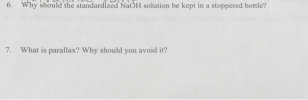 6. Why should the standardized NaÓH solution be kept in a stoppered bottle? 7. What is parallax? Why should you avoid it?
why was water added to a flask during the titration of hydrogen peroxide and thiosulfate
why was water added to a flask during the titration of hydrogen peroxide and thiosulfate
5. During the titration of an acid with a base, the sides of the Erlenmeyer flask...
 5. During the titration of an acid with a base, the sides of the Erlenmeyer flask are washed with distilled water. Do you think this rinsing will affect the outcome of the titration? Why or why not? 6. The approximate concentration of the NaOH solution you will prepare in Part A of this ex- periment is 0.12 M. Calculate the number of moles and the number of grams of oxalic acid (H,C,0, 2H,O) that will be required to neutralize 25...
7. (6 points) a. A flask containing gaseous N2 is irradiated with 25-nm light. Using the...
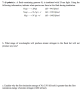 7. (6 points) a. A flask containing gaseous N2 is irradiated with 25-nm light. Using the following information, indicate what species can form in this flask during irradiation. ΔΗ-941 kJ/mol N2lg)2N(g) N2(g)N2(g) AH- 1501 kJ/mol Ng)N (g) eAH- 1402 k/mol b. What range of wavelengths will produce atomic nitrogen in the flask but will not produce any ions? c. Explain why the first ionization energy of N2 (1501 kJ/mol) is greater than the first ionization energy of atomic nitrogen (1402...
After 5 days of heparin therapy, T.M. was prescribed warfarin 5 mg PO daily 4. Why...
 After 5 days of heparin therapy, T.M. was prescribed warfarin 5 mg PO daily 4. Why was T.M changed to warfarin? What is the pharmacologic action of warfarin? 5. What laboratory test(s) would be monitored for patients taking warfarin? Explain your answer. 6. Explain the half-life and protein-binding for warfarin. What additional concerns do you have? How does this knowledge impact teaching for patient's taking warfarin? Explain. 7. What assessments should be performed before starting anticoagulant therapy? 8. Explain the...
sidering how cellular metabolism (catabolism and anabolism) works, explain why a bacteria. faster on this complex...
 sidering how cellular metabolism (catabolism and anabolism) works, explain why a bacteria. faster on this complex medium (glucose, beef extract, yeast extract, peptone, and water) vs. this fined/synthetic medium (sucrose, KzHPO., KH PO, (NH), HPO4, MgSO4, FeSO4, MnSO4, and water 6. Explain why Conside 4. Complement proteins, which are part of your immune system, can for large pores in the cytoplasmic 5. Escherichia coli is a facultative acrobe. Imagine a culture of E coli growing at 37°C in a complex...
Thumbs up for good answer. Why does the liquid in the round bottom flask turn light...
 Thumbs up for good answer. Why does the liquid in the round
bottom flask turn light pink?, please explain (This happened
during/after step 2). This is the procedure and the experiment is
called Synthesis of Artificial Flavorings by Fischer
Esterification.
Thank you!
SAMPLE PROCEDURES: 1. Isoanvl acetate (banana) + H2O OH HO 1. Mix 6 mL of isoamyl alcohol (0.809 g/mL, 88.148 g/mol) and 10 ml ofglacial acetic acid (1.05 g/ml 60.05 g/mol) in a 100 mL round bottom flask....
Thumbs up for good answer. Why does the liquid in the round
bottom flask turn light pink?, please explain (This happened
during/after step 2). This is the procedure and the experiment is
called Synthesis of Artificial Flavorings by Fischer
Esterification.
Thank you!
SAMPLE PROCEDURES: 1. Isoanvl acetate (banana) + H2O OH HO 1. Mix 6 mL of isoamyl alcohol (0.809 g/mL, 88.148 g/mol) and 10 ml ofglacial acetic acid (1.05 g/ml 60.05 g/mol) in a 100 mL round bottom flask....
3) Irrigation: (6) Explain why irrigation during surgery is important What fluid is generally used during...
 3) Irrigation: (6) Explain why irrigation during surgery is important What fluid is generally used during surgery? What are the signs of tissue dehydration? Why must the surgical technologist keep track of how much irrigation is used? Do all surgeries require irrigation? which surgeries may not require irrigation? What is continuous irrigation? Which surgeries require continuous irrigation?
 i just wanna double check whether i answered correct or not
please.
Why do we measure the volume of the flask in this experiment with water rather than using the volume listed on the side? Select all correct answers that apply. Must include all correct answers for full credit. The volume is not accurate on a flask to the number of significant figures required for this experiment The volumetric markings on the flask do not extend to it's full height...
i just wanna double check whether i answered correct or not
please.
Why do we measure the volume of the flask in this experiment with water rather than using the volume listed on the side? Select all correct answers that apply. Must include all correct answers for full credit. The volume is not accurate on a flask to the number of significant figures required for this experiment The volumetric markings on the flask do not extend to it's full height...
 PRELAB Pre-Lab Questions: (To be submitted at the beginning of lab) . Summary of the procedure in words. Should be sufficiently detailed that someone who has not read this lab could perform the lab properly. If you need more room please continue on the back of this page. 2. Fill in the following before meeting for lab: a) Since you are measuring pressure in mmHg. , which value of R should you use? b) Suppose you have a stoppered flask...
 6. Why should the standardized NaÓH solution be kept in a stoppered bottle? 7. What is parallax? Why should you avoid it?
 5. During the titration of an acid with a base, the sides of the Erlenmeyer flask are washed with distilled water. Do you think this rinsing will affect the outcome of the titration? Why or why not? 6. The approximate concentration of the NaOH solution you will prepare in Part A of this ex- periment is 0.12 M. Calculate the number of moles and the number of grams of oxalic acid (H,C,0, 2H,O) that will be required to neutralize 25...
 7. (6 points) a. A flask containing gaseous N2 is irradiated with 25-nm light. Using the following information, indicate what species can form in this flask during irradiation. ΔΗ-941 kJ/mol N2lg)2N(g) N2(g)N2(g) AH- 1501 kJ/mol Ng)N (g) eAH- 1402 k/mol b. What range of wavelengths will produce atomic nitrogen in the flask but will not produce any ions? c. Explain why the first ionization energy of N2 (1501 kJ/mol) is greater than the first ionization energy of atomic nitrogen (1402...
 After 5 days of heparin therapy, T.M. was prescribed warfarin 5 mg PO daily 4. Why was T.M changed to warfarin? What is the pharmacologic action of warfarin? 5. What laboratory test(s) would be monitored for patients taking warfarin? Explain your answer. 6. Explain the half-life and protein-binding for warfarin. What additional concerns do you have? How does this knowledge impact teaching for patient's taking warfarin? Explain. 7. What assessments should be performed before starting anticoagulant therapy? 8. Explain the...
 sidering how cellular metabolism (catabolism and anabolism) works, explain why a bacteria. faster on this complex medium (glucose, beef extract, yeast extract, peptone, and water) vs. this fined/synthetic medium (sucrose, KzHPO., KH PO, (NH), HPO4, MgSO4, FeSO4, MnSO4, and water 6. Explain why Conside 4. Complement proteins, which are part of your immune system, can for large pores in the cytoplasmic 5. Escherichia coli is a facultative acrobe. Imagine a culture of E coli growing at 37°C in a complex...
 Thumbs up for good answer. Why does the liquid in the round
bottom flask turn light pink?, please explain (This happened
during/after step 2). This is the procedure and the experiment is
called Synthesis of Artificial Flavorings by Fischer
Esterification.
Thank you!
SAMPLE PROCEDURES: 1. Isoanvl acetate (banana) + H2O OH HO 1. Mix 6 mL of isoamyl alcohol (0.809 g/mL, 88.148 g/mol) and 10 ml ofglacial acetic acid (1.05 g/ml 60.05 g/mol) in a 100 mL round bottom flask....
Thumbs up for good answer. Why does the liquid in the round
bottom flask turn light pink?, please explain (This happened
during/after step 2). This is the procedure and the experiment is
called Synthesis of Artificial Flavorings by Fischer
Esterification.
Thank you!
SAMPLE PROCEDURES: 1. Isoanvl acetate (banana) + H2O OH HO 1. Mix 6 mL of isoamyl alcohol (0.809 g/mL, 88.148 g/mol) and 10 ml ofglacial acetic acid (1.05 g/ml 60.05 g/mol) in a 100 mL round bottom flask....
 3) Irrigation: (6) Explain why irrigation during surgery is important What fluid is generally used during surgery? What are the signs of tissue dehydration? Why must the surgical technologist keep track of how much irrigation is used? Do all surgeries require irrigation? which surgeries may not require irrigation? What is continuous irrigation? Which surgeries require continuous irrigation?
Most questions answered within 3 hours.
-
Where is the error in this code sequence?
String s1 = "Hello";
String s2 = "ello";...
asked 10 months ago -
Financial data for Joel de Paris, Inc., for last year
follow:
Joel de Paris, Inc.
Balance...
asked 10 months ago -
Consider this reaction:
Al2(SO4)3 (aq)+ BaCl3
(aq) Al2Cl6 (aq)- +
3BaSO4(s) . What is the...
asked 10 months ago -
Suppose that Savneet is considering increasing her
recent random sample from 20 car rentals to 40...
asked 10 months ago -
Trucks arrive at an unloading terminal at an average rate of 120
per hour.
Trucks arrive...
asked 10 months ago -
Why are methanol and ethanol completely soluble in water while
octanol is not very little soluble....
asked 10 months ago -
A facilities manager at a university reads in a research report
that the mean amount of...
asked 10 months ago -
When the CuSO4 is rehydrated by adding water to the anhydrous
compound, is this an endothermic...
asked 10 months ago -
A ray of sunlight is passing from diamond into crown glass; the
angle of incidence is...
asked 10 months ago -
A block of mass 0.249 kg is placed on top of a light, vertical
spring of...
asked 10 months ago -
how do the kidneys compensate in the presences of acidosis
a) trigger hyperventilate
b) reserve acid...
asked 10 months ago -
Question 501 pts
The rental rate of capital to the firm increases. Which of the
following...
asked 10 months ago