
Homework Answers
An experiment is performed where light of different frequencies is shined on a copper plate. The...
An experiment is performed where light of different frequencies is shined on a copper plate. The work function for copper is 4.70 eV. (a) What is the lowest frequency (the "cutoff" frequency, in Hz) of light incident on copper, below which no photoelectrons will be emitted from its surface? Hz (b) What is the longest wavelength (the "cutoff" wavelength, in nm) of light incident on copper, above which no photoelectrons will be emitted from its surface? nm (c) Photons of...
A thin copper plate is compressed between two identical thick polymer plates. Heat is to be...
 A thin copper plate is compressed between two identical thick
polymer plates. Heat is to be conducted 2 pts through one edge of
the plate as shown.
a.) Determine the effective thermal conductivity in the
direction shown. Assume that no heat is transferred from the top or
bottom of the composite plate nor out the sides of length L and
that the ends are at a constant temperature.
b.) What fraction of heat will be conducted through the copper
plate?
A thin copper plate is compressed between two identical thick
polymer plates. Heat is to be conducted 2 pts through one edge of
the plate as shown.
a.) Determine the effective thermal conductivity in the
direction shown. Assume that no heat is transferred from the top or
bottom of the composite plate nor out the sides of length L and
that the ends are at a constant temperature.
b.) What fraction of heat will be conducted through the copper
plate?
80. What current is required to plate out 6.0 g of copper from ą copper(I1) nitrate...
 80. What current is required to plate out 6.0 g of copper from ą copper(I1) nitrate solution in 5.0 HOUPS a. 2.5 A b. 2.0 A c. 1.5 A d. 1.0 A e. 0.50 A
A square plate of copper with 55.0 cm sides has no net charge and is placed...
A square plate of copper with 55.0 cm sides has no net charge and is placed in a region of uniform electric field of 83.0 kN/C directed perpendicularly to the plate. (a) Find the charge density of each face of the plate. (b) Find the total charge on each face.
007 10.0 points A flat circular plate of copper has a radius of 0.115 m and...
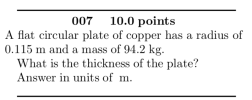 007 10.0 points A flat circular plate of copper has a radius of 0.115 m and a mass of 94.2 kg. What is the thickness of the plate? Answer in units of m.
Q. 4: (20 pts) A1-mm-thick copper plate (k = 386 W/m - °C) is sandwiched between...
 Q. 4: (20 pts) A1-mm-thick copper plate (k = 386 W/m - °C) is sandwiched between two 5-mm-thick epoxy boards (k = 0.26 W/m - °C) that are 15 cm 20 cm in size. If the thermal contact conductance on both sides of the copper plate is estimated to be 6000 W/m °C, determine the error involved in the total thermal resistance of the plate if the thermal contact conductances are ignored. Copper Epoxy ( Epoxy Dh Heat flow
estion 18 of 20 > Attempt 2 - The United States Mint uses electrolysis to copper plate zinc pennies by placing t...
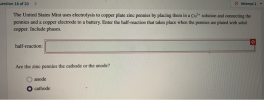 estion 18 of 20 > Attempt 2 - The United States Mint uses electrolysis to copper plate zinc pennies by placing them in a Cut solution and connecting the pennies and a copper electrode to a battery. Enter the half-reaction that takes place when the pennies are plated with solid copper. Include phases half-reaction: Are the zinc pennies the cathode or the anode? anode cathode
A thin, horizontal, 20-cm-diameter copper plate is charged to -4.4 nC . Assume that the electrons...
A thin, horizontal, 20-cm-diameter copper plate is charged to -4.4 nC . Assume that the electrons are uniformly distributed on the surface What is the strength of the electric field 0.1 mm above the center of the top surface of the plate? What is the strength of the electric field at the plate's center of mass? What is the strength of the electric field 0.1 mm below the center of the bottom surface of the plate?
Mаппүеnu Grades Contents »Assignment #5 » 25-70 Slab of copper thrust into a parallel-plate capacitor Course...
 Mаппүеnu Grades Contents »Assignment #5 » 25-70 Slab of copper thrust into a parallel-plate capacitor Course Contents » ... Evaluate Feedback Timer Notes Сopper A slab of copper of thickness b = 2.25 mm is thrust into a parallel-plate capacitor of plate area A = 2.40 cm2 and plate separation d = 5.50 mm, as shown in the figure; the slab is exactly halfway between the plates. What is the capacitance after the slab is introduced? Tries 0/10 Submit Answer...
-Part A Review A thin, horizontal, 11-cudiameter copper plate is charged to 2.6 mC. Assume that...
 -Part A Review A thin, horizontal, 11-cudiameter copper plate is charged to 2.6 mC. Assume that the electrons are uniformly distributed on the surface What is the strength of the electric field 0.1 mmabove the center of the top surface of the plate? Express your answer to two significant figures and include the appropriate units. Value Units Submit Request Answer ▼ Part B What is the direction of the electric field 0.1 uuabove the center of the top surface of...
 A thin copper plate is compressed between two identical thick
polymer plates. Heat is to be conducted 2 pts through one edge of
the plate as shown.
a.) Determine the effective thermal conductivity in the
direction shown. Assume that no heat is transferred from the top or
bottom of the composite plate nor out the sides of length L and
that the ends are at a constant temperature.
b.) What fraction of heat will be conducted through the copper
plate?
A thin copper plate is compressed between two identical thick
polymer plates. Heat is to be conducted 2 pts through one edge of
the plate as shown.
a.) Determine the effective thermal conductivity in the
direction shown. Assume that no heat is transferred from the top or
bottom of the composite plate nor out the sides of length L and
that the ends are at a constant temperature.
b.) What fraction of heat will be conducted through the copper
plate?
 80. What current is required to plate out 6.0 g of copper from ą copper(I1) nitrate solution in 5.0 HOUPS a. 2.5 A b. 2.0 A c. 1.5 A d. 1.0 A e. 0.50 A
 007 10.0 points A flat circular plate of copper has a radius of 0.115 m and a mass of 94.2 kg. What is the thickness of the plate? Answer in units of m.
 Q. 4: (20 pts) A1-mm-thick copper plate (k = 386 W/m - °C) is sandwiched between two 5-mm-thick epoxy boards (k = 0.26 W/m - °C) that are 15 cm 20 cm in size. If the thermal contact conductance on both sides of the copper plate is estimated to be 6000 W/m °C, determine the error involved in the total thermal resistance of the plate if the thermal contact conductances are ignored. Copper Epoxy ( Epoxy Dh Heat flow
 estion 18 of 20 > Attempt 2 - The United States Mint uses electrolysis to copper plate zinc pennies by placing them in a Cut solution and connecting the pennies and a copper electrode to a battery. Enter the half-reaction that takes place when the pennies are plated with solid copper. Include phases half-reaction: Are the zinc pennies the cathode or the anode? anode cathode
 Mаппүеnu Grades Contents »Assignment #5 » 25-70 Slab of copper thrust into a parallel-plate capacitor Course Contents » ... Evaluate Feedback Timer Notes Сopper A slab of copper of thickness b = 2.25 mm is thrust into a parallel-plate capacitor of plate area A = 2.40 cm2 and plate separation d = 5.50 mm, as shown in the figure; the slab is exactly halfway between the plates. What is the capacitance after the slab is introduced? Tries 0/10 Submit Answer...
 -Part A Review A thin, horizontal, 11-cudiameter copper plate is charged to 2.6 mC. Assume that the electrons are uniformly distributed on the surface What is the strength of the electric field 0.1 mmabove the center of the top surface of the plate? Express your answer to two significant figures and include the appropriate units. Value Units Submit Request Answer ▼ Part B What is the direction of the electric field 0.1 uuabove the center of the top surface of...
Most questions answered within 3 hours.
-
Where is the error in this code sequence?
String s1 = "Hello";
String s2 = "ello";...
asked 10 months ago -
Financial data for Joel de Paris, Inc., for last year
follow:
Joel de Paris, Inc.
Balance...
asked 10 months ago -
Consider this reaction:
Al2(SO4)3 (aq)+ BaCl3
(aq) Al2Cl6 (aq)- +
3BaSO4(s) . What is the...
asked 10 months ago -
Suppose that Savneet is considering increasing her
recent random sample from 20 car rentals to 40...
asked 10 months ago -
Trucks arrive at an unloading terminal at an average rate of 120
per hour.
Trucks arrive...
asked 10 months ago -
Why are methanol and ethanol completely soluble in water while
octanol is not very little soluble....
asked 10 months ago -
A facilities manager at a university reads in a research report
that the mean amount of...
asked 10 months ago -
When the CuSO4 is rehydrated by adding water to the anhydrous
compound, is this an endothermic...
asked 10 months ago -
A ray of sunlight is passing from diamond into crown glass; the
angle of incidence is...
asked 10 months ago -
A block of mass 0.249 kg is placed on top of a light, vertical
spring of...
asked 10 months ago -
how do the kidneys compensate in the presences of acidosis
a) trigger hyperventilate
b) reserve acid...
asked 10 months ago -
Question 501 pts
The rental rate of capital to the firm increases. Which of the
following...
asked 10 months ago