
Homework Answers
Add Answer to:
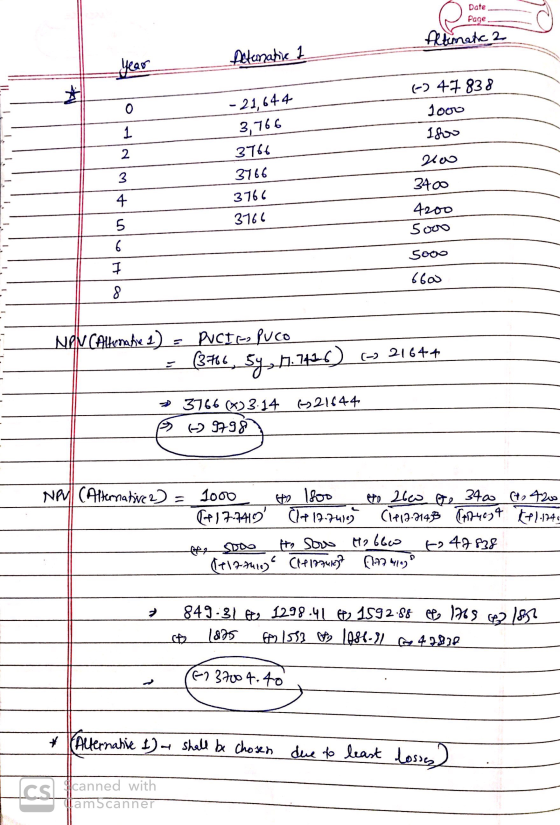
Consider the two investments shown below, only one of which can be chosen. They are one-shot...
Consider the two investments shown below, only one of which can be chosen. They are one-shot...
 Consider the two investments shown below, only one of which can
be chosen. They are one-shot investments. Given a MARR of 15%,
which (if either) should be chosen?
$6000 $4500 $5000 $4000 $3500 $3500 $3500 $3000 $2000 $1000 2 3 2 3 4 Alternative 1 Alternative 2 MARR = 15% $4000 $5000
Consider the two investments shown below, only one of which can
be chosen. They are one-shot investments. Given a MARR of 15%,
which (if either) should be chosen?
$6000 $4500 $5000 $4000 $3500 $3500 $3500 $3000 $2000 $1000 2 3 2 3 4 Alternative 1 Alternative 2 MARR = 15% $4000 $5000
Question 2 20 points Saved A railway company is building a railway line to connect two...
 Question 2 20 points Saved A railway company is building a railway line to connect two cities at an initial cost of SR 219,913,103. A major rehabilitation will be needed every 7 years and costs SR 16,321.608 . What will be the capitalized cost at an interest rate 8 compounded annually Moving to another question will save this response Question 3 of 5 Question 3 20 points You have available two equal-lived, mutually exclusive investment alternatives with cash flows as...
3. (15 points) For the alternatives show below, only one can be chosen. The first and...
 3. (15 points) For the alternatives show below, only one can be chosen. The first and annual costs are estimated. Both options are expected to have a 3-year useful life. If the MARR is 20% per year, determine which alternative should be selected based on rate of return. Calculate by hand or use spreadsheet. Robot X First Cost, $ Maintenance & Operations, $/year Salvage Value, $ Revenue, $/year Life -84,000 -31,000 40,000 96,000 Robot Y -146,000 -28,000 47,000 119,000 3...
3. (15 points) For the alternatives show below, only one can be chosen. The first and...
 3. (15 points) For the alternatives show below, only one can be chosen. The first and annual costs are estimated. Both options are expected to have a 3-year useful life. If the MARR is 20% per year, determine which alternative should be selected based on rate of return. Calculate by hand or use spreadsheet. First Cost, $ Maintenance & Operations, $/year Salvage Value, $ Revenue, $/year Robot X -84,000 -31,000 40,000 96,000 Robot Y -146,000 -28,000 47,000 119,000 Life
Consider the following EOY cash flows for two mutually exclusive alternatives (one must be chosen). The...
 Consider the following EOY cash flows for two mutually
exclusive alternatives (one must be chosen). The MARR is 5% per
year.
I need the PW of the Lead Acid and Lithium Ion.
Problem 6-28 (algorithmic) EQuestion Help Consider the following EOY cash flows for two mutually exclusive alternatives (one must be chosen) The MARR is 5% per year ead Acid $7,000 thium lon Capital investment Annual expenses Useful life Market value at end of useful life $13,000 $2.500 $2,750 12...
Consider the following EOY cash flows for two mutually
exclusive alternatives (one must be chosen). The MARR is 5% per
year.
I need the PW of the Lead Acid and Lithium Ion.
Problem 6-28 (algorithmic) EQuestion Help Consider the following EOY cash flows for two mutually exclusive alternatives (one must be chosen) The MARR is 5% per year ead Acid $7,000 thium lon Capital investment Annual expenses Useful life Market value at end of useful life $13,000 $2.500 $2,750 12...
Consider two $60,000 investments – call them Investment A and Investment B. Both investments will...
Consider two $60,000 investments – call them Investment A and Investment B. Both investments will earn $5,000 with a probability of 0.5 and $1,000 with a probability of 0.5. Investment A will use 100% equity financing (issuing stocks). Investment B will get $30,000 through issuing stocks and $30,000 through issuing bonds. Investment B must pay 4% interest on the bonds. a. Calculate the expected returns on equity (returns after interest payments divided by the amount of equity) for Investment A...
0.6. Consider the following EOY cash flows for two mutually exclusive alternatives (one must be chosen):...
 0.6. Consider the following EOY cash flows for two mutually exclusive alternatives (one must be chosen): Solar Panel A Solar Panel B Capital investment, $ 7,000 13.000 Annual operating expenses, SL 2.200 2.000 Market value, $ 1.000 2.30) Useful life, years 12 The MARR is 12% per year. Determine (using FW method) which alternative should be selected if the analysis period is 18 years, the repeatability assumption does not apply, and a solar panel can be leased for $6,000 per...
Consider the following EOY cash flows for two mutually exclusive alternatives (one must be chosen). The...
 Consider the following EOY cash flows for two mutually exclusive alternatives (one must be chosen). The MARR is 12% per year. Capital Investment Annual expenses Useful life Market value at end of useful life Lead Acid $8,000 $2,250 12 years $0 Lithium lon $13,000 $2,300 18 years $2,800 Click the icon to view the interest and annuity table for discrete compounding when /= 12% per year. (a) Determine which altemative should be selected based on the PW method. Assume repeatabllity...
Compare a two-year bond with two successive one-year bonds in a situation in which an investor...
Compare a two-year bond with two successive one-year bonds in a situation in which an investor buys a one-year bond today and then another one-year bond when the first matures. Suppose that the two-year bond has an interest rate of 8 percent each year. Now consider the pattern of interest rates on the one-year bonds listed below and explain whether an investor should by the two-year bond or the one-year bond today, assuming that the only thing that matters to...
1. Consider the following two reactions, only one of which will work as shown: a) What...
 1. Consider the following two reactions, only one of which will
work as shown:
a) What is the stereochemical relationship between starting
material A and B?
b) Draw the mechanism for the reaction to convert the starting
material into the product. You can use either starting material A
or B to show the mechanism.
c) Draw the two chair forms for starting material A and circle
the more stable chair form. Explain why the one you circled is more
stable....
1. Consider the following two reactions, only one of which will
work as shown:
a) What is the stereochemical relationship between starting
material A and B?
b) Draw the mechanism for the reaction to convert the starting
material into the product. You can use either starting material A
or B to show the mechanism.
c) Draw the two chair forms for starting material A and circle
the more stable chair form. Explain why the one you circled is more
stable....
 Consider the two investments shown below, only one of which can
be chosen. They are one-shot investments. Given a MARR of 15%,
which (if either) should be chosen?
$6000 $4500 $5000 $4000 $3500 $3500 $3500 $3000 $2000 $1000 2 3 2 3 4 Alternative 1 Alternative 2 MARR = 15% $4000 $5000
Consider the two investments shown below, only one of which can
be chosen. They are one-shot investments. Given a MARR of 15%,
which (if either) should be chosen?
$6000 $4500 $5000 $4000 $3500 $3500 $3500 $3000 $2000 $1000 2 3 2 3 4 Alternative 1 Alternative 2 MARR = 15% $4000 $5000
 Question 2 20 points Saved A railway company is building a railway line to connect two cities at an initial cost of SR 219,913,103. A major rehabilitation will be needed every 7 years and costs SR 16,321.608 . What will be the capitalized cost at an interest rate 8 compounded annually Moving to another question will save this response Question 3 of 5 Question 3 20 points You have available two equal-lived, mutually exclusive investment alternatives with cash flows as...
 3. (15 points) For the alternatives show below, only one can be chosen. The first and annual costs are estimated. Both options are expected to have a 3-year useful life. If the MARR is 20% per year, determine which alternative should be selected based on rate of return. Calculate by hand or use spreadsheet. Robot X First Cost, $ Maintenance & Operations, $/year Salvage Value, $ Revenue, $/year Life -84,000 -31,000 40,000 96,000 Robot Y -146,000 -28,000 47,000 119,000 3...
 3. (15 points) For the alternatives show below, only one can be chosen. The first and annual costs are estimated. Both options are expected to have a 3-year useful life. If the MARR is 20% per year, determine which alternative should be selected based on rate of return. Calculate by hand or use spreadsheet. First Cost, $ Maintenance & Operations, $/year Salvage Value, $ Revenue, $/year Robot X -84,000 -31,000 40,000 96,000 Robot Y -146,000 -28,000 47,000 119,000 Life
 Consider the following EOY cash flows for two mutually
exclusive alternatives (one must be chosen). The MARR is 5% per
year.
I need the PW of the Lead Acid and Lithium Ion.
Problem 6-28 (algorithmic) EQuestion Help Consider the following EOY cash flows for two mutually exclusive alternatives (one must be chosen) The MARR is 5% per year ead Acid $7,000 thium lon Capital investment Annual expenses Useful life Market value at end of useful life $13,000 $2.500 $2,750 12...
Consider the following EOY cash flows for two mutually
exclusive alternatives (one must be chosen). The MARR is 5% per
year.
I need the PW of the Lead Acid and Lithium Ion.
Problem 6-28 (algorithmic) EQuestion Help Consider the following EOY cash flows for two mutually exclusive alternatives (one must be chosen) The MARR is 5% per year ead Acid $7,000 thium lon Capital investment Annual expenses Useful life Market value at end of useful life $13,000 $2.500 $2,750 12...
 0.6. Consider the following EOY cash flows for two mutually exclusive alternatives (one must be chosen): Solar Panel A Solar Panel B Capital investment, $ 7,000 13.000 Annual operating expenses, SL 2.200 2.000 Market value, $ 1.000 2.30) Useful life, years 12 The MARR is 12% per year. Determine (using FW method) which alternative should be selected if the analysis period is 18 years, the repeatability assumption does not apply, and a solar panel can be leased for $6,000 per...
 Consider the following EOY cash flows for two mutually exclusive alternatives (one must be chosen). The MARR is 12% per year. Capital Investment Annual expenses Useful life Market value at end of useful life Lead Acid $8,000 $2,250 12 years $0 Lithium lon $13,000 $2,300 18 years $2,800 Click the icon to view the interest and annuity table for discrete compounding when /= 12% per year. (a) Determine which altemative should be selected based on the PW method. Assume repeatabllity...
 1. Consider the following two reactions, only one of which will
work as shown:
a) What is the stereochemical relationship between starting
material A and B?
b) Draw the mechanism for the reaction to convert the starting
material into the product. You can use either starting material A
or B to show the mechanism.
c) Draw the two chair forms for starting material A and circle
the more stable chair form. Explain why the one you circled is more
stable....
1. Consider the following two reactions, only one of which will
work as shown:
a) What is the stereochemical relationship between starting
material A and B?
b) Draw the mechanism for the reaction to convert the starting
material into the product. You can use either starting material A
or B to show the mechanism.
c) Draw the two chair forms for starting material A and circle
the more stable chair form. Explain why the one you circled is more
stable....
Most questions answered within 3 hours.
-
Where is the error in this code sequence?
String s1 = "Hello";
String s2 = "ello";...
asked 10 months ago -
Financial data for Joel de Paris, Inc., for last year
follow:
Joel de Paris, Inc.
Balance...
asked 10 months ago -
Consider this reaction:
Al2(SO4)3 (aq)+ BaCl3
(aq) Al2Cl6 (aq)- +
3BaSO4(s) . What is the...
asked 10 months ago -
Suppose that Savneet is considering increasing her
recent random sample from 20 car rentals to 40...
asked 10 months ago -
Trucks arrive at an unloading terminal at an average rate of 120
per hour.
Trucks arrive...
asked 10 months ago -
Why are methanol and ethanol completely soluble in water while
octanol is not very little soluble....
asked 10 months ago -
A facilities manager at a university reads in a research report
that the mean amount of...
asked 10 months ago -
When the CuSO4 is rehydrated by adding water to the anhydrous
compound, is this an endothermic...
asked 10 months ago -
A ray of sunlight is passing from diamond into crown glass; the
angle of incidence is...
asked 10 months ago -
A block of mass 0.249 kg is placed on top of a light, vertical
spring of...
asked 10 months ago -
how do the kidneys compensate in the presences of acidosis
a) trigger hyperventilate
b) reserve acid...
asked 10 months ago -
Question 501 pts
The rental rate of capital to the firm increases. Which of the
following...
asked 10 months ago