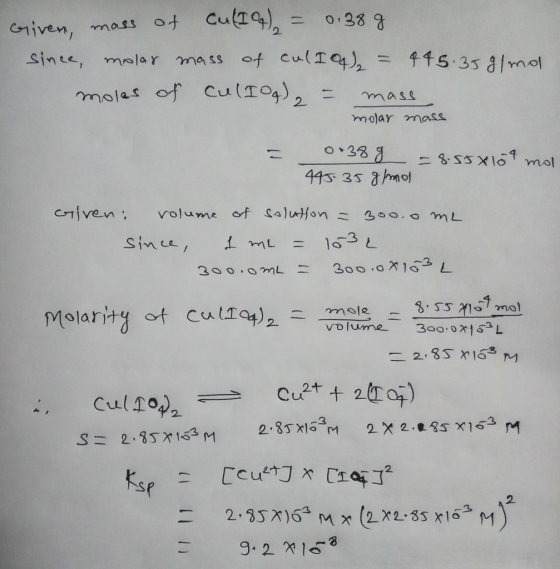
A 300.0-mL saturated solution of copper(II) periodate, Cu(IO4)2, contains 0.38 grams of dissolved salt. Determine the...
A 300.0-mL saturated solution of copper(II) periodate, Cu(IO4)2, contains 0.38 grams of dissolved salt. Determine the Ksp.
a. 1.6 x 10⁻⁵
b. 3.2 x 10⁻⁵
c. 2.8 x 10⁻³
d. 9.2 x 10⁻⁸
e. 2.5 x 10⁻⁹
Homework Answers
Add Answer to:
A 300.0-mL saturated solution of copper(II) periodate, Cu(IO4)2,
contains 0.38 grams of dissolved salt. Determine the...
The mass of copper(II) hydroxide that is dissolved in 175 mL of a saturated solution is...
The mass of copper(II) hydroxide that is dissolved in 175 mL of a saturated solution is _____grams How many grams?
A 500.0 mL solution saturated with lead(II) iodide contains 0.270 g of this salt at a...
A 500.0 mL solution saturated with lead(II) iodide contains 0.270 g of this salt at a particular temperature. Calculate the solubility-product constant for this salt at this temperature.
0.05285 grams of nickel(II) nitrate is dissolved in enough water to produce 125.0 mL of solution....
 0.05285 grams of nickel(II) nitrate is dissolved in enough water to produce 125.0 mL of solution. How many mL of a 0.010 M sodium carbonate solution is required to begin the precipitation of nickel(II) carbonate? x mL The Ksp of nickel(II) carbonate is 1.40 x 10⁻⁷.
28. Describe the pH of the following salts? NaF, NH,CI, KI, NH.F A) acidic, basic, neutral,...
 28. Describe the pH of the following salts? NaF, NH,CI, KI, NH.F A) acidic, basic, neutral, cannot tell without further information B) neutral, acidic, neutral, cannot tell without further information C) neutral, acidic, neutral, neutral D) basic, acidic, neutral, cannot tell without further information E) basic, acidic, neutral, neutral 29. Which of the following salts is(are) considered basic when dissolved in water? I NaNO IL K PO III NH C A) l only B) II only C) land il D)...
The mass of nickel(II) cyanide that is dissolved in 225 mL of a saturated solution is...
 The mass of nickel(II) cyanide that is dissolved in 225 mL of a saturated solution is grams Chromates BaCr04 2.0 * 10-10 CaCro4 7.1 x 10⁴ PbCro4 1.8 x 10⁻¹⁴ Ag2Cr04 9.0 x 10⁻¹² Cyanides Ni(CN)2 3.0 x 10⁻²³ AgCN 1.2 x 10⁻¹⁶ Zn(CN)2 8.0 x 10⁻¹² Fluorides BaF2 1.7 x 10⁻⁶ CaF2 3.9 ~ 10-11
1)A solution contains 2.0×10⁻⁹ M Cu+ and 1.9×10⁻³ M Pb2+. If a source of I- is...
1)A solution contains 2.0×10⁻⁹ M Cu+ and 1.9×10⁻³ M Pb2+. If a source of I- is added gradually to this solution, will PbI2 (Ksp=1.4×10⁻⁸) or CuI (Ksp=5.3×10⁻¹²) precipitate first? 2)Calculate the solubility of AgCl at 25 °C, if its Ksp = 1.6×10⁻¹⁰ at 25 °C. 3)Calculate the Ksp for the dissolution of copper(I) bromide in water at 25 °C if it has a solubility of 2.0×10⁻⁴ M at 25 °C. 4)A solution is prepared by adding 750.0 mL of 4.00×10⁻³ M...
A 3.7514 g sample of copper(II) nitrate is dissolved in water and 2.000 g of copper(II)...
A 3.7514 g sample of copper(II) nitrate is dissolved in water and 2.000 g of copper(II) arsenate (Ksp = 7.6 x 10-36) is added so that the total solution volume is exactly 1 L. What is the concentration of the arsenate ion in the solution (assuming the arsenate ion does not react with water)? (b) If the arsenate ion does react with water, write the overall principal chemical equation and determine K. (Arsenic acid is triprotic: Ka1 5.8 x 10⁻³...
Determine the mass in grams of lead (II) iodide that will dissolve in 500.0 mL of...
Determine the mass in grams of lead (II) iodide that will dissolve in 500.0 mL of a solution containing 1.82 grams of lead (II) nitrate. Ksp of lead (II) iodide is 1.4 x 10⁻⁸. Hint: Think about common ion effect.
Which copper solution is saturated? 7.0x10⁻⁵M CuBr (Ksp=5.3x10⁻⁹) 1.5x10⁻⁵M CuCO3 (Ksp=2.3x10⁻¹⁰) 2.0x10⁻⁷M Cu(OH)2 (Ksp=4.8x10⁻²⁰) 7.0x10⁻¹⁹M CuS...
Which copper solution is saturated? 7.0x10⁻⁵M CuBr (Ksp=5.3x10⁻⁹) 1.5x10⁻⁵M CuCO3 (Ksp=2.3x10⁻¹⁰) 2.0x10⁻⁷M Cu(OH)2 (Ksp=4.8x10⁻²⁰) 7.0x10⁻¹⁹M CuS (Ksp=6x10-37) Please explain how i can find out
Prelab Activity: Electrochemical Cells To determine the solubility product of copper(II) carbonate, CuCO3 , a concentration...
 Prelab Activity:
Electrochemical Cells
To determine the solubility product of copper(II) carbonate,
CuCO3 , a concentration cell as described on pages 71-72
of the lab handout is constructed. The temperature of the Galvanic
cell is measured to be 22.5°C, and the cell potential 282 mV (0.282
V). Using this data and Equation 8 in the lab manual, calculate the
Ksp for CuCO3 and report your answer with
three significant digits.
For the Galvanic cell you will construct in PART B,...
Prelab Activity:
Electrochemical Cells
To determine the solubility product of copper(II) carbonate,
CuCO3 , a concentration cell as described on pages 71-72
of the lab handout is constructed. The temperature of the Galvanic
cell is measured to be 22.5°C, and the cell potential 282 mV (0.282
V). Using this data and Equation 8 in the lab manual, calculate the
Ksp for CuCO3 and report your answer with
three significant digits.
For the Galvanic cell you will construct in PART B,...
 0.05285 grams of nickel(II) nitrate is dissolved in enough water to produce 125.0 mL of solution. How many mL of a 0.010 M sodium carbonate solution is required to begin the precipitation of nickel(II) carbonate? x mL The Ksp of nickel(II) carbonate is 1.40 x 10⁻⁷.
 28. Describe the pH of the following salts? NaF, NH,CI, KI, NH.F A) acidic, basic, neutral, cannot tell without further information B) neutral, acidic, neutral, cannot tell without further information C) neutral, acidic, neutral, neutral D) basic, acidic, neutral, cannot tell without further information E) basic, acidic, neutral, neutral 29. Which of the following salts is(are) considered basic when dissolved in water? I NaNO IL K PO III NH C A) l only B) II only C) land il D)...
 The mass of nickel(II) cyanide that is dissolved in 225 mL of a saturated solution is grams Chromates BaCr04 2.0 * 10-10 CaCro4 7.1 x 10⁴ PbCro4 1.8 x 10⁻¹⁴ Ag2Cr04 9.0 x 10⁻¹² Cyanides Ni(CN)2 3.0 x 10⁻²³ AgCN 1.2 x 10⁻¹⁶ Zn(CN)2 8.0 x 10⁻¹² Fluorides BaF2 1.7 x 10⁻⁶ CaF2 3.9 ~ 10-11
 Prelab Activity:
Electrochemical Cells
To determine the solubility product of copper(II) carbonate,
CuCO3 , a concentration cell as described on pages 71-72
of the lab handout is constructed. The temperature of the Galvanic
cell is measured to be 22.5°C, and the cell potential 282 mV (0.282
V). Using this data and Equation 8 in the lab manual, calculate the
Ksp for CuCO3 and report your answer with
three significant digits.
For the Galvanic cell you will construct in PART B,...
Prelab Activity:
Electrochemical Cells
To determine the solubility product of copper(II) carbonate,
CuCO3 , a concentration cell as described on pages 71-72
of the lab handout is constructed. The temperature of the Galvanic
cell is measured to be 22.5°C, and the cell potential 282 mV (0.282
V). Using this data and Equation 8 in the lab manual, calculate the
Ksp for CuCO3 and report your answer with
three significant digits.
For the Galvanic cell you will construct in PART B,...
Most questions answered within 3 hours.
-
Where is the error in this code sequence?
String s1 = "Hello";
String s2 = "ello";...
asked 10 months ago -
Financial data for Joel de Paris, Inc., for last year
follow:
Joel de Paris, Inc.
Balance...
asked 10 months ago -
Consider this reaction:
Al2(SO4)3 (aq)+ BaCl3
(aq) Al2Cl6 (aq)- +
3BaSO4(s) . What is the...
asked 10 months ago -
Suppose that Savneet is considering increasing her
recent random sample from 20 car rentals to 40...
asked 10 months ago -
Trucks arrive at an unloading terminal at an average rate of 120
per hour.
Trucks arrive...
asked 10 months ago -
Why are methanol and ethanol completely soluble in water while
octanol is not very little soluble....
asked 10 months ago -
A facilities manager at a university reads in a research report
that the mean amount of...
asked 10 months ago -
When the CuSO4 is rehydrated by adding water to the anhydrous
compound, is this an endothermic...
asked 10 months ago -
A ray of sunlight is passing from diamond into crown glass; the
angle of incidence is...
asked 10 months ago -
A block of mass 0.249 kg is placed on top of a light, vertical
spring of...
asked 10 months ago -
how do the kidneys compensate in the presences of acidosis
a) trigger hyperventilate
b) reserve acid...
asked 10 months ago -
Question 501 pts
The rental rate of capital to the firm increases. Which of the
following...
asked 10 months ago