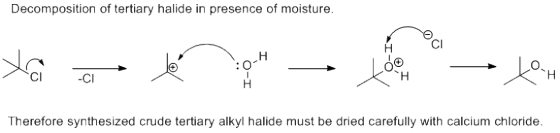
why must synthesized crude tertiary alkyl halide be dried carefully with calcium chloride before the distillation...
why must synthesized crude tertiary alkyl halide be dried carefully with calcium chloride before the distillation for purifying purpose? (try to answer what kind of reaction could be happening with water and alkyl halide?)
Homework Answers
Add Answer to:
why must synthesized crude tertiary alkyl halide be dried
carefully with calcium chloride before the distillation...
MSISTRY 203-204 Grganic Chemistry Lab Manual 3 4 EXPERIMENT #9 The Preparation of t Butyl Chloride A tertiary carbonium ion is more rapidly formed than a secondary or primary carbonium ion. Onc...
 MSISTRY 203-204 Grganic Chemistry Lab Manual 3 4 EXPERIMENT #9 The Preparation of t Butyl Chloride A tertiary carbonium ion is more rapidly formed than a secondary or primary carbonium ion. Once formed, a tertiary carbonium ion is stabilized by charge dispersal to a greater extent than a secondary or primary carbonium ion. It therefore has a longer life expectancy. Primary carbonium ions, protons, may exist in solution only in solvated form have any free existence, they dehydration reaction and...
Experiment 4: Synthesis of a tertiary alkyl halide Page 4 of 6 Why do we wash...
 Experiment 4: Synthesis of a tertiary alkyl halide Page 4 of 6 Why do we wash the organic layer with saturated NaHCO3(aq)? Include a balanced chemical equation illustrating the chemical reaction that is occurring as part of your answer. (1 Mark) Scenario: While working in an organic lab, you have been asked to prepare 5.0 g of 2,5-dichloro-2,5- dimethylhexane from 2,5-dimethyl-2,5-hexanediol. Draw the complete mechanism for the reaction. [2 Marks] When setting up the reaction above, is your starting material...
Questions on Procedures: 1. Write the reaction of the synthesis of tert-amyl chloride. 2. Based on...
 Questions on Procedures: 1. Write the reaction of the synthesis of tert-amyl chloride. 2. Based on the densities of tert-amyl chloride and water, which is the tert-amyl chloride layer? 3. Why is it necessary to wash the crude tert-amyl chloride with 5% NaHCO,? 4. What is the purpose of treating the organic layer with anhydrous calcium chloride pellets? Simple Distill Simple Distillation Results: I collected 12.02 mL of tert-amyl chloride 5. Calculate the percent yield of tert-amyl chloride. Conclusion: 6....
please show the reaction mechanisms drying. Dry the crude t-pentyl chloride over 1.0 g of anhydrous...
 please show the reaction mechanisms
drying. Dry the crude t-pentyl chloride over 1.0 g of anhydrous calcium chloride until it is clear (se- Technique 12, Section 12.9). Swirl the alkyl halide with the drying agent to aid the drying. Part C: Distillation and Analysis of t-pentyl chloride product Transfer the clear liquid to a dry 25-mL round-bottom flask using a Pasteur pipet. Add a boili stone and distill the crude t-pentyl chloride in a dry apparatus (see Technique 14, Section...
please show the reaction mechanisms
drying. Dry the crude t-pentyl chloride over 1.0 g of anhydrous calcium chloride until it is clear (se- Technique 12, Section 12.9). Swirl the alkyl halide with the drying agent to aid the drying. Part C: Distillation and Analysis of t-pentyl chloride product Transfer the clear liquid to a dry 25-mL round-bottom flask using a Pasteur pipet. Add a boili stone and distill the crude t-pentyl chloride in a dry apparatus (see Technique 14, Section...
please show the reaction mechanisms drying. Dry the crude t-pentyl chloride over 1.0 g of anhydrous...
 please show the reaction mechanisms
drying. Dry the crude t-pentyl chloride over 1.0 g of anhydrous calcium chloride until it is clear (se- Technique 12, Section 12.9). Swirl the alkyl halide with the drying agent to aid the drying. Part C: Distillation and Analysis of t-pentyl chloride product Transfer the clear liquid to a dry 25-mL round-bottom flask using a Pasteur pipet. Add a boili stone and distill the crude t-pentyl chloride in a dry apparatus (see Technique 14, Section...
please show the reaction mechanisms
drying. Dry the crude t-pentyl chloride over 1.0 g of anhydrous calcium chloride until it is clear (se- Technique 12, Section 12.9). Swirl the alkyl halide with the drying agent to aid the drying. Part C: Distillation and Analysis of t-pentyl chloride product Transfer the clear liquid to a dry 25-mL round-bottom flask using a Pasteur pipet. Add a boili stone and distill the crude t-pentyl chloride in a dry apparatus (see Technique 14, Section...
please show the reaction mechanisms sride over 1.0 g of anhydrous calcium chloride until it is...
 please show the reaction mechanisms
sride over 1.0 g of anhydrous calcium chloride until it is clear (se the alkyl halide with the drying agent to aid the drying. drying. Dry the crude t-pentyl chloride Technique 12, Section 12.9). Swirl the all c. Distillation and Analysis of l-pentyl chloride Transfer the clear liquid to a dry 25, stone and distill the crude t-pentyl chlori 14.1). Collect the pure t-pentyl chloride in erial that boils between 78°C and 84°C. Record the...
please show the reaction mechanisms
sride over 1.0 g of anhydrous calcium chloride until it is clear (se the alkyl halide with the drying agent to aid the drying. drying. Dry the crude t-pentyl chloride Technique 12, Section 12.9). Swirl the all c. Distillation and Analysis of l-pentyl chloride Transfer the clear liquid to a dry 25, stone and distill the crude t-pentyl chlori 14.1). Collect the pure t-pentyl chloride in erial that boils between 78°C and 84°C. Record the...
question in first picture information located below mass of empty vial (979.2mg) then mass with crude...
 question in first picture
information located below
mass of empty vial (979.2mg) then mass with crude
(1769.1mg)
mass of empty vial (1769.1mg) then yield with pure
ester product(18535.6mg)
Actual ester yield (calculations in your lab notebook must be present, re-type it in the report). Theoretical yield (calculations in your lab notebook must be present, re-type it in the report). Percent yield (calculations in your lab notebook must be present, re-type it in the report). in loto in table format) drawstructure...
question in first picture
information located below
mass of empty vial (979.2mg) then mass with crude
(1769.1mg)
mass of empty vial (1769.1mg) then yield with pure
ester product(18535.6mg)
Actual ester yield (calculations in your lab notebook must be present, re-type it in the report). Theoretical yield (calculations in your lab notebook must be present, re-type it in the report). Percent yield (calculations in your lab notebook must be present, re-type it in the report). in loto in table format) drawstructure...
Organic chemistry post-lab question: "Why is important to add the alkyl halide dropwise in your reaction?...
 Organic chemistry post-lab question: "Why is important
to add the alkyl halide dropwise in your reaction? (Hint: your
reaction is not heated, but you still need a water-cooled
condenser!)" Please answer in detail!
Here is a copy of the experiment, thank you!
The Grignard reaction is an important synthetic process by which a carbon-carbon bond is formed. Magnesium metal is first reacted with an organic halide. The resultant organo-magnesium halide (Grignard reagent) is then combined with a carbonyl compound, ultimately...
Organic chemistry post-lab question: "Why is important
to add the alkyl halide dropwise in your reaction? (Hint: your
reaction is not heated, but you still need a water-cooled
condenser!)" Please answer in detail!
Here is a copy of the experiment, thank you!
The Grignard reaction is an important synthetic process by which a carbon-carbon bond is formed. Magnesium metal is first reacted with an organic halide. The resultant organo-magnesium halide (Grignard reagent) is then combined with a carbonyl compound, ultimately...
help please Pre-laboratory assignment: Due Friday, March 27, 2020 1. Draw the reaction scheme for this...
 help please
Pre-laboratory assignment: Due Friday, March 27, 2020 1. Draw the reaction scheme for this reaction. 2. Complete the following table of reagents for the dehydration of 2-methylcyclohexanol: | Molecular weight (g/mol) Density (g/mL) Mass Moles Volume (ml) Reagent 2-methylcyclohexanol CHO Dehydration products (CH) Role in the reaction Limiting reagent Product 3. List the safety precautions that must be observed when using concentrated sulfuric and phosphoric acids. 4. What are the boiling points of 2-methylcyclohexanol and methylcyclohexene? 5. Why...
help please
Pre-laboratory assignment: Due Friday, March 27, 2020 1. Draw the reaction scheme for this reaction. 2. Complete the following table of reagents for the dehydration of 2-methylcyclohexanol: | Molecular weight (g/mol) Density (g/mL) Mass Moles Volume (ml) Reagent 2-methylcyclohexanol CHO Dehydration products (CH) Role in the reaction Limiting reagent Product 3. List the safety precautions that must be observed when using concentrated sulfuric and phosphoric acids. 4. What are the boiling points of 2-methylcyclohexanol and methylcyclohexene? 5. Why...
2416F19 Exp. 7 Report Discussion 1. Explicitly show your calculation for the theoretical yield from the...
 2416F19 Exp. 7 Report Discussion 1. Explicitly show your calculation for the theoretical yield from the reaction you performed, including the moles of both reactants. HCI (CH)sCCl H20 (CH)COH+ Yield Actua theore hica 1007. This experiment In this experiment you will prepare t-butyl chloride from t-butyl alcohol using concentrated hydrochloric acid. You will perform qualitative tests on the product to characterize the t-butyl chloride. The first qualitative test will be to hydrolyze the t-butyl chloride in water, and observe the...
 MSISTRY 203-204 Grganic Chemistry Lab Manual 3 4 EXPERIMENT #9 The Preparation of t Butyl Chloride A tertiary carbonium ion is more rapidly formed than a secondary or primary carbonium ion. Once formed, a tertiary carbonium ion is stabilized by charge dispersal to a greater extent than a secondary or primary carbonium ion. It therefore has a longer life expectancy. Primary carbonium ions, protons, may exist in solution only in solvated form have any free existence, they dehydration reaction and...
 Experiment 4: Synthesis of a tertiary alkyl halide Page 4 of 6 Why do we wash the organic layer with saturated NaHCO3(aq)? Include a balanced chemical equation illustrating the chemical reaction that is occurring as part of your answer. (1 Mark) Scenario: While working in an organic lab, you have been asked to prepare 5.0 g of 2,5-dichloro-2,5- dimethylhexane from 2,5-dimethyl-2,5-hexanediol. Draw the complete mechanism for the reaction. [2 Marks] When setting up the reaction above, is your starting material...
 Questions on Procedures: 1. Write the reaction of the synthesis of tert-amyl chloride. 2. Based on the densities of tert-amyl chloride and water, which is the tert-amyl chloride layer? 3. Why is it necessary to wash the crude tert-amyl chloride with 5% NaHCO,? 4. What is the purpose of treating the organic layer with anhydrous calcium chloride pellets? Simple Distill Simple Distillation Results: I collected 12.02 mL of tert-amyl chloride 5. Calculate the percent yield of tert-amyl chloride. Conclusion: 6....
 please show the reaction mechanisms
drying. Dry the crude t-pentyl chloride over 1.0 g of anhydrous calcium chloride until it is clear (se- Technique 12, Section 12.9). Swirl the alkyl halide with the drying agent to aid the drying. Part C: Distillation and Analysis of t-pentyl chloride product Transfer the clear liquid to a dry 25-mL round-bottom flask using a Pasteur pipet. Add a boili stone and distill the crude t-pentyl chloride in a dry apparatus (see Technique 14, Section...
please show the reaction mechanisms
drying. Dry the crude t-pentyl chloride over 1.0 g of anhydrous calcium chloride until it is clear (se- Technique 12, Section 12.9). Swirl the alkyl halide with the drying agent to aid the drying. Part C: Distillation and Analysis of t-pentyl chloride product Transfer the clear liquid to a dry 25-mL round-bottom flask using a Pasteur pipet. Add a boili stone and distill the crude t-pentyl chloride in a dry apparatus (see Technique 14, Section...
 please show the reaction mechanisms
drying. Dry the crude t-pentyl chloride over 1.0 g of anhydrous calcium chloride until it is clear (se- Technique 12, Section 12.9). Swirl the alkyl halide with the drying agent to aid the drying. Part C: Distillation and Analysis of t-pentyl chloride product Transfer the clear liquid to a dry 25-mL round-bottom flask using a Pasteur pipet. Add a boili stone and distill the crude t-pentyl chloride in a dry apparatus (see Technique 14, Section...
please show the reaction mechanisms
drying. Dry the crude t-pentyl chloride over 1.0 g of anhydrous calcium chloride until it is clear (se- Technique 12, Section 12.9). Swirl the alkyl halide with the drying agent to aid the drying. Part C: Distillation and Analysis of t-pentyl chloride product Transfer the clear liquid to a dry 25-mL round-bottom flask using a Pasteur pipet. Add a boili stone and distill the crude t-pentyl chloride in a dry apparatus (see Technique 14, Section...
 please show the reaction mechanisms
sride over 1.0 g of anhydrous calcium chloride until it is clear (se the alkyl halide with the drying agent to aid the drying. drying. Dry the crude t-pentyl chloride Technique 12, Section 12.9). Swirl the all c. Distillation and Analysis of l-pentyl chloride Transfer the clear liquid to a dry 25, stone and distill the crude t-pentyl chlori 14.1). Collect the pure t-pentyl chloride in erial that boils between 78°C and 84°C. Record the...
please show the reaction mechanisms
sride over 1.0 g of anhydrous calcium chloride until it is clear (se the alkyl halide with the drying agent to aid the drying. drying. Dry the crude t-pentyl chloride Technique 12, Section 12.9). Swirl the all c. Distillation and Analysis of l-pentyl chloride Transfer the clear liquid to a dry 25, stone and distill the crude t-pentyl chlori 14.1). Collect the pure t-pentyl chloride in erial that boils between 78°C and 84°C. Record the...
 question in first picture
information located below
mass of empty vial (979.2mg) then mass with crude
(1769.1mg)
mass of empty vial (1769.1mg) then yield with pure
ester product(18535.6mg)
Actual ester yield (calculations in your lab notebook must be present, re-type it in the report). Theoretical yield (calculations in your lab notebook must be present, re-type it in the report). Percent yield (calculations in your lab notebook must be present, re-type it in the report). in loto in table format) drawstructure...
question in first picture
information located below
mass of empty vial (979.2mg) then mass with crude
(1769.1mg)
mass of empty vial (1769.1mg) then yield with pure
ester product(18535.6mg)
Actual ester yield (calculations in your lab notebook must be present, re-type it in the report). Theoretical yield (calculations in your lab notebook must be present, re-type it in the report). Percent yield (calculations in your lab notebook must be present, re-type it in the report). in loto in table format) drawstructure...
 Organic chemistry post-lab question: "Why is important
to add the alkyl halide dropwise in your reaction? (Hint: your
reaction is not heated, but you still need a water-cooled
condenser!)" Please answer in detail!
Here is a copy of the experiment, thank you!
The Grignard reaction is an important synthetic process by which a carbon-carbon bond is formed. Magnesium metal is first reacted with an organic halide. The resultant organo-magnesium halide (Grignard reagent) is then combined with a carbonyl compound, ultimately...
Organic chemistry post-lab question: "Why is important
to add the alkyl halide dropwise in your reaction? (Hint: your
reaction is not heated, but you still need a water-cooled
condenser!)" Please answer in detail!
Here is a copy of the experiment, thank you!
The Grignard reaction is an important synthetic process by which a carbon-carbon bond is formed. Magnesium metal is first reacted with an organic halide. The resultant organo-magnesium halide (Grignard reagent) is then combined with a carbonyl compound, ultimately...
 help please
Pre-laboratory assignment: Due Friday, March 27, 2020 1. Draw the reaction scheme for this reaction. 2. Complete the following table of reagents for the dehydration of 2-methylcyclohexanol: | Molecular weight (g/mol) Density (g/mL) Mass Moles Volume (ml) Reagent 2-methylcyclohexanol CHO Dehydration products (CH) Role in the reaction Limiting reagent Product 3. List the safety precautions that must be observed when using concentrated sulfuric and phosphoric acids. 4. What are the boiling points of 2-methylcyclohexanol and methylcyclohexene? 5. Why...
help please
Pre-laboratory assignment: Due Friday, March 27, 2020 1. Draw the reaction scheme for this reaction. 2. Complete the following table of reagents for the dehydration of 2-methylcyclohexanol: | Molecular weight (g/mol) Density (g/mL) Mass Moles Volume (ml) Reagent 2-methylcyclohexanol CHO Dehydration products (CH) Role in the reaction Limiting reagent Product 3. List the safety precautions that must be observed when using concentrated sulfuric and phosphoric acids. 4. What are the boiling points of 2-methylcyclohexanol and methylcyclohexene? 5. Why...
 2416F19 Exp. 7 Report Discussion 1. Explicitly show your calculation for the theoretical yield from the reaction you performed, including the moles of both reactants. HCI (CH)sCCl H20 (CH)COH+ Yield Actua theore hica 1007. This experiment In this experiment you will prepare t-butyl chloride from t-butyl alcohol using concentrated hydrochloric acid. You will perform qualitative tests on the product to characterize the t-butyl chloride. The first qualitative test will be to hydrolyze the t-butyl chloride in water, and observe the...
Most questions answered within 3 hours.
-
Where is the error in this code sequence?
String s1 = "Hello";
String s2 = "ello";...
asked 10 months ago -
Financial data for Joel de Paris, Inc., for last year
follow:
Joel de Paris, Inc.
Balance...
asked 10 months ago -
Consider this reaction:
Al2(SO4)3 (aq)+ BaCl3
(aq) Al2Cl6 (aq)- +
3BaSO4(s) . What is the...
asked 10 months ago -
Suppose that Savneet is considering increasing her
recent random sample from 20 car rentals to 40...
asked 10 months ago -
Trucks arrive at an unloading terminal at an average rate of 120
per hour.
Trucks arrive...
asked 10 months ago -
Why are methanol and ethanol completely soluble in water while
octanol is not very little soluble....
asked 10 months ago -
A facilities manager at a university reads in a research report
that the mean amount of...
asked 10 months ago -
When the CuSO4 is rehydrated by adding water to the anhydrous
compound, is this an endothermic...
asked 10 months ago -
A ray of sunlight is passing from diamond into crown glass; the
angle of incidence is...
asked 10 months ago -
A block of mass 0.249 kg is placed on top of a light, vertical
spring of...
asked 10 months ago -
how do the kidneys compensate in the presences of acidosis
a) trigger hyperventilate
b) reserve acid...
asked 10 months ago -
Question 501 pts
The rental rate of capital to the firm increases. Which of the
following...
asked 10 months ago