Calculate your pre-tax rate of return (profit divided by investment) in each of these scenarios (SHOW YOUR WORK):
- buy 1,000 shares of ABC common stock at $50 and sell at $60 one year later.
- buy 1,000 shares of ABC common stock at $50, borrowing 50% of the amount necessary to buy it, at a 2% interest rate, sell the stock at $60 one year later, paying back the loan at the same time.
- buy listed options at $400 for 1,000 shares of ABC, giving you
the right but not the obligation to buy the shares at $50 one year
later, you exercise the option one year later when the stock price
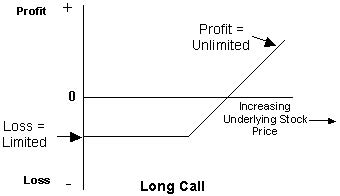
is $60. Also, use the Long Call chart (from the CBOE
material in this PDF) to explain what is going on
Homework Answers
a)
- Selling Price per share = $60
- Cost price per share = $50
- Profit = $10
- Profit% = Profit/Cost price x 100 = 10/50 x 100 = 20%
b)
- Total share bought = 1000
- Cost price per share = $50
- Total amount spent on purchase = 50 x 1000 = 50000
- Loan amount = 50% x 50000 = 25000
- Interest = 2% x 25000 = 500
- Selling Price per share = $60
- Total Amount available at sale = 60 x 1000 = 60000
- Amount paid off as loan repayment & interest = 25000+500 = 25500
- Amount remaining = 60000-25500 = 34500
- Original amount invested = 50% x 50000 = 25000
- So profit = 34500-25000 = 9500
- Profit % = 9500/25000 x 100 = 38%
c)
Lets first discuss what's happening in the below chart:
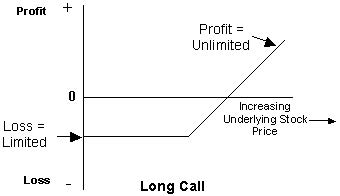
Till the time the selling price per share is below $50 the option holder doesn't exercise it and therefore the $400 spent on purchasing the option is the only loss he has to bear. This is depicted in the above chart for all the time the graph is below the x axis and parallel to it
The graph intersects the x axis when the (SP-CP) x number of shares = 400. This happens when (SP-50) x 1000 = 400, Sp = 50.40
For all other Selling price higher than 50.40, the option holder earns a profit. So at SP = 60, the profit = 10 x 1000 - 400 = 9600
As the profit has no upper limit, because the selling price can go up to any amount, the graph is upward sloping without any upper bound
Add Answer to:
Calculate your pre-tax rate of return (profit divided by
investment) in each of these scenarios (SHOW...
QUESTION 1 Michael opened a margin account with a discount, online broker. Two months ago he...
QUESTION 1 Michael opened a margin account with a discount, online broker. Two months ago he sold short 100 shares of stock; the market price of the stock at that time was $63.50. Today it is priced at $47.30. If he decides to “buy to close” (i.e., buy 100 shares of stock in order to close his open “short position”) what will be his net gain or loss? (For purposes of this problem assume each trade costs $25.) $1,620 gain...
PLEASE show your work as neatly as possible. Thanks The Choco Inc. Corporation has the following...
PLEASE show your work as neatly as possible. Thanks The Choco Inc. Corporation has the following information as of December 31, 20X0: 8% Preferred Stock $50 par 6250 shares outstanding....$312,500 Common Stock $2 par 250,000 shares outstanding (as of Jan 1).....$500,000 10% Bonds Payable $200,000 Discount on Bonds Payable $16,000......$184,000 One share of preferred stock can be converted into 16 shares of common stock. Each $1,000 bond can be converted into 200 shares of common stock. The effective rate on...
XYZ stock is trading at $120 per share, and the company will not pay any dividends...
XYZ stock is trading at $120 per share, and the company will not pay any dividends over the next year. Consider an XYZ European call option and a European put option, both having an exercise price of $124 and both maturing in exactly one year. The simple (annualized) interest rate for borrowing and lending between now and one year from now is 3% for each 6 month period (6.09% per year). Assume that there are no arbitrage opportunities. Is there...
I need to know process of computing those problem and why that answer is correct. 1....
I need to know process of computing those problem and why that answer is correct. 1. An XYZ OCT 30 call option is trading at a premium of 2 and 1/2. If XYZ is trading at 28, the option has which two of the following properties? 1. An intrinsic value of 2 2. An intrinsic value of 0 3. A time value of 1/2 4. A time value of 2 and 1/2 Answer : 2 and 4 2. M. Bullock...
a) XYZ stock is trading at $120 per share, and the company will not pay any...
 a) XYZ stock is trading at $120 per share, and the company will not pay any dividends over the next year. Consider an XYZ European call option and a European put option, both having an exercise price of $124 and both maturing in exactly one year. The simple (annualized) interest rate for borrowing and lending between now and one year from now is 3% for each 6 month period (6.09% per year). Assume that there are no arbitrage opportunities. Is...
The derivatives markets contain different types of contracts. Forward contracts, futures contracts, options, and swaps are...
 The derivatives markets contain different types of contracts. Forward contracts, futures contracts, options, and swaps are some common types of derivatives contracts. True or False: One of the major differences between futures and forward contracts is that forward contracts are revalued and marked-to-market daily, whereas futures contracts are traded on an organized exchange. O False True Which of the following are used to hedge against fluctuating interest rates, stock prices, and exchange rates? Commodity futures Financial futures O Ahmad feels...
I screenshot everything and put them in order, please complete every little boxes. the others are...
 I screenshot everything and put them in order, please complete
every little boxes. the others are the info provided for it.
Problems: Nondirection Dependent Strategies -- Straddles and Strangles Straddles and Strangles can be profitable regardless of which way the underlying moves -- profitability is not dependent on the direction of the underlying. Depending on whether you are long or short the position, profitability may not depend upon a move at all. This does not by any means make them...
I screenshot everything and put them in order, please complete
every little boxes. the others are the info provided for it.
Problems: Nondirection Dependent Strategies -- Straddles and Strangles Straddles and Strangles can be profitable regardless of which way the underlying moves -- profitability is not dependent on the direction of the underlying. Depending on whether you are long or short the position, profitability may not depend upon a move at all. This does not by any means make them...
This is an Excel homework on options. Very important: You must label your x-axis and y-axis....
 This is an Excel homework on options.
Very important:
You must label your x-axis and y-axis.
You must provide info on the graph, which means what the graph
shows, title of the graph.
If there are more than one line on the table, you must separate
them either with color or solid versus broken line, as in my
lecture notes.
Appendix-2:
Some Problems to Work on Option
NOTE: For each problem on options
on stocks, one option contract is equal...
This is an Excel homework on options.
Very important:
You must label your x-axis and y-axis.
You must provide info on the graph, which means what the graph
shows, title of the graph.
If there are more than one line on the table, you must separate
them either with color or solid versus broken line, as in my
lecture notes.
Appendix-2:
Some Problems to Work on Option
NOTE: For each problem on options
on stocks, one option contract is equal...
Please, Complete questions 1, 3 and 5. Table 5.1 indicates that the average annual rate of return on common stocks ove...
Please, Complete questions 1, 3 and 5. Table 5.1 indicates that the average annual rate of return on common stocks over many years has exceeded the return on government bonds in the United States. Why do we observe this pattern? 2. Suppose the realized rate of return on government bonds exceeded the return on common stocks one year. How would you interpret this result? 3. What is most important to investors: the number of a company’s shares they own, the...
 a) XYZ stock is trading at $120 per share, and the company will not pay any dividends over the next year. Consider an XYZ European call option and a European put option, both having an exercise price of $124 and both maturing in exactly one year. The simple (annualized) interest rate for borrowing and lending between now and one year from now is 3% for each 6 month period (6.09% per year). Assume that there are no arbitrage opportunities. Is...
 The derivatives markets contain different types of contracts. Forward contracts, futures contracts, options, and swaps are some common types of derivatives contracts. True or False: One of the major differences between futures and forward contracts is that forward contracts are revalued and marked-to-market daily, whereas futures contracts are traded on an organized exchange. O False True Which of the following are used to hedge against fluctuating interest rates, stock prices, and exchange rates? Commodity futures Financial futures O Ahmad feels...
 I screenshot everything and put them in order, please complete
every little boxes. the others are the info provided for it.
Problems: Nondirection Dependent Strategies -- Straddles and Strangles Straddles and Strangles can be profitable regardless of which way the underlying moves -- profitability is not dependent on the direction of the underlying. Depending on whether you are long or short the position, profitability may not depend upon a move at all. This does not by any means make them...
I screenshot everything and put them in order, please complete
every little boxes. the others are the info provided for it.
Problems: Nondirection Dependent Strategies -- Straddles and Strangles Straddles and Strangles can be profitable regardless of which way the underlying moves -- profitability is not dependent on the direction of the underlying. Depending on whether you are long or short the position, profitability may not depend upon a move at all. This does not by any means make them...
 This is an Excel homework on options.
Very important:
You must label your x-axis and y-axis.
You must provide info on the graph, which means what the graph
shows, title of the graph.
If there are more than one line on the table, you must separate
them either with color or solid versus broken line, as in my
lecture notes.
Appendix-2:
Some Problems to Work on Option
NOTE: For each problem on options
on stocks, one option contract is equal...
This is an Excel homework on options.
Very important:
You must label your x-axis and y-axis.
You must provide info on the graph, which means what the graph
shows, title of the graph.
If there are more than one line on the table, you must separate
them either with color or solid versus broken line, as in my
lecture notes.
Appendix-2:
Some Problems to Work on Option
NOTE: For each problem on options
on stocks, one option contract is equal...
Most questions answered within 3 hours.
-
Where is the error in this code sequence?
String s1 = "Hello";
String s2 = "ello";...
asked 11 months ago -
Financial data for Joel de Paris, Inc., for last year
follow:
Joel de Paris, Inc.
Balance...
asked 11 months ago -
Consider this reaction:
Al2(SO4)3 (aq)+ BaCl3
(aq) Al2Cl6 (aq)- +
3BaSO4(s) . What is the...
asked 11 months ago -
Suppose that Savneet is considering increasing her
recent random sample from 20 car rentals to 40...
asked 11 months ago -
Trucks arrive at an unloading terminal at an average rate of 120
per hour.
Trucks arrive...
asked 11 months ago -
Why are methanol and ethanol completely soluble in water while
octanol is not very little soluble....
asked 11 months ago -
A facilities manager at a university reads in a research report
that the mean amount of...
asked 11 months ago -
When the CuSO4 is rehydrated by adding water to the anhydrous
compound, is this an endothermic...
asked 11 months ago -
A ray of sunlight is passing from diamond into crown glass; the
angle of incidence is...
asked 11 months ago -
A block of mass 0.249 kg is placed on top of a light, vertical
spring of...
asked 11 months ago -
how do the kidneys compensate in the presences of acidosis
a) trigger hyperventilate
b) reserve acid...
asked 11 months ago -
Question 501 pts
The rental rate of capital to the firm increases. Which of the
following...
asked 11 months ago