

Homework Answers
Add Answer to:
Ch.3 - Quiz You have the choice between two investments that have the same maturity and...
You will be asked to find the simple interest for an account. You have $10,000 in...
You will be asked to find the simple interest for an account. You have $10,000 in a savings account that pays 2% simple interest per year. Find the interest earned for the first year. Find the balance on an account that accrues compound interest . Given an investment, APR, compounding rate and length of investment find the balance after maturity. You have $10,000 in a savings account that pays 2% APR compounded monthly. Find the balance on the account after...
You have two choices of investments: Investment A is a 15-year annuity that requires end-of-quarter $1,400...
 You have two choices of investments: Investment A is a 15-year annuity that requires end-of-quarter $1,400 payments that earn an interest rate of 9% compounded quarterly. - Investment B is a 15-year lump sum investment that earns an interest rate of 11% compounded annually. How much money would you need to invest in Investment B today for it to be worth as much as Investment A 15 years from now? 1) $34,415 2) $40,415 3) $36,415 4) $42,415 5) $38,415
You have $10,000 to invest for five years. You are offered with two investments. • How...
You have $10,000 to invest for five years. You are offered with two investments. • How much additional interest will you earn from the investment providing a 5% annual return compared to an investment of a 4% annual return? • How much additional interest will you earn if the interests are compounded semi-annually for both investments?
Question 54 Amanda has to choose between two investments that have the same cost today. Both...
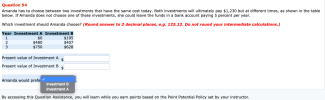 Question 54 Amanda has to choose between two investments that have the same cost today. Both investments will ultimately pay $1,230 but at different times, as shown in the table below. If Amanda does not choose one of these investments, she could leave the funds in a bank account paying 5 percent per year. Which investment should Amanda choose? (Round answer to 2 decimal places, e.g. 125.12. Do not round your intermediate calculations.) Year Investment A Investment B $0 $195...
51. You have your choice of two investment accounts. Investment A is a 10 year annuity...
51. You have your choice of two investment accounts. Investment A is a 10 year annuity that features end of month $1,145 payments and has an interest rate of 7% compounded monthly. Investment B is an annually compounded lump – sum investment with an interest rate of 9%, also good for 10 years. How much money would you need to invest in B today for it to be worth as much as Investment A 10 years from now.
You have your choice of two investment accounts. Investment A is a 6-year annuity that features...
You have your choice of two investment accounts. Investment A is a 6-year annuity that features end-of-month $2,380 payments and has an interest rate of 10 percent compounded monthly. Investment B is an annually compounded lump-sum investment with an interest rate of 12 percent, also good for 6 years. How much money would you need to invest in B today for it to be worth as much as Investment A 6 years from now? (Do not round intermediate calculations and...
4 Given a choice of two investments, would you choose one that pays a total return...
 4
Given a choice of two investments, would you choose one that pays a total return of 30 percent over five years or one that pays 0.5 percent per month for five years? What annual rate of return does each give you? Instructions: Enter your responses in percentages to the nearest hundredth, for example, 3.00 for 3 percent. The return of 30 percent over 5 years provides an annual return of percent. The return of 0.5 percent per month for...
4
Given a choice of two investments, would you choose one that pays a total return of 30 percent over five years or one that pays 0.5 percent per month for five years? What annual rate of return does each give you? Instructions: Enter your responses in percentages to the nearest hundredth, for example, 3.00 for 3 percent. The return of 30 percent over 5 years provides an annual return of percent. The return of 0.5 percent per month for...
You have your choice of two investment accounts. Investment A is a 10-year annuity that features...
 You have your choice of two investment accounts. Investment A is a 10-year annuity that features end-of-month $1,525 payments and has an interest rate of 7 percent compounded monthly. Investment B is an annually compounded lump-sum investment with an interest rate of 9 percent, also good for 10 years. How much money would you need to invest in B today for it to be worth as much as Investment A 10 years from now? (Do not round intermediate calculations and...
You have your choice of two investment accounts. Investment A is a 6-year annuity that features...
 You have your choice of two investment accounts. Investment A is a 6-year annuity that features end-of-month $3,000 payments and has an interest rate of 8 percent compounded monthly. Investment B is an annually compounded lump-sum investment with an interest rate of 10 percent, also good for 6 years. 0.5 points How much money would you need to invest in B today for it to be worth as much as Investment A 6 years from now? (Do not round intermediate...
You have your choice of two investment accounts. Investment A is a 14-year annuity that features...
You have your choice of two investment accounts. Investment A is a 14-year annuity that features end-of-month $1,200 payments and has a rate of 6.9 percent compounded monthly. Investment B is a lump-sum investment with an interest rate of 6.4 percent compounded continuously, also good for 14 years. How much money would you need to invest in B today for it to be worth as much as Investment A 14 years from now? (Do not round intermediate calculations and...
 You have two choices of investments: Investment A is a 15-year annuity that requires end-of-quarter $1,400 payments that earn an interest rate of 9% compounded quarterly. - Investment B is a 15-year lump sum investment that earns an interest rate of 11% compounded annually. How much money would you need to invest in Investment B today for it to be worth as much as Investment A 15 years from now? 1) $34,415 2) $40,415 3) $36,415 4) $42,415 5) $38,415
 Question 54 Amanda has to choose between two investments that have the same cost today. Both investments will ultimately pay $1,230 but at different times, as shown in the table below. If Amanda does not choose one of these investments, she could leave the funds in a bank account paying 5 percent per year. Which investment should Amanda choose? (Round answer to 2 decimal places, e.g. 125.12. Do not round your intermediate calculations.) Year Investment A Investment B $0 $195...
 4
Given a choice of two investments, would you choose one that pays a total return of 30 percent over five years or one that pays 0.5 percent per month for five years? What annual rate of return does each give you? Instructions: Enter your responses in percentages to the nearest hundredth, for example, 3.00 for 3 percent. The return of 30 percent over 5 years provides an annual return of percent. The return of 0.5 percent per month for...
4
Given a choice of two investments, would you choose one that pays a total return of 30 percent over five years or one that pays 0.5 percent per month for five years? What annual rate of return does each give you? Instructions: Enter your responses in percentages to the nearest hundredth, for example, 3.00 for 3 percent. The return of 30 percent over 5 years provides an annual return of percent. The return of 0.5 percent per month for...
 You have your choice of two investment accounts. Investment A is a 10-year annuity that features end-of-month $1,525 payments and has an interest rate of 7 percent compounded monthly. Investment B is an annually compounded lump-sum investment with an interest rate of 9 percent, also good for 10 years. How much money would you need to invest in B today for it to be worth as much as Investment A 10 years from now? (Do not round intermediate calculations and...
 You have your choice of two investment accounts. Investment A is a 6-year annuity that features end-of-month $3,000 payments and has an interest rate of 8 percent compounded monthly. Investment B is an annually compounded lump-sum investment with an interest rate of 10 percent, also good for 6 years. 0.5 points How much money would you need to invest in B today for it to be worth as much as Investment A 6 years from now? (Do not round intermediate...
Most questions answered within 3 hours.
-
Where is the error in this code sequence?
String s1 = "Hello";
String s2 = "ello";...
asked 10 months ago -
Financial data for Joel de Paris, Inc., for last year
follow:
Joel de Paris, Inc.
Balance...
asked 10 months ago -
Consider this reaction:
Al2(SO4)3 (aq)+ BaCl3
(aq) Al2Cl6 (aq)- +
3BaSO4(s) . What is the...
asked 10 months ago -
Suppose that Savneet is considering increasing her
recent random sample from 20 car rentals to 40...
asked 10 months ago -
Trucks arrive at an unloading terminal at an average rate of 120
per hour.
Trucks arrive...
asked 10 months ago -
Why are methanol and ethanol completely soluble in water while
octanol is not very little soluble....
asked 10 months ago -
A facilities manager at a university reads in a research report
that the mean amount of...
asked 10 months ago -
When the CuSO4 is rehydrated by adding water to the anhydrous
compound, is this an endothermic...
asked 10 months ago -
A ray of sunlight is passing from diamond into crown glass; the
angle of incidence is...
asked 10 months ago -
A block of mass 0.249 kg is placed on top of a light, vertical
spring of...
asked 10 months ago -
how do the kidneys compensate in the presences of acidosis
a) trigger hyperventilate
b) reserve acid...
asked 10 months ago -
Question 501 pts
The rental rate of capital to the firm increases. Which of the
following...
asked 10 months ago