Delsing Canning Company is considering an expansion of its facilities. Its current income statement is as follows:
| Sales | $ | 6,600,000 |
| Variable costs (50% of sales) | 3,300,000 | |
| Fixed costs | 1,960,000 | |
| Earnings before interest and taxes (EBIT) | $ | 1,340,000 |
| Interest (10% cost) | 520,000 | |
| Earnings before taxes (EBT) | $ | 820,000 |
| Tax (35%) | 287,000 | |
| Earnings after taxes (EAT) | $ | 533,000 |
| Shares of common stock | 360,000 | |
| Earnings per share | $ | 1.48 |
The company is currently financed with 50 percent debt and 50 percent equity (common stock, par value of $10). In order to expand the facilities, Mr. Delsing estimates a need for $3.6 million in additional financing. His investment banker has laid out three plans for him to consider:
- Sell $3.6 million of debt at 12 percent.
- Sell $3.6 million of common stock at $30 per share.
- Sell $1.80 million of debt at 11 percent and $1.80 million of common stock at $40 per share.
Variable costs are expected to stay at 50 percent of sales, while fixed expenses will increase to $2,460,000 per year. Delsing is not sure how much this expansion will add to sales, but he estimates that sales will rise by $1 million per year for the next five years
Delsing is interested in a thorough analysis of his expansion plans and methods of financing.He would like you to analyze the following:
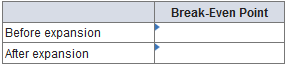
a. The break-even point for operating expenses before and after expansion (in sales dollars). (Enter your answers in dollars not in millions, i.e, $1,234,567.)
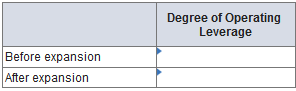
b. The degree of operating leverage before and after expansion. Assume sales of $6.6 million before expansion and $7.6 million after expansion. Use the formula: DOL = (S − TVC) / (S − TVC − FC). (Round your answers to 2 decimal places.)
c-1. The degree of financial leverage before expansion. (Round your answer to 2 decimal places.)

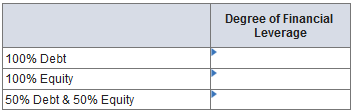
c-2. The degree of financial leverage for all three methods after expansion. Assume sales of $7.6 million for this question. (Round your answers to 2 decimal places.)
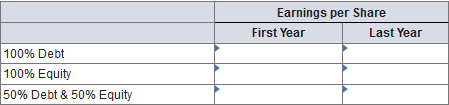
d. Compute EPS under all three methods of financing the expansion at $7.6 million in sales (first year) and $10.5 million in sales (last year). (Round your answers to 2 decimal places.)
Homework Answers
Ans
a) The break-even point for operating expenses before and after expansion (in sales dollars)
At break even before expansion:
PQ = FC + VC
where PQ equals sales volume at break-even point
Sales = Fixed costs + Variable costs
(Variable costs = 50% of sales)
Sales = $1,960,000 + 0.50 Sales
0.50 Sales = $1,960,000
Sales = $3,920,000
At break even after expansion:
PQ = FC + VC
where PQ equals sales volume at break-even point
Sales = Fixed costs + Variable costs
(Variable costs = 50% of sales)
Sales = $2,460,000 + 0.50 Sales
0.50 Sales = $2,460,000
Sales = $4,920,000
b)
Degree of operating leverage, before expansion, at sales of $ 6,600,000
DOL = Q ( P - VC) / Q ( P - VC) - FC = S - TVC / S - TVC - FC
DOL = $6,600,000 - $ 3,300,000 / $6,600,000 - $ 3,300,000 - $ 1,960,000
DOL = $ 3,300,000 / $ 1,340,000 = 2.46
Degree of operating leverage, before expansion, at sales of $ 7,600,000
DOL = Q ( P - VC) / Q ( P - VC) - FC = S - TVC / S - TVC - FC
DOL = $7,600,000 - $ 3,800,000 / $7,600,000 - $ 3,800,000 - $ 2,460,000
DOL = $ 3,800,000 / $ 1,340,000 = 2.84
c-1) The degree of financial leverage before expansion.
DFL = EBIT / (EBIT - Interest)
DFL = $ 1,340,000 / ($ 1,340,000 - $ 520,000)
DFL = $ 1,340,000 / $ 820,000 = 1.63
c-2. The degree of financial leverage for all three methods after expansion
| 100% Debt (1) | 100% Equity (2) | 50% Debt + 50% Equity (3) | |
| Sales | $7,600,000 | $7,600,000 | $7,600,000 |
| - TVC | 3,800,000 | 3,800,000 | 3,800,000 |
| - FC | 2,460,000 | 2,460,000 | 2,460,000 |
| EBIT | $1,340,000 | $1,340,000 | $1,340,000 |
| Interest (old) | 520,000 | 520,000 | 520,000 |
| Interest (new) | 432,000 | 0 | 198,000 |
| Total Interest (I) | $952,000 | $520,000 | $718,000 |
DFL = EBIT / (EBIT - Interest)
1. $ 1,340,000 / ( $ 1,340,000 - $ 952,000) = 3.45
2. $ 1,340,000 / ( $ 1,340,000 - $ 520,000) = 1.63
3. $ 1,340,000 / ( $ 1,340,000 - $ 718,000) = 2.15
d)Compute EPS under all three methods of financing the expansion at $7.6 million in sales (first year) and $10.5 million in sales (last year).
| 100% Debt (1) | 100% Equity (2) | 50% Debt + 50% Equity (3) | |
| EBIT | $1,340,000 | $1,340,000 | $1,340,000 |
| Total Interest (I) | 952,000 | 520,000 | 718,000 |
| EBT | 388,000 | 820,000 | 622,000 |
| Taxes (35%) | 135,800 | 287,000 | 217,700 |
| EAT | $252,200 | $533,000 | $404,300 |
| Shares (old) | 360,000 | 360,000 | 360,000 |
| Shares (new) | 0 | 120,000 | 45,000 |
| Total shares | 360,000 | 480,000 | 405,000 |
| EPS (EAT /Total shares) | $0.70 | $1.11 | $1.00 |
| 100% Debt (1) | 100% Equity (2) | 50% Debt + 50% Equity (3) | |
| Sales | $10,500,000 | $10,500,000 | $10,500,000 |
| - TVC | 5,250,000 | 5,250,000 | 5,250,000 |
| - FC | 2,460,000 | 2,460,000 | 2,460,000 |
| EBIT | $2,790,000 | $2,790,000 | $2,790,000 |
| Total Interest (I) | 952,000 | 520,000 | 718,000 |
| EBT | 1,838,000 | 2,270,000 | 2,072,000 |
| Taxes (35%) | 643,300 | 794,500 | 725,200 |
| EAT | $1,194,700 | $1,475,500 | $1,346,800 |
| Shares (old) | 360,000 | 360,000 | 360,000 |
| Shares (new) | 0 | 120,000 | 45,000 |
| Total shares | 360,000 | 480,000 | 405,000 |
| EPS | $3.32 | $3.07 | $3.33 |
Add Answer to:
Delsing Canning Company is considering an expansion of its
facilities. Its current income statement is as...
Most questions answered within 3 hours.
-
Where is the error in this code sequence?
String s1 = "Hello";
String s2 = "ello";...
asked 11 months ago -
Financial data for Joel de Paris, Inc., for last year
follow:
Joel de Paris, Inc.
Balance...
asked 11 months ago -
Consider this reaction:
Al2(SO4)3 (aq)+ BaCl3
(aq) Al2Cl6 (aq)- +
3BaSO4(s) . What is the...
asked 11 months ago -
Suppose that Savneet is considering increasing her
recent random sample from 20 car rentals to 40...
asked 11 months ago -
Trucks arrive at an unloading terminal at an average rate of 120
per hour.
Trucks arrive...
asked 11 months ago -
Why are methanol and ethanol completely soluble in water while
octanol is not very little soluble....
asked 11 months ago -
A facilities manager at a university reads in a research report
that the mean amount of...
asked 11 months ago -
When the CuSO4 is rehydrated by adding water to the anhydrous
compound, is this an endothermic...
asked 11 months ago -
A ray of sunlight is passing from diamond into crown glass; the
angle of incidence is...
asked 11 months ago -
A block of mass 0.249 kg is placed on top of a light, vertical
spring of...
asked 11 months ago -
how do the kidneys compensate in the presences of acidosis
a) trigger hyperventilate
b) reserve acid...
asked 11 months ago -
Question 501 pts
The rental rate of capital to the firm increases. Which of the
following...
asked 11 months ago