Consider the two mutually exclusive projects in the table below. Salvage values represent the net proceeds (after tax) from disposal of the assets if they are sold at the end of each year. Both projects B1 and B2 will be available (or can be repeated) with the same costs and salvage values for an indefinite period
 .
.
-
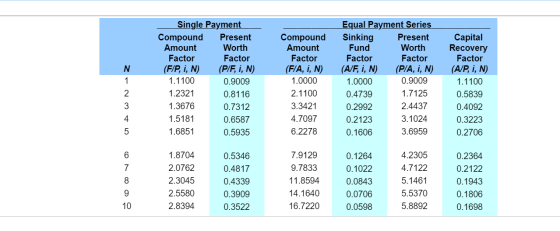
Assuming an infinite planning horizon, which project is a better choice at MARR = 11%? Use 15 years as the common analysis period.
-
The present worth for project B1 is $______thousand.
-
The present worth for project B2 is $______thousand.
-
-
Which is better project choice?
-
With a ten-year planning horizon, which project is a better choice at MARR = 11%?
-
The present worth for project B1 is $______thousand.
-
The present worth for project B2 is $______thousand.
-
4. Which is better project choice?
Homework Answers
Here the present worth analysis period is 15 years. The present worth of B1 can be calculated as follows






Now calculate for machine B2




Select B1 since it's present worth cost is less in comparison to B2.
When MARR =11% and useful life is 10 years




Now calculate the PW of B2



Select B1.
Please contact if having any query will be obliged to you for your generous support. Your help mean a lot to me, please help. Thank you.
Add Answer to:
Consider the two mutually exclusive projects in the table below.
Salvage values represent the net proceeds...
Consider the two mutually exclusive projects in the table below. Salvage values represent the net proceeds...
 Consider the two mutually exclusive projects in the table below. Salvage values represent the net proceeds (after tax) from disposal of the assets if they are sold at the end of each year. Both projects B1 and B2 will be available (or can be repeated) with the same costs and salvage values for an indefinite period. B Click the icon to view the additional data about the mutually exclusive projects. Click the icon to view the interest factors for discrete...
Consider the two mutually exclusive projects in the table below. Salvage values represent the net proceeds...
 Consider the two mutually exclusive projects in the table below. Salvage values represent the net proceeds (after tax) from disposal of the assets if they are sold at the end of each year. Both projects B1 and B2 will be available (or can be repeated) with the same costs and salvage values for an indefinite period. Click the icon to view the additional data about the mutually exclusive projects. Click the icon to view the interest factors for discrete compounding...
Consider the two mutually exclusive projects in the table below. Salvage values represent the not proceeds...
 Consider the two mutually exclusive projects in the table below. Salvage values represent the not proceeds (after tax) from disposal of the assets if they are sold at the end of each year. Both projects B1 and B2 will be available (or can be repeated) with the same costs and salvage values for an indefinite period Click the icon to view the additional data about the mutually exclusive projects. Click the icon to view the interest factors for discrete compounding...
Consider the two mutual exclusive projects in the table below. Salvage values represent the net proceeds...
 Consider the two mutual exclusive projects in the table below.
Salvage values represent the net proceeds (after tax) from disposal
of the assets if they are sold at the sold at the end of each year.
Both Projects B1 and B2 will be available (or can be tepeated) with
the same costs and salvage values for an indefinite period.
A.) Assuming an infinite planning horizon, which project is
better choice at MARR=11%? Use 15 years as tge common analysis
period....
Consider the two mutual exclusive projects in the table below.
Salvage values represent the net proceeds (after tax) from disposal
of the assets if they are sold at the sold at the end of each year.
Both Projects B1 and B2 will be available (or can be tepeated) with
the same costs and salvage values for an indefinite period.
A.) Assuming an infinite planning horizon, which project is
better choice at MARR=11%? Use 15 years as tge common analysis
period....
ABC Brand 1,600 XYZ Brand 5,600 Purchase Price $ Life in Years Salvage Value $ Annual...
 ABC Brand 1,600 XYZ Brand 5,600 Purchase Price $ Life in Years Salvage Value $ Annual Maintenance $ Efficiency % None 190 None 350 Discrete Compounding; i = 11% Uniform Series Single Payment Capital Recovery Factor To Find A Given P А/Р Compound Amount Present Factor Worth Factor To Find F To Find P Given P Given F P F/ P /F 1.1100 0.9009 1.2321 0.8116 1.3676 0.7312 1.5181 0.6587 1.6851 0.5935 1.8704 0.5346 2.0762 0.4817 2.3045 0.4339 2.5580 0.3909...
I just need help with Part B. Please DON'T use Excel, and show all calculations. Thank...
 I just need help with Part B. Please
DON'T use Excel, and show all calculations. Thank
you in advance.
Net Cash Flow Project 3 Project 1 $1,400 Project 2 0 -$1,400 -$1,400 1 2,900 1,970 1,070 2,000 400 2 930 Single Payment Compound Amount Equal Payment Series Capital Recovery Factor Present Compound Amount Sinking Fund Present Worth Worth Factor Factor Factor Factor Factor (FIP, i, N) (P/F, i, N) (FIA, i, N) (A/F, i, N) (P/A, i, N) (A/P, i,...
I just need help with Part B. Please
DON'T use Excel, and show all calculations. Thank
you in advance.
Net Cash Flow Project 3 Project 1 $1,400 Project 2 0 -$1,400 -$1,400 1 2,900 1,970 1,070 2,000 400 2 930 Single Payment Compound Amount Equal Payment Series Capital Recovery Factor Present Compound Amount Sinking Fund Present Worth Worth Factor Factor Factor Factor Factor (FIP, i, N) (P/F, i, N) (FIA, i, N) (A/F, i, N) (P/A, i, N) (A/P, i,...
A firm can purchase a centrifugal separator (5-year MACRS property) for $21,000. The estimated salvage value...
 A firm can
purchase a centrifugal separator (5-year
MACRS property) for
$21,000.
The estimated
salvage value is
$2,500
after a useful
life of six years. Operating and maintenance
(O&M)
costs for the first year are expected to be
$2,100.
These
O&M
costs are projected to increase by
$500
per year each
year thereafter. The income tax rate is
25%
and the MARR
is
11%
after taxes.
What must the uniform annual benefits be for the purchase of the
centrifugal separator...
A firm can
purchase a centrifugal separator (5-year
MACRS property) for
$21,000.
The estimated
salvage value is
$2,500
after a useful
life of six years. Operating and maintenance
(O&M)
costs for the first year are expected to be
$2,100.
These
O&M
costs are projected to increase by
$500
per year each
year thereafter. The income tax rate is
25%
and the MARR
is
11%
after taxes.
What must the uniform annual benefits be for the purchase of the
centrifugal separator...
Problem 5-49 (algorithmic) Question Help Consider the two mutually exclusive projects in the table below. Salvage...
 Problem 5-49 (algorithmic) Question Help Consider the two mutually exclusive projects in the table below. Salvage values represent the net proceeds (after tax) from disposal of the assets if they are sold at the end of each year. Both projects B1 and B2 will be available (or can be repeated) with the same costs and salvage values for an indefinite period. Click the icon to view the additional data about the mutually exclusive projects. Click the icon to view the...
Can someone help me with part b? I can not seem to find the correct answer for present worth of B1 with 10 year plannin...
 Can someone help me with part b? I can not seem to find the
correct answer for present worth of B1 with 10 year planning
horizon or the present worth of B2 with 10 year planning
horizon.
Consider the two mutually exclusive projects in the table below. Salvage values represent the net proceeds (after tax) from disposal of the assets if they are sold at the end of each year. Both projects B1 and B2 will be available (or can...
Can someone help me with part b? I can not seem to find the
correct answer for present worth of B1 with 10 year planning
horizon or the present worth of B2 with 10 year planning
horizon.
Consider the two mutually exclusive projects in the table below. Salvage values represent the net proceeds (after tax) from disposal of the assets if they are sold at the end of each year. Both projects B1 and B2 will be available (or can...
Consider the independent investment projects in the table below. Compute the project worth of each project...
 Consider the independent investment projects in the table below. Compute the project worth of each project at the end of six years with variable MARRs as follows: 10% for n = 0 to n= 3 and 15% for n = 4 to n=6. B Click the icon to view the information about the independent investment projects. Click the icon to view the interest factors for discrete compounding when MARR = 10% per year. Click the icon to view the interest...
 Consider the two mutually exclusive projects in the table below. Salvage values represent the net proceeds (after tax) from disposal of the assets if they are sold at the end of each year. Both projects B1 and B2 will be available (or can be repeated) with the same costs and salvage values for an indefinite period. B Click the icon to view the additional data about the mutually exclusive projects. Click the icon to view the interest factors for discrete...
 Consider the two mutually exclusive projects in the table below. Salvage values represent the net proceeds (after tax) from disposal of the assets if they are sold at the end of each year. Both projects B1 and B2 will be available (or can be repeated) with the same costs and salvage values for an indefinite period. Click the icon to view the additional data about the mutually exclusive projects. Click the icon to view the interest factors for discrete compounding...
 Consider the two mutually exclusive projects in the table below. Salvage values represent the not proceeds (after tax) from disposal of the assets if they are sold at the end of each year. Both projects B1 and B2 will be available (or can be repeated) with the same costs and salvage values for an indefinite period Click the icon to view the additional data about the mutually exclusive projects. Click the icon to view the interest factors for discrete compounding...
 Consider the two mutual exclusive projects in the table below.
Salvage values represent the net proceeds (after tax) from disposal
of the assets if they are sold at the sold at the end of each year.
Both Projects B1 and B2 will be available (or can be tepeated) with
the same costs and salvage values for an indefinite period.
A.) Assuming an infinite planning horizon, which project is
better choice at MARR=11%? Use 15 years as tge common analysis
period....
Consider the two mutual exclusive projects in the table below.
Salvage values represent the net proceeds (after tax) from disposal
of the assets if they are sold at the sold at the end of each year.
Both Projects B1 and B2 will be available (or can be tepeated) with
the same costs and salvage values for an indefinite period.
A.) Assuming an infinite planning horizon, which project is
better choice at MARR=11%? Use 15 years as tge common analysis
period....
 ABC Brand 1,600 XYZ Brand 5,600 Purchase Price $ Life in Years Salvage Value $ Annual Maintenance $ Efficiency % None 190 None 350 Discrete Compounding; i = 11% Uniform Series Single Payment Capital Recovery Factor To Find A Given P А/Р Compound Amount Present Factor Worth Factor To Find F To Find P Given P Given F P F/ P /F 1.1100 0.9009 1.2321 0.8116 1.3676 0.7312 1.5181 0.6587 1.6851 0.5935 1.8704 0.5346 2.0762 0.4817 2.3045 0.4339 2.5580 0.3909...
 I just need help with Part B. Please
DON'T use Excel, and show all calculations. Thank
you in advance.
Net Cash Flow Project 3 Project 1 $1,400 Project 2 0 -$1,400 -$1,400 1 2,900 1,970 1,070 2,000 400 2 930 Single Payment Compound Amount Equal Payment Series Capital Recovery Factor Present Compound Amount Sinking Fund Present Worth Worth Factor Factor Factor Factor Factor (FIP, i, N) (P/F, i, N) (FIA, i, N) (A/F, i, N) (P/A, i, N) (A/P, i,...
I just need help with Part B. Please
DON'T use Excel, and show all calculations. Thank
you in advance.
Net Cash Flow Project 3 Project 1 $1,400 Project 2 0 -$1,400 -$1,400 1 2,900 1,970 1,070 2,000 400 2 930 Single Payment Compound Amount Equal Payment Series Capital Recovery Factor Present Compound Amount Sinking Fund Present Worth Worth Factor Factor Factor Factor Factor (FIP, i, N) (P/F, i, N) (FIA, i, N) (A/F, i, N) (P/A, i, N) (A/P, i,...
 A firm can
purchase a centrifugal separator (5-year
MACRS property) for
$21,000.
The estimated
salvage value is
$2,500
after a useful
life of six years. Operating and maintenance
(O&M)
costs for the first year are expected to be
$2,100.
These
O&M
costs are projected to increase by
$500
per year each
year thereafter. The income tax rate is
25%
and the MARR
is
11%
after taxes.
What must the uniform annual benefits be for the purchase of the
centrifugal separator...
A firm can
purchase a centrifugal separator (5-year
MACRS property) for
$21,000.
The estimated
salvage value is
$2,500
after a useful
life of six years. Operating and maintenance
(O&M)
costs for the first year are expected to be
$2,100.
These
O&M
costs are projected to increase by
$500
per year each
year thereafter. The income tax rate is
25%
and the MARR
is
11%
after taxes.
What must the uniform annual benefits be for the purchase of the
centrifugal separator...
 Problem 5-49 (algorithmic) Question Help Consider the two mutually exclusive projects in the table below. Salvage values represent the net proceeds (after tax) from disposal of the assets if they are sold at the end of each year. Both projects B1 and B2 will be available (or can be repeated) with the same costs and salvage values for an indefinite period. Click the icon to view the additional data about the mutually exclusive projects. Click the icon to view the...
 Can someone help me with part b? I can not seem to find the
correct answer for present worth of B1 with 10 year planning
horizon or the present worth of B2 with 10 year planning
horizon.
Consider the two mutually exclusive projects in the table below. Salvage values represent the net proceeds (after tax) from disposal of the assets if they are sold at the end of each year. Both projects B1 and B2 will be available (or can...
Can someone help me with part b? I can not seem to find the
correct answer for present worth of B1 with 10 year planning
horizon or the present worth of B2 with 10 year planning
horizon.
Consider the two mutually exclusive projects in the table below. Salvage values represent the net proceeds (after tax) from disposal of the assets if they are sold at the end of each year. Both projects B1 and B2 will be available (or can...
 Consider the independent investment projects in the table below. Compute the project worth of each project at the end of six years with variable MARRs as follows: 10% for n = 0 to n= 3 and 15% for n = 4 to n=6. B Click the icon to view the information about the independent investment projects. Click the icon to view the interest factors for discrete compounding when MARR = 10% per year. Click the icon to view the interest...
Most questions answered within 3 hours.
-
Where is the error in this code sequence?
String s1 = "Hello";
String s2 = "ello";...
asked 11 months ago -
Financial data for Joel de Paris, Inc., for last year
follow:
Joel de Paris, Inc.
Balance...
asked 11 months ago -
Consider this reaction:
Al2(SO4)3 (aq)+ BaCl3
(aq) Al2Cl6 (aq)- +
3BaSO4(s) . What is the...
asked 11 months ago -
Suppose that Savneet is considering increasing her
recent random sample from 20 car rentals to 40...
asked 11 months ago -
Trucks arrive at an unloading terminal at an average rate of 120
per hour.
Trucks arrive...
asked 11 months ago -
Why are methanol and ethanol completely soluble in water while
octanol is not very little soluble....
asked 11 months ago -
A facilities manager at a university reads in a research report
that the mean amount of...
asked 11 months ago -
When the CuSO4 is rehydrated by adding water to the anhydrous
compound, is this an endothermic...
asked 11 months ago -
A ray of sunlight is passing from diamond into crown glass; the
angle of incidence is...
asked 11 months ago -
A block of mass 0.249 kg is placed on top of a light, vertical
spring of...
asked 11 months ago -
how do the kidneys compensate in the presences of acidosis
a) trigger hyperventilate
b) reserve acid...
asked 11 months ago -
Question 501 pts
The rental rate of capital to the firm increases. Which of the
following...
asked 11 months ago