PLEASE ANSWER NUMBER THREE (not number two)

This problem (number 2) is only for reference.
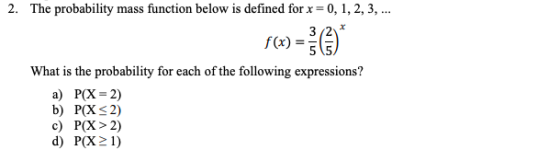
Homework Answers
3)here as cumulative distribution function:
F(x)=P(X<=x)=P(X=0)+P(X=1)+P(X=2)+...+P(X=x)
=(3/5)*((2/5)0+(2/5)1+(2/5)2+...(2/5)x)
=(3/5)*1*(1-(2/5)x+1)/(1-2/5)
F(x)=1-(2/5)x+1 for x=0,1,2,3,.............
Add Answer to:
PLEASE ANSWER NUMBER THREE (not number two)
This problem (number 2) is only for
reference.
Determine...
Previous Problem: Determine values of the cumulative distribution function for the random variable in the previous...
 Previous Problem:
Determine values of the cumulative distribution function for the random variable in the previous problem. 3. 2. The probability mass function below is defined for x 0, 1,2,3,.. fr 5 5 -56 What is the probability for each of the following expressions? a) P(X 2) b) P(XE 2) c) P(X> 2) d) P(X2 1)
Previous Problem:
Determine values of the cumulative distribution function for the random variable in the previous problem. 3. 2. The probability mass function below is defined for x 0, 1,2,3,.. fr 5 5 -56 What is the probability for each of the following expressions? a) P(X 2) b) P(XE 2) c) P(X> 2) d) P(X2 1)
2. The probability mass function below is defined for x 0, 1,2,3,.. fr 5 5 -56...
 2. The probability mass function below is defined for x 0, 1,2,3,.. fr 5 5 -56 What is the probability for each of the following expressions? a) P(X 2) b) P(XE 2) c) P(X> 2) d) P(X2 1)
Answer number 3, please. 2. The probability mass function below is defined forx - 0, 1,2,3,......
 Answer number 3, please.
2. The probability mass function below is defined forx - 0, 1,2,3,... 32 f(x)- What is the probability for each of the following expressions? a) P(X 2) b) P(X S2) c) P(X>2) d) P(X2 1) Determine values of the cumulative distribution function for the random variable in the previous problem 3.
Answer number 3, please.
2. The probability mass function below is defined forx - 0, 1,2,3,... 32 f(x)- What is the probability for each of the following expressions? a) P(X 2) b) P(X S2) c) P(X>2) d) P(X2 1) Determine values of the cumulative distribution function for the random variable in the previous problem 3.
2.5.9. The random variable X has a cumulative distribution function for xo , for xsO ....
 2.5.9. The random variable X has a cumulative distribution function for xo , for xsO . for r>0 F(x) = z? 1 +x2 Find the probability density function of X.
2.5.9. The random variable X has a cumulative distribution function for xo , for xsO ....
 2.5.9. The random variable X has a cumulative distribution function for xo , for xsO . for r>0 F(x) = z? 1 +x2 Find the probability density function of X.
Problem 2 If the cumulative distribution function of X is given by o F(b) = b<0...
 Problem 2 If the cumulative distribution function of X is given by o F(b) = b<0 0<b<1 1<b<2 2<b<3 3<b<3.5 b> 3.5 1 calculate the probability mass function of X.
Problem 8: 10 points Suppose that (X, Y) are two independent identically distributed random variables with...
 Problem 8: 10 points Suppose that (X, Y) are two independent identically distributed random variables with the density function defined as f (x) λ exp (-Ar) , for x > 0. For the ratio, z-y, find the cumulative distribution function and density function.
Problem 9: 10 points Suppose that X, Y are two independent identically distributed random variables with...
 Problem 9: 10 points Suppose that X, Y are two independent identically distributed random variables with the density function f(x)= λ exp (-Az), for >0. Consider T- and find its cumulative distribution function and density function.
Prove that there are no natural number solutions to the equation where x, y ≥ 2...
 Prove that there are no natural number solutions to the equation
where x, y ≥ 2 ... (See Picture Below)
Prove that there are no natural number solutions to the equation where X, Y > 2. x2 - y2 = 1.
Prove that there are no natural number solutions to the equation
where x, y ≥ 2 ... (See Picture Below)
Prove that there are no natural number solutions to the equation where X, Y > 2. x2 - y2 = 1.
c can be any number, cVaR does not mean conditional value at risk. Hence, please just...
 c can be any number, cVaR does
not mean conditional value at risk. Hence, please just prvoe the
positively homogeneous property of VaR.
Q1. Assume that X is a continuous and nonnegative random variable with the cumulative distribution function Fx and density fx, and let c>O. Verify that for the Value-at-Risk we have VaR,x (p) = cVaRx (p)
c can be any number, cVaR does
not mean conditional value at risk. Hence, please just prvoe the
positively homogeneous property of VaR.
Q1. Assume that X is a continuous and nonnegative random variable with the cumulative distribution function Fx and density fx, and let c>O. Verify that for the Value-at-Risk we have VaR,x (p) = cVaRx (p)
 Previous Problem:
Determine values of the cumulative distribution function for the random variable in the previous problem. 3. 2. The probability mass function below is defined for x 0, 1,2,3,.. fr 5 5 -56 What is the probability for each of the following expressions? a) P(X 2) b) P(XE 2) c) P(X> 2) d) P(X2 1)
Previous Problem:
Determine values of the cumulative distribution function for the random variable in the previous problem. 3. 2. The probability mass function below is defined for x 0, 1,2,3,.. fr 5 5 -56 What is the probability for each of the following expressions? a) P(X 2) b) P(XE 2) c) P(X> 2) d) P(X2 1)
 2. The probability mass function below is defined for x 0, 1,2,3,.. fr 5 5 -56 What is the probability for each of the following expressions? a) P(X 2) b) P(XE 2) c) P(X> 2) d) P(X2 1)
 Answer number 3, please.
2. The probability mass function below is defined forx - 0, 1,2,3,... 32 f(x)- What is the probability for each of the following expressions? a) P(X 2) b) P(X S2) c) P(X>2) d) P(X2 1) Determine values of the cumulative distribution function for the random variable in the previous problem 3.
Answer number 3, please.
2. The probability mass function below is defined forx - 0, 1,2,3,... 32 f(x)- What is the probability for each of the following expressions? a) P(X 2) b) P(X S2) c) P(X>2) d) P(X2 1) Determine values of the cumulative distribution function for the random variable in the previous problem 3.
 2.5.9. The random variable X has a cumulative distribution function for xo , for xsO . for r>0 F(x) = z? 1 +x2 Find the probability density function of X.
 2.5.9. The random variable X has a cumulative distribution function for xo , for xsO . for r>0 F(x) = z? 1 +x2 Find the probability density function of X.
 Problem 2 If the cumulative distribution function of X is given by o F(b) = b<0 0<b<1 1<b<2 2<b<3 3<b<3.5 b> 3.5 1 calculate the probability mass function of X.
 Problem 8: 10 points Suppose that (X, Y) are two independent identically distributed random variables with the density function defined as f (x) λ exp (-Ar) , for x > 0. For the ratio, z-y, find the cumulative distribution function and density function.
 Problem 9: 10 points Suppose that X, Y are two independent identically distributed random variables with the density function f(x)= λ exp (-Az), for >0. Consider T- and find its cumulative distribution function and density function.
 Prove that there are no natural number solutions to the equation
where x, y ≥ 2 ... (See Picture Below)
Prove that there are no natural number solutions to the equation where X, Y > 2. x2 - y2 = 1.
Prove that there are no natural number solutions to the equation
where x, y ≥ 2 ... (See Picture Below)
Prove that there are no natural number solutions to the equation where X, Y > 2. x2 - y2 = 1.
 c can be any number, cVaR does
not mean conditional value at risk. Hence, please just prvoe the
positively homogeneous property of VaR.
Q1. Assume that X is a continuous and nonnegative random variable with the cumulative distribution function Fx and density fx, and let c>O. Verify that for the Value-at-Risk we have VaR,x (p) = cVaRx (p)
c can be any number, cVaR does
not mean conditional value at risk. Hence, please just prvoe the
positively homogeneous property of VaR.
Q1. Assume that X is a continuous and nonnegative random variable with the cumulative distribution function Fx and density fx, and let c>O. Verify that for the Value-at-Risk we have VaR,x (p) = cVaRx (p)
Most questions answered within 3 hours.
-
Where is the error in this code sequence?
String s1 = "Hello";
String s2 = "ello";...
asked 11 months ago -
Financial data for Joel de Paris, Inc., for last year
follow:
Joel de Paris, Inc.
Balance...
asked 11 months ago -
Consider this reaction:
Al2(SO4)3 (aq)+ BaCl3
(aq) Al2Cl6 (aq)- +
3BaSO4(s) . What is the...
asked 11 months ago -
Suppose that Savneet is considering increasing her
recent random sample from 20 car rentals to 40...
asked 11 months ago -
Trucks arrive at an unloading terminal at an average rate of 120
per hour.
Trucks arrive...
asked 11 months ago -
Why are methanol and ethanol completely soluble in water while
octanol is not very little soluble....
asked 11 months ago -
A facilities manager at a university reads in a research report
that the mean amount of...
asked 11 months ago -
When the CuSO4 is rehydrated by adding water to the anhydrous
compound, is this an endothermic...
asked 11 months ago -
A ray of sunlight is passing from diamond into crown glass; the
angle of incidence is...
asked 11 months ago -
A block of mass 0.249 kg is placed on top of a light, vertical
spring of...
asked 11 months ago -
how do the kidneys compensate in the presences of acidosis
a) trigger hyperventilate
b) reserve acid...
asked 11 months ago -
Question 501 pts
The rental rate of capital to the firm increases. Which of the
following...
asked 11 months ago