1. During a recession, what is likely to happen to the risk premium? a. the risk...
1. During a recession, what is likely to happen to the risk premium?
a. the risk premium will be higher because there are fewer investment opportunities
b. the risk premium will be lower because there are fewer investment opportunities
c. the risk premium will be unchanged because the overall level of risk has not changed
d. the risk premium will be higher because the risk of default is greater
2. The risk-free rate is:
a. usually approximated by interest rates on U.S. government debt.
b. the interest rate at which one would lend if there were no risk of default.
c. lower than any other interest rate.
d. All of these are true.
3. Shares of stock are:
a. legal promises to repay a debt.
b. claims to partial ownership of a firm.
c. regular payments made to owners of a firm.
d. legal promises to make regular payments to the stockholder.
Homework Answers
1.
The answer is B-The risk premium will be lower because there are few investment opportunities.
During downturns, as organization income fall and financial specialists become more hazard opposed, stock costs modify descending, which raises anticipated returns. ... On the other hand, financial specialists will acknowledge a lower expected return when they view stocks as less dangerous comparative with money.
2.
The answer is B-the interest rate at which one would lend if there were no risk of default.
The risk-free pace of return is the hypothetical pace of return of speculation with zero risks. The hazard free rate speaks to the premium a speculator would anticipate from a totally chance free venture over a predetermined timeframe.
3.
The answer is B-claims to partial ownership of firms.
Shares, frequently called stocks or portions of stock, speak to the value responsibility for organization split into units, with the goal that different individuals can possess a level of a business.
Add Answer to:
1. During a recession, what is likely to happen to the risk
premium?
a. the risk...
The risk premium measures: 14 the interest paid on a U.S. government bond. the total interest...
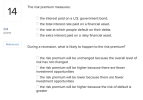 The risk premium measures: 14 the interest paid on a U.S. government bond. the total interest rate paid on a financial asset. the rate at which people default on their debts. the extra interest paid on a risky financial asset. 0.4 points References During a recession, what is likely to happen to the risk premium? the risk premium will be unchanged because the overall level of risk has not changed the risk premium will be higher because there are fewer...
If you expect the inflation premium to be 2%, the default risk premium to be 1%...
If you expect the inflation premium to be 2%, the default risk premium to be 1% and the real interest rate to be 4%, what interest would you expect to observe in the marketplace on short term treasury securities? a. 8% b. 7% c. 6% d. 5%
2 Low 18. Based on Table 3, what is the liquidity risk premium? Table 3 Investment...
 2 Low 18. Based on Table 3, what is the liquidity risk premium? Table 3 Investment Maturity Liquidity Default Risk High Low 2 I 2 Low I 3 7 I Low Low 4 8 High High Low 5 8 Low High A. 3.40% B. 0.81% C. 1.50% 10000 UN Interest Rate 3.00% 3.81% 4.81% 5.25% 6.75% I 19. Based on Table 3, what is the default risk premium? A. 0.69% B. 1.25% C. 0.44% D. 1.50%
4.Which of the following statements is (are) correct?(x)A 2-year Treasury security has a higher liquidity risk...
4.Which of the following statements is (are) correct?(x)A 2-year Treasury security has a higher liquidity risk premium than a 2-year corporate bond because the current White House administration is in the process of melting down (liquifying).(y)AAA corporate bonds have a lower interest rate than BBB corporate bonds because the default risk premium is higher on a BBB corporate bond than a AAA corporate bond.(z)The higher the default risk, the higher the interest rate that security buyers will demand. A.(x), (y)...
Which of the following types of “risk” are encountered in financial markets? Interest rate risk: Higher...
Which of the following types of “risk” are encountered in financial markets? Interest rate risk: Higher interest rate risks impair the value of fixed income securities (such as bonds). Credit risk: Risk of possible default, where the borrower cannot make timely interest payments and/or principal repayments. Inflation risk: Purchasing power is impeded by a general increase in the price of goods and services. Reinvestment risk: Inability to reinvest coupons that have been paid to you at a similar investment yield...
Please Help Incorrect Question 43 0/2 pts Because interest rates on government bonds reflect the risk...
 Please Help
Incorrect Question 43 0/2 pts Because interest rates on government bonds reflect the risk of default, the historically high bond yields are signaling that government bonds are a risky investment. a country perceived as a higher credit risk can pay lower interest rates when it borrows. bond buyers are willing to accept lower interest payments for bonds perceived as high-risk investments. a country perceived as a higher credit risk must pay higher interest rates when it borrows. Incorrect...
Please Help
Incorrect Question 43 0/2 pts Because interest rates on government bonds reflect the risk of default, the historically high bond yields are signaling that government bonds are a risky investment. a country perceived as a higher credit risk can pay lower interest rates when it borrows. bond buyers are willing to accept lower interest payments for bonds perceived as high-risk investments. a country perceived as a higher credit risk must pay higher interest rates when it borrows. Incorrect...
It changes over time, depending on the expected rate of return on productive assets exchanged among Real risk-free...
 It changes over time, depending on the expected rate of return on productive assets exchanged among Real risk-free rate market participants and people's time preferences for consumption This is the rate on a U.S. Treasury bill or a U.S. Treasury bond This is the premium added to the real risk-free rate to compensate for a decrease in purchasing power inflation premium over time It is based on the bond's rating: the higher the rating, the lower the premium added, thus...
1)Ceteris paribus, what do you think would be the most likely impact on the price of...
1)Ceteris paribus, what do you think would be the most likely impact on the price of short-term securities and their interest rates if the Treasury were to issue $100 billion of short-term debt securities. Select one: a. I don't know b. Prices and interest rates would both decline c. Prices and interest rates would both rise d. Prices would rise and interest rates would decline e. Prices would decline and interest rates would rise. 2) If we see that the...
1) For U.S. Treasury bonds, what type of risk exists when rates are historically low? _______...
1) For U.S. Treasury bonds, what type of risk exists when rates are historically low? _______ A) Gap risk B) Interest-rate risk C) Default risk D) Reinvestment risk 2) Which of the following institutions assign ratings for bonds in the United States? _______ A) The Securities and Exchange Commission B) The Federal Reserve District Banks C) The U.S. Treasury D) Private companies such as Moody’s and Fitch 3) If the three-month Treasury bill yields 3.1% while the yield on a...
12:037 final exam.pdf d wary of future downturns, and shift the supply curve for kanable funds...
 12:037 final exam.pdf d wary of future downturns, and shift the supply curve for kanable funds to the left 23. Since the future holds more uncertainty over longer periods of time, lenders generally want a higher interest rate for loans over a longer period ba lower interest rate for loans over a longer period a higher interest rate for loans over a shorter period d. None of these is true 24. When a borrower fails to pay back a lon...
 The risk premium measures: 14 the interest paid on a U.S. government bond. the total interest rate paid on a financial asset. the rate at which people default on their debts. the extra interest paid on a risky financial asset. 0.4 points References During a recession, what is likely to happen to the risk premium? the risk premium will be unchanged because the overall level of risk has not changed the risk premium will be higher because there are fewer...
 2 Low 18. Based on Table 3, what is the liquidity risk premium? Table 3 Investment Maturity Liquidity Default Risk High Low 2 I 2 Low I 3 7 I Low Low 4 8 High High Low 5 8 Low High A. 3.40% B. 0.81% C. 1.50% 10000 UN Interest Rate 3.00% 3.81% 4.81% 5.25% 6.75% I 19. Based on Table 3, what is the default risk premium? A. 0.69% B. 1.25% C. 0.44% D. 1.50%
 Please Help
Incorrect Question 43 0/2 pts Because interest rates on government bonds reflect the risk of default, the historically high bond yields are signaling that government bonds are a risky investment. a country perceived as a higher credit risk can pay lower interest rates when it borrows. bond buyers are willing to accept lower interest payments for bonds perceived as high-risk investments. a country perceived as a higher credit risk must pay higher interest rates when it borrows. Incorrect...
Please Help
Incorrect Question 43 0/2 pts Because interest rates on government bonds reflect the risk of default, the historically high bond yields are signaling that government bonds are a risky investment. a country perceived as a higher credit risk can pay lower interest rates when it borrows. bond buyers are willing to accept lower interest payments for bonds perceived as high-risk investments. a country perceived as a higher credit risk must pay higher interest rates when it borrows. Incorrect...
 It changes over time, depending on the expected rate of return on productive assets exchanged among Real risk-free rate market participants and people's time preferences for consumption This is the rate on a U.S. Treasury bill or a U.S. Treasury bond This is the premium added to the real risk-free rate to compensate for a decrease in purchasing power inflation premium over time It is based on the bond's rating: the higher the rating, the lower the premium added, thus...
 12:037 final exam.pdf d wary of future downturns, and shift the supply curve for kanable funds to the left 23. Since the future holds more uncertainty over longer periods of time, lenders generally want a higher interest rate for loans over a longer period ba lower interest rate for loans over a longer period a higher interest rate for loans over a shorter period d. None of these is true 24. When a borrower fails to pay back a lon...
Most questions answered within 3 hours.
-
Where is the error in this code sequence?
String s1 = "Hello";
String s2 = "ello";...
asked 11 months ago -
Financial data for Joel de Paris, Inc., for last year
follow:
Joel de Paris, Inc.
Balance...
asked 11 months ago -
Consider this reaction:
Al2(SO4)3 (aq)+ BaCl3
(aq) Al2Cl6 (aq)- +
3BaSO4(s) . What is the...
asked 11 months ago -
Suppose that Savneet is considering increasing her
recent random sample from 20 car rentals to 40...
asked 11 months ago -
Trucks arrive at an unloading terminal at an average rate of 120
per hour.
Trucks arrive...
asked 11 months ago -
Why are methanol and ethanol completely soluble in water while
octanol is not very little soluble....
asked 11 months ago -
A facilities manager at a university reads in a research report
that the mean amount of...
asked 11 months ago -
When the CuSO4 is rehydrated by adding water to the anhydrous
compound, is this an endothermic...
asked 11 months ago -
A ray of sunlight is passing from diamond into crown glass; the
angle of incidence is...
asked 11 months ago -
A block of mass 0.249 kg is placed on top of a light, vertical
spring of...
asked 11 months ago -
how do the kidneys compensate in the presences of acidosis
a) trigger hyperventilate
b) reserve acid...
asked 11 months ago -
Question 501 pts
The rental rate of capital to the firm increases. Which of the
following...
asked 11 months ago