can anyone please explain me this question step by
step, thank you sir/miss
Homework Answers
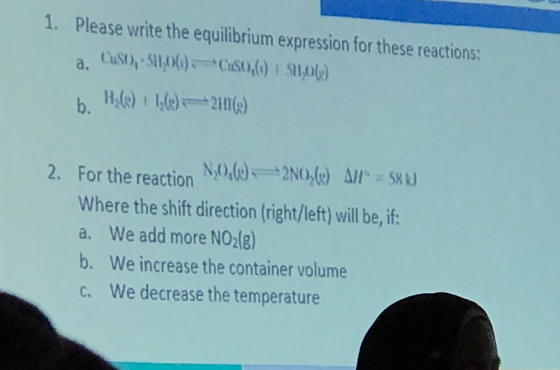
Ans 1 :
The equillibrium expression is given as the ration of product concentration over reactant concentration at equilibrium , each raised to the power of their stoichiometric coefficients,
Solid species are not included in the expression.
So here :
a)
K = [H2O]5
b)
K = [HI]2/ [H2] [I2]
Add Answer to:
can anyone please explain me this question step by
step, thank you sir/miss
1. Please write...
Can you please explain me this question step by step? Thank you so much
 Can you please explain me this question step by step?
Thank you so much
Can you please explain me this question step by step?
Thank you so much
Could anyone please explain me this? or can you write this other way? Thank you public...
Could anyone please explain me this? or can you write this other way? Thank you public double getTotal() { return (item1==null?0:item1.getPrice())+ (item2==null?0:item2.getPrice())+ (item3==null?0:item3.getPrice());
Anyone please help me step by step Thank you dx dt dy dt v=vo +at 1)...
 Anyone please help me step by step
Thank you
dx dt dy dt v=vo +at 1) A car is traveling at +40 m/s and brakes to a stop with constant acceleration over 200 m. a) Draw a picture that shows all the relevant physical quantities, including unknowns b) Solve for the stopping time symbolically based on the given quantites (do not substitute in any values, including 0 values). e) What is the stopping time (numerically)?
Anyone please help me step by step
Thank you
dx dt dy dt v=vo +at 1) A car is traveling at +40 m/s and brakes to a stop with constant acceleration over 200 m. a) Draw a picture that shows all the relevant physical quantities, including unknowns b) Solve for the stopping time symbolically based on the given quantites (do not substitute in any values, including 0 values). e) What is the stopping time (numerically)?
Please anyone can help me with this probability question and please provide explanation. Thank you so...
Please anyone can help me with this probability question and please provide explanation. Thank you so much! (i) Consider two events A and B, with P(A) = 0.3, P(B) = 1. Compute P(A∩B), P(Ac ∩B), and P(A ∩ Bc) (where we denote by Ac = Ω \ A the complement of an event A). (ii) We now consider three independent events A, B, and C. Using the definition of inde- pendence, show that the two events Ac and Bc ∪...
Hello! Can someone help me and solve these? Thank you! 4. The following mechanism has been...
 Hello! Can someone help me and solve these? Thank you!
4. The following mechanism has been proposed for a reaction: Step 1 H2(g) + Step 2 O(g) + O2(g) H2(g) → O(g) H2O(g) + H2O(g) → (a) What is the equation for the overall reaction? (b) What are the expected rate laws for Step 1 and Step 2? Step 1 - Step 2 (c) What if any intermediates are there? (d) If step 1 is slow and step 2 is...
Hello! Can someone help me and solve these? Thank you!
4. The following mechanism has been proposed for a reaction: Step 1 H2(g) + Step 2 O(g) + O2(g) H2(g) → O(g) H2O(g) + H2O(g) → (a) What is the equation for the overall reaction? (b) What are the expected rate laws for Step 1 and Step 2? Step 1 - Step 2 (c) What if any intermediates are there? (d) If step 1 is slow and step 2 is...
Can anyone help me find the answer to this? Thank you! part B please View Available...
 Can anyone help me find the answer to this?
Thank you! part B please
View Available Hint(s) The ideal gas law (PV = nRT) describes the relationship among pressure P, volume V, temperature T, and molar amount n. When n and V are fixed, the equation can be rearranged to take the following form where k is a constant: Pfinal = 2.61 atm f = np = k or ( a = ( ) final initial Submit Previous Answers When...
Can anyone help me find the answer to this?
Thank you! part B please
View Available Hint(s) The ideal gas law (PV = nRT) describes the relationship among pressure P, volume V, temperature T, and molar amount n. When n and V are fixed, the equation can be rearranged to take the following form where k is a constant: Pfinal = 2.61 atm f = np = k or ( a = ( ) final initial Submit Previous Answers When...
Hello! Can someone answer this question and explain it? Thank you! 8. Consider the following equilibrium....
 Hello! Can someone answer this question and explain it? Thank
you!
8. Consider the following equilibrium. The AHrxn-- 116.2 kJ/mol 2NO(g) + O2(B) 2NO2(g) If the following changes are made to the reaction, in which direction will the equilibrium shift? (a) NO is added to the reaction flask. (b) O2 is removed from the reaction flask (C) NO2 is removed from the reaction flask (d) The volume of the flask is doubled (e) The temperature is increased
Hello! Can someone answer this question and explain it? Thank
you!
8. Consider the following equilibrium. The AHrxn-- 116.2 kJ/mol 2NO(g) + O2(B) 2NO2(g) If the following changes are made to the reaction, in which direction will the equilibrium shift? (a) NO is added to the reaction flask. (b) O2 is removed from the reaction flask (C) NO2 is removed from the reaction flask (d) The volume of the flask is doubled (e) The temperature is increased
both probelms please! show work thank you (: 1 pts Question 10 Consider the following reaction:...
 both probelms please! show work thank you (:
1 pts Question 10 Consider the following reaction: 2NOBr(g) + 2NO(g) + Bra(s) A1 L vessel is initially filled with pure NOBr. After equilibrium is reached, the volume is increased to 2L, while the temperature was kept constant. This will result in a shift in the equilibrium position to the right such that more products are made a decrease in ko an increase in Ko two of these answers are correct a...
both probelms please! show work thank you (:
1 pts Question 10 Consider the following reaction: 2NOBr(g) + 2NO(g) + Bra(s) A1 L vessel is initially filled with pure NOBr. After equilibrium is reached, the volume is increased to 2L, while the temperature was kept constant. This will result in a shift in the equilibrium position to the right such that more products are made a decrease in ko an increase in Ko two of these answers are correct a...
More Equilibrium: Please write equilibrium expressions for the following reactions: 1. i. 2 SO2 (g) +...
 More Equilibrium: Please write equilibrium expressions for the following reactions: 1. i. 2 SO2 (g) + O2 (g) 2 SO3 (g) il. NH4NOs (s) N2O (g) +2 H20 (g) i CaCO3 (s) + CaO (s) + CO2 (g) iv. HNO2 (aq) +H2O (I) HaO* (aq) + NO2 (aq) 2. Predict which way the equilibrium will shift for each of the following changes: CO (g) + H2 (g) C (s) H2O (g) + heat i. increase [H2O] ii. increase [C0] iii....
Can you please explain me this question step by step? Thank you P2. (6-23) When the...
 Can you please explain me this question step by step?
Thank you
P2. (6-23) When the three blocks in Fig. are released from rest, they accelerate with a magnitude of 0.5m/s2. Block 1 has mass M, block 2 has 2M, and block 3 has 2M. What is the coefficient of kinetic friction between block 2 and the table? (Assume that the pulleys are frictionless.) (Ans: 0.37)
Can you please explain me this question step by step?
Thank you
P2. (6-23) When the three blocks in Fig. are released from rest, they accelerate with a magnitude of 0.5m/s2. Block 1 has mass M, block 2 has 2M, and block 3 has 2M. What is the coefficient of kinetic friction between block 2 and the table? (Assume that the pulleys are frictionless.) (Ans: 0.37)
 Can you please explain me this question step by step?
Thank you so much
Can you please explain me this question step by step?
Thank you so much
 Anyone please help me step by step
Thank you
dx dt dy dt v=vo +at 1) A car is traveling at +40 m/s and brakes to a stop with constant acceleration over 200 m. a) Draw a picture that shows all the relevant physical quantities, including unknowns b) Solve for the stopping time symbolically based on the given quantites (do not substitute in any values, including 0 values). e) What is the stopping time (numerically)?
Anyone please help me step by step
Thank you
dx dt dy dt v=vo +at 1) A car is traveling at +40 m/s and brakes to a stop with constant acceleration over 200 m. a) Draw a picture that shows all the relevant physical quantities, including unknowns b) Solve for the stopping time symbolically based on the given quantites (do not substitute in any values, including 0 values). e) What is the stopping time (numerically)?
 Hello! Can someone help me and solve these? Thank you!
4. The following mechanism has been proposed for a reaction: Step 1 H2(g) + Step 2 O(g) + O2(g) H2(g) → O(g) H2O(g) + H2O(g) → (a) What is the equation for the overall reaction? (b) What are the expected rate laws for Step 1 and Step 2? Step 1 - Step 2 (c) What if any intermediates are there? (d) If step 1 is slow and step 2 is...
Hello! Can someone help me and solve these? Thank you!
4. The following mechanism has been proposed for a reaction: Step 1 H2(g) + Step 2 O(g) + O2(g) H2(g) → O(g) H2O(g) + H2O(g) → (a) What is the equation for the overall reaction? (b) What are the expected rate laws for Step 1 and Step 2? Step 1 - Step 2 (c) What if any intermediates are there? (d) If step 1 is slow and step 2 is...
 Can anyone help me find the answer to this?
Thank you! part B please
View Available Hint(s) The ideal gas law (PV = nRT) describes the relationship among pressure P, volume V, temperature T, and molar amount n. When n and V are fixed, the equation can be rearranged to take the following form where k is a constant: Pfinal = 2.61 atm f = np = k or ( a = ( ) final initial Submit Previous Answers When...
Can anyone help me find the answer to this?
Thank you! part B please
View Available Hint(s) The ideal gas law (PV = nRT) describes the relationship among pressure P, volume V, temperature T, and molar amount n. When n and V are fixed, the equation can be rearranged to take the following form where k is a constant: Pfinal = 2.61 atm f = np = k or ( a = ( ) final initial Submit Previous Answers When...
 Hello! Can someone answer this question and explain it? Thank
you!
8. Consider the following equilibrium. The AHrxn-- 116.2 kJ/mol 2NO(g) + O2(B) 2NO2(g) If the following changes are made to the reaction, in which direction will the equilibrium shift? (a) NO is added to the reaction flask. (b) O2 is removed from the reaction flask (C) NO2 is removed from the reaction flask (d) The volume of the flask is doubled (e) The temperature is increased
Hello! Can someone answer this question and explain it? Thank
you!
8. Consider the following equilibrium. The AHrxn-- 116.2 kJ/mol 2NO(g) + O2(B) 2NO2(g) If the following changes are made to the reaction, in which direction will the equilibrium shift? (a) NO is added to the reaction flask. (b) O2 is removed from the reaction flask (C) NO2 is removed from the reaction flask (d) The volume of the flask is doubled (e) The temperature is increased
 both probelms please! show work thank you (:
1 pts Question 10 Consider the following reaction: 2NOBr(g) + 2NO(g) + Bra(s) A1 L vessel is initially filled with pure NOBr. After equilibrium is reached, the volume is increased to 2L, while the temperature was kept constant. This will result in a shift in the equilibrium position to the right such that more products are made a decrease in ko an increase in Ko two of these answers are correct a...
both probelms please! show work thank you (:
1 pts Question 10 Consider the following reaction: 2NOBr(g) + 2NO(g) + Bra(s) A1 L vessel is initially filled with pure NOBr. After equilibrium is reached, the volume is increased to 2L, while the temperature was kept constant. This will result in a shift in the equilibrium position to the right such that more products are made a decrease in ko an increase in Ko two of these answers are correct a...
 More Equilibrium: Please write equilibrium expressions for the following reactions: 1. i. 2 SO2 (g) + O2 (g) 2 SO3 (g) il. NH4NOs (s) N2O (g) +2 H20 (g) i CaCO3 (s) + CaO (s) + CO2 (g) iv. HNO2 (aq) +H2O (I) HaO* (aq) + NO2 (aq) 2. Predict which way the equilibrium will shift for each of the following changes: CO (g) + H2 (g) C (s) H2O (g) + heat i. increase [H2O] ii. increase [C0] iii....
 Can you please explain me this question step by step?
Thank you
P2. (6-23) When the three blocks in Fig. are released from rest, they accelerate with a magnitude of 0.5m/s2. Block 1 has mass M, block 2 has 2M, and block 3 has 2M. What is the coefficient of kinetic friction between block 2 and the table? (Assume that the pulleys are frictionless.) (Ans: 0.37)
Can you please explain me this question step by step?
Thank you
P2. (6-23) When the three blocks in Fig. are released from rest, they accelerate with a magnitude of 0.5m/s2. Block 1 has mass M, block 2 has 2M, and block 3 has 2M. What is the coefficient of kinetic friction between block 2 and the table? (Assume that the pulleys are frictionless.) (Ans: 0.37)
Most questions answered within 3 hours.
-
Where is the error in this code sequence?
String s1 = "Hello";
String s2 = "ello";...
asked 10 months ago -
Financial data for Joel de Paris, Inc., for last year
follow:
Joel de Paris, Inc.
Balance...
asked 10 months ago -
Consider this reaction:
Al2(SO4)3 (aq)+ BaCl3
(aq) Al2Cl6 (aq)- +
3BaSO4(s) . What is the...
asked 10 months ago -
Suppose that Savneet is considering increasing her
recent random sample from 20 car rentals to 40...
asked 10 months ago -
Trucks arrive at an unloading terminal at an average rate of 120
per hour.
Trucks arrive...
asked 10 months ago -
Why are methanol and ethanol completely soluble in water while
octanol is not very little soluble....
asked 10 months ago -
A facilities manager at a university reads in a research report
that the mean amount of...
asked 10 months ago -
When the CuSO4 is rehydrated by adding water to the anhydrous
compound, is this an endothermic...
asked 10 months ago -
A ray of sunlight is passing from diamond into crown glass; the
angle of incidence is...
asked 10 months ago -
A block of mass 0.249 kg is placed on top of a light, vertical
spring of...
asked 10 months ago -
how do the kidneys compensate in the presences of acidosis
a) trigger hyperventilate
b) reserve acid...
asked 10 months ago -
Question 501 pts
The rental rate of capital to the firm increases. Which of the
following...
asked 10 months ago