
Homework Answers
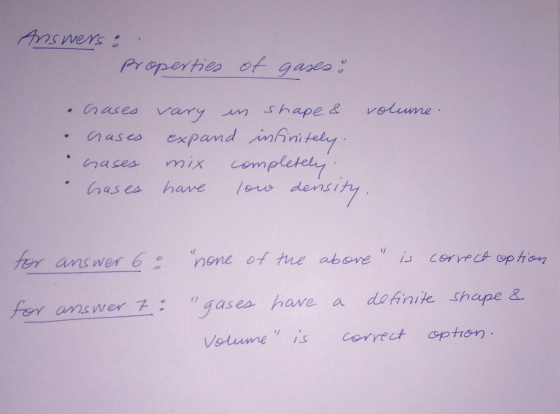
Please do give a thumbs up.
Add Answer to:
Question 6 0.5 pts Which of the following is an observed property of gases? gases compress...
Which of the following is a property of both gases and liquids? O definite shape O...
 Which of the following is a property of both gases and liquids? O definite shape O definite volume indefinite shape O indefinite volume Question 4 4 pts In which one of the following measure numbers are all of the zeros significant? O 0.0705 O 0.000440 O 3,300,000 O 3.945900
QUESTION 1 Which of the following is a property of both gases and liquids? a. Indefinite...
 QUESTION 1 Which of the following is a property of both gases and liquids? a. Indefinite volume b. Definite shape c. Definite volume d. Indefinite shape QUESTION 2 In which of the following pairs of chemical formulas do the two members of the pair contain the same number of elements as well as the same number of atoms? a. CoBry and COBr2 b. Cs and CS c. CoCl2 and CoCl3 d. NH4Brand NISO4 QUESTION 3 Which of the following statements...
Which assumption is not part of the kinetic-molecular theory of gases? A. The kinetic energy of...
Which assumption is not part of the kinetic-molecular theory of gases? A. The kinetic energy of gas particles change with change in temperature. B. Because the space between gas particles is large, gas particles exert no attractive forces on each other. C. When gas particles collide with each other, they rebound and travel in new directions D. The size of gas particles is small compared to the space between the particles. E. Gas consists of particles that move randomly and...
Match the property with s, l, or g QUESTION 3 Match the property with s, Torg,...
 Match the property with s, l, or g
QUESTION 3 Match the property with s, Torg, Expands to fill the container A fixed volume that takes the shape of the container it occupies A definite shape and volume A. gas Arrangement of particles: randomly arranged, disorganized and far apart. • Fixed arrangement of very close particles • Density is low (< 0.01 g/mL) B.liquid C.solid • Particles are moving very fast Interactions between the particles is very strong • Densities...
Match the property with s, l, or g
QUESTION 3 Match the property with s, Torg, Expands to fill the container A fixed volume that takes the shape of the container it occupies A definite shape and volume A. gas Arrangement of particles: randomly arranged, disorganized and far apart. • Fixed arrangement of very close particles • Density is low (< 0.01 g/mL) B.liquid C.solid • Particles are moving very fast Interactions between the particles is very strong • Densities...
QUESTION 3 0.5 points Save Answer According the the kinetic molecular theory of gases, rank the...
 QUESTION 3 0.5 points Save Answer According the the kinetic molecular theory of gases, rank the following molecules at STP by their density: H2 CH4 Cl2 {In each blank type <; =, or > as appropriate.} QUESTION 4 0.5 points Save Answer pressure, A real gas will deviate most from the properties of an ideal gas, at volumes, temperature. In other words, what conditions are the least ideal. {Fill in each blank with the word high, large, small or low...
Suppose you have a mixture of ideal gases. Which of the following statements is false? Select...
 Suppose you have a mixture of ideal gases. Which of the following statements is false? Select one: a. The mixture will behave as an ideal gas to a first approximation. b. The molar volume depends on the identity of the gases c. The gases will expand to fill the entire container. The total pressure is equal to the sum of partial pressures of the constituent d. gases.
Question 1 0.5 pts Which of the following decreases the pressure of a gas? none of...
 Question 1 0.5 pts Which of the following decreases the pressure of a gas? none of the above decreasing the temperature increasing the volume O all of the above decreasing the number of gas molecules Question 2 0.25 pts If a piston compresses air in a steel cylinder, what happens in the cylinder? the volume decreases, and the presure decreases none of the above o the volume decreases, and the pressure increases the volume increases, and the pressure decreases the...
1. Short Answer Questions on Gases: a State whether the following comments are True or Falso....
 1. Short Answer Questions on Gases: a State whether the following comments are True or Falso. If false, modify the statement so that it is correct (5 pts ench). 1. Pressure and volume are inversely proportional 2. Gases behave most ideally at high pressure and low temperature 3. Gases have definite shape and no definite volume 4. Pressure and temperature are directly proportional b. In a reaction flask, 120 torr of CO2 is combined with 150 torr of NH3(g) and...
Question 40 Which of the following statements regarding the mixing of gases is correct? More massive...
 Question 40 Which of the following statements regarding the mixing of gases is correct? More massive gases settle to the bottom of a container, leaving lighter gases near the top b. Nonpolar gases do not mix with polar gases The relative proportions of gases in a mixture vary throughout the container, depending on the pressure d. Gases mix more uniformly at lower temperatures All gas mixtures are homogeneous
8:574 Question 8 of 23 Submit Which is NOT a property of an ideal gas? A)...
 8:574 Question 8 of 23 Submit Which is NOT a property of an ideal gas? A) Consists of point particles B) Can pass through walls C) There are no attractive/repulsive forces D) All of the above are properties of ideal gases E) None of the above are properties of ideal gases Tap here or pull up for additional resources
 Which of the following is a property of both gases and liquids? O definite shape O definite volume indefinite shape O indefinite volume Question 4 4 pts In which one of the following measure numbers are all of the zeros significant? O 0.0705 O 0.000440 O 3,300,000 O 3.945900
 QUESTION 1 Which of the following is a property of both gases and liquids? a. Indefinite volume b. Definite shape c. Definite volume d. Indefinite shape QUESTION 2 In which of the following pairs of chemical formulas do the two members of the pair contain the same number of elements as well as the same number of atoms? a. CoBry and COBr2 b. Cs and CS c. CoCl2 and CoCl3 d. NH4Brand NISO4 QUESTION 3 Which of the following statements...
 Match the property with s, l, or g
QUESTION 3 Match the property with s, Torg, Expands to fill the container A fixed volume that takes the shape of the container it occupies A definite shape and volume A. gas Arrangement of particles: randomly arranged, disorganized and far apart. • Fixed arrangement of very close particles • Density is low (< 0.01 g/mL) B.liquid C.solid • Particles are moving very fast Interactions between the particles is very strong • Densities...
Match the property with s, l, or g
QUESTION 3 Match the property with s, Torg, Expands to fill the container A fixed volume that takes the shape of the container it occupies A definite shape and volume A. gas Arrangement of particles: randomly arranged, disorganized and far apart. • Fixed arrangement of very close particles • Density is low (< 0.01 g/mL) B.liquid C.solid • Particles are moving very fast Interactions between the particles is very strong • Densities...
 QUESTION 3 0.5 points Save Answer According the the kinetic molecular theory of gases, rank the following molecules at STP by their density: H2 CH4 Cl2 {In each blank type <; =, or > as appropriate.} QUESTION 4 0.5 points Save Answer pressure, A real gas will deviate most from the properties of an ideal gas, at volumes, temperature. In other words, what conditions are the least ideal. {Fill in each blank with the word high, large, small or low...
 Suppose you have a mixture of ideal gases. Which of the following statements is false? Select one: a. The mixture will behave as an ideal gas to a first approximation. b. The molar volume depends on the identity of the gases c. The gases will expand to fill the entire container. The total pressure is equal to the sum of partial pressures of the constituent d. gases.
 Question 1 0.5 pts Which of the following decreases the pressure of a gas? none of the above decreasing the temperature increasing the volume O all of the above decreasing the number of gas molecules Question 2 0.25 pts If a piston compresses air in a steel cylinder, what happens in the cylinder? the volume decreases, and the presure decreases none of the above o the volume decreases, and the pressure increases the volume increases, and the pressure decreases the...
 1. Short Answer Questions on Gases: a State whether the following comments are True or Falso. If false, modify the statement so that it is correct (5 pts ench). 1. Pressure and volume are inversely proportional 2. Gases behave most ideally at high pressure and low temperature 3. Gases have definite shape and no definite volume 4. Pressure and temperature are directly proportional b. In a reaction flask, 120 torr of CO2 is combined with 150 torr of NH3(g) and...
 Question 40 Which of the following statements regarding the mixing of gases is correct? More massive gases settle to the bottom of a container, leaving lighter gases near the top b. Nonpolar gases do not mix with polar gases The relative proportions of gases in a mixture vary throughout the container, depending on the pressure d. Gases mix more uniformly at lower temperatures All gas mixtures are homogeneous
 8:574 Question 8 of 23 Submit Which is NOT a property of an ideal gas? A) Consists of point particles B) Can pass through walls C) There are no attractive/repulsive forces D) All of the above are properties of ideal gases E) None of the above are properties of ideal gases Tap here or pull up for additional resources
Most questions answered within 3 hours.
-
Where is the error in this code sequence?
String s1 = "Hello";
String s2 = "ello";...
asked 11 months ago -
Financial data for Joel de Paris, Inc., for last year
follow:
Joel de Paris, Inc.
Balance...
asked 11 months ago -
Consider this reaction:
Al2(SO4)3 (aq)+ BaCl3
(aq) Al2Cl6 (aq)- +
3BaSO4(s) . What is the...
asked 11 months ago -
Suppose that Savneet is considering increasing her
recent random sample from 20 car rentals to 40...
asked 11 months ago -
Trucks arrive at an unloading terminal at an average rate of 120
per hour.
Trucks arrive...
asked 11 months ago -
Why are methanol and ethanol completely soluble in water while
octanol is not very little soluble....
asked 11 months ago -
A facilities manager at a university reads in a research report
that the mean amount of...
asked 11 months ago -
When the CuSO4 is rehydrated by adding water to the anhydrous
compound, is this an endothermic...
asked 11 months ago -
A ray of sunlight is passing from diamond into crown glass; the
angle of incidence is...
asked 11 months ago -
A block of mass 0.249 kg is placed on top of a light, vertical
spring of...
asked 11 months ago -
how do the kidneys compensate in the presences of acidosis
a) trigger hyperventilate
b) reserve acid...
asked 11 months ago -
Question 501 pts
The rental rate of capital to the firm increases. Which of the
following...
asked 11 months ago