Please use the following formulas to answer the question:
![1. Arithmetic average stock returns .-= (+r)x(1+r)x.X(1+r)]š –1 = 19+r)*-1 2. Geometric average stock returns 3. APR versus E](http://img.homeworklib.com/questions/d00ba660-741f-11ea-be73-c7a55ee9ce8f.png?x-oss-process=image/resize,w_560)
Homework Answers
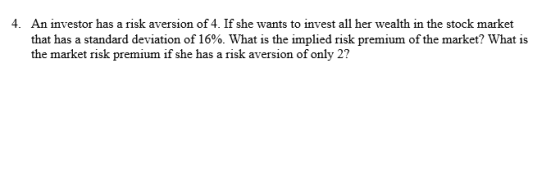
Risk Aversion factor =4
Standard Deviation of market =16%
Risk Aversion (A) =Risk Premium/Standard Deviation^2
Risk Premium =4*16%^2 =10.24%
If Risk Aversion =2
Then Risk Premium =2*16%^2 =5.12%
Add Answer to:
Please use the following formulas to answer the question:
4. An investor has a risk aversion...
dont use excel solve using any equations 1. An investor has a risk aversion of 4....
 dont use excel
solve using any equations
1. An investor has a risk aversion of 4. If she wants to invest all her wealth in the stock market that has a standard deviation of 16%. What is the implied risk premium of the market? What is the market risk premium if she has a risk aversion of only 2? 2. There are two stocks: A and B, and Treasury Bill (TB). The parameters of these securities are following: Expected Return...
dont use excel
solve using any equations
1. An investor has a risk aversion of 4. If she wants to invest all her wealth in the stock market that has a standard deviation of 16%. What is the implied risk premium of the market? What is the market risk premium if she has a risk aversion of only 2? 2. There are two stocks: A and B, and Treasury Bill (TB). The parameters of these securities are following: Expected Return...
An investor has mean-variance utility preferences: U = E(R) – 0.5A02 coefficient of risk aversion A...
 An investor has mean-variance utility preferences: U = E(R) – 0.5A02 coefficient of risk aversion A = 5. market expected return is E(RM) = 5% standard deviation of the market is om = 10%. risk-free rate is Rf = 2%. Under CAPM, what's the weight of the risk-free assets (Wf) on your optimal portfolio?
6) Consider a simple stock market where there exist two risky securities, s stock in a...
 6) Consider a simple stock market where there exist two risky securities, s stock in a two-stock portfolio be w, and w, the projected return on each stock be denoted by E(R )and E(R,), the variance of each stock be σ' and σ| respectively, and the covariance of the two stocks be σ12 . ecurity 1 and security 2. Let the weights attached to each The expected return of the portfolio is given by the expression E(R,)-w,E(R, ) + w2E(R2)...
T- bill rate is 4%. A risk-averse investor with a degree of risk aversion A =...
T- bill rate is 4%. A risk-averse investor with a degree of risk aversion A = 3 invests entirely in a risky portfolio with a standard deviation of 24%. What should the risky portfolio's expected return be?
Please show work. An investor has a risk aversion of 4. If she wants to invest...
 Please show work.
An investor has a risk aversion of 4. If she wants to invest all her wealth in the stock market that has a standard deviation of 16%. What is the implied risk premium of the market? What is the market risk premium if she has a risk aversion of only 2?| T
Please show work.
An investor has a risk aversion of 4. If she wants to invest all her wealth in the stock market that has a standard deviation of 16%. What is the implied risk premium of the market? What is the market risk premium if she has a risk aversion of only 2?| T
Assume an investor has mean-variance utility preferences U = E(R) - 0.5A02 with coefficient of risk...
 Assume an investor has mean-variance utility preferences U = E(R) - 0.5A02 with coefficient of risk aversion A = 5. The market expected return is E(RM) = 5% and the standard deviation of the market is OM = 10%. The risk-free rate is Rs = 2%. Under CAPM, what's the weight of the risk-free assets (We) on your optimal portfolio?
Greta, an elderly investor, has a degree of risk aversion of A = 4 when applied...
 Greta, an elderly investor, has a degree of risk aversion of A = 4 when applied to return on wealth over a one-year horizon. She is pondering two portfolios, the S&P 500 and a hedge fund, as well as a number of 4-year strategies. (All rates are annual, continuously compounded.) The S&P 500 risk premium is estimated at 7% per year, with a SD of 18%. The hedge fund risk premium is estimated at 5% with a SD of 25%....
D EAL 4. (20 pts) An investor has a risk aversion of 4. If she wants...
 D EAL 4. (20 pts) An investor has a risk aversion of 4. If she wants to invest all her wealth in the stock market that has a standard deviation of 16%. What is the implied risk premium of the market? What is the market risk premium if she has a risk aversion of only 2?
1. Consider an investor with $1 of wealth. He has to compose a portfolio with the...
1. Consider an investor with $1 of wealth. He has to compose a portfolio with the following two risky assets. The rates of returns from those assets are specified by expectations, variances and correlations. var[r 1] = 0.02 E[r 1] = 0.05 var[r 2] = 0.03 E[r 2] = 0.08 corr[r 1, r 2] = 0.7 (a) Draw an efficient frontier of the investor. (b) How will the mean-variance efficient frontier in (a) change if corr[r 1, r 2] =...
You are constructing a portfolio for an investor with a risk aversion of A=4. You can...
You are constructing a portfolio for an investor with a risk aversion of A=4. You can invest their money in a riskless asset with a return of 0.022, or a risky asset with an expected return of 0.124 and a standard deviation of 0.39. What proportion of their assets should you put in the risky asset? An answer of 0 means none of their assets, an answer of 1 means all of their assets.
 dont use excel
solve using any equations
1. An investor has a risk aversion of 4. If she wants to invest all her wealth in the stock market that has a standard deviation of 16%. What is the implied risk premium of the market? What is the market risk premium if she has a risk aversion of only 2? 2. There are two stocks: A and B, and Treasury Bill (TB). The parameters of these securities are following: Expected Return...
dont use excel
solve using any equations
1. An investor has a risk aversion of 4. If she wants to invest all her wealth in the stock market that has a standard deviation of 16%. What is the implied risk premium of the market? What is the market risk premium if she has a risk aversion of only 2? 2. There are two stocks: A and B, and Treasury Bill (TB). The parameters of these securities are following: Expected Return...
 An investor has mean-variance utility preferences: U = E(R) – 0.5A02 coefficient of risk aversion A = 5. market expected return is E(RM) = 5% standard deviation of the market is om = 10%. risk-free rate is Rf = 2%. Under CAPM, what's the weight of the risk-free assets (Wf) on your optimal portfolio?
 6) Consider a simple stock market where there exist two risky securities, s stock in a two-stock portfolio be w, and w, the projected return on each stock be denoted by E(R )and E(R,), the variance of each stock be σ' and σ| respectively, and the covariance of the two stocks be σ12 . ecurity 1 and security 2. Let the weights attached to each The expected return of the portfolio is given by the expression E(R,)-w,E(R, ) + w2E(R2)...
 Please show work.
An investor has a risk aversion of 4. If she wants to invest all her wealth in the stock market that has a standard deviation of 16%. What is the implied risk premium of the market? What is the market risk premium if she has a risk aversion of only 2?| T
Please show work.
An investor has a risk aversion of 4. If she wants to invest all her wealth in the stock market that has a standard deviation of 16%. What is the implied risk premium of the market? What is the market risk premium if she has a risk aversion of only 2?| T
 Assume an investor has mean-variance utility preferences U = E(R) - 0.5A02 with coefficient of risk aversion A = 5. The market expected return is E(RM) = 5% and the standard deviation of the market is OM = 10%. The risk-free rate is Rs = 2%. Under CAPM, what's the weight of the risk-free assets (We) on your optimal portfolio?
 Greta, an elderly investor, has a degree of risk aversion of A = 4 when applied to return on wealth over a one-year horizon. She is pondering two portfolios, the S&P 500 and a hedge fund, as well as a number of 4-year strategies. (All rates are annual, continuously compounded.) The S&P 500 risk premium is estimated at 7% per year, with a SD of 18%. The hedge fund risk premium is estimated at 5% with a SD of 25%....
 D EAL 4. (20 pts) An investor has a risk aversion of 4. If she wants to invest all her wealth in the stock market that has a standard deviation of 16%. What is the implied risk premium of the market? What is the market risk premium if she has a risk aversion of only 2?
Most questions answered within 3 hours.
-
Where is the error in this code sequence?
String s1 = "Hello";
String s2 = "ello";...
asked 10 months ago -
Financial data for Joel de Paris, Inc., for last year
follow:
Joel de Paris, Inc.
Balance...
asked 10 months ago -
Consider this reaction:
Al2(SO4)3 (aq)+ BaCl3
(aq) Al2Cl6 (aq)- +
3BaSO4(s) . What is the...
asked 10 months ago -
Suppose that Savneet is considering increasing her
recent random sample from 20 car rentals to 40...
asked 10 months ago -
Trucks arrive at an unloading terminal at an average rate of 120
per hour.
Trucks arrive...
asked 10 months ago -
Why are methanol and ethanol completely soluble in water while
octanol is not very little soluble....
asked 10 months ago -
A facilities manager at a university reads in a research report
that the mean amount of...
asked 10 months ago -
When the CuSO4 is rehydrated by adding water to the anhydrous
compound, is this an endothermic...
asked 10 months ago -
A ray of sunlight is passing from diamond into crown glass; the
angle of incidence is...
asked 10 months ago -
A block of mass 0.249 kg is placed on top of a light, vertical
spring of...
asked 10 months ago -
how do the kidneys compensate in the presences of acidosis
a) trigger hyperventilate
b) reserve acid...
asked 10 months ago -
Question 501 pts
The rental rate of capital to the firm increases. Which of the
following...
asked 10 months ago