
Homework Answers
Add Answer to:
In a chemical reaction, the reactant that limits the amount of product that can be formed...
The limiting reactant is the chemical substance that determines the amount of product(s) that can ultimately...
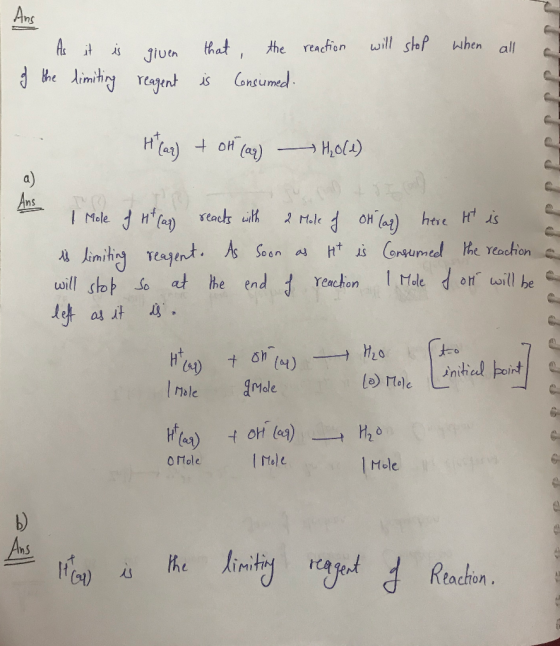
 The limiting reactant is the chemical substance that determines the amount of product(s) that can ultimately be formed in a reaction. During the reaction, the limiting reactant is completely consumed or used up, and therefore, causes the reaction to stop The limiting reactant can be identified through stoichiometric calculations. After comparing the results, the reactant that produces the smaller mass of product is identified as the limiting reactant. Determine the excess reactant and calculate the mass of the remaining excess...
QUESTION 9 In a chemical reaction, the reactant remaining after all of the other reactants has...
 QUESTION 9 In a chemical reaction, the reactant remaining after all of the other reactants has been used up is referred to Excess reactant Limiting reactant Primary reactant Primary product QUESTION 10 Calculate the mass of hydrogen(H2) formed when 0.927 moles of aluminum(Al) reacts with excess hydrochloric acid (HCI) 0.41 g 1.2g 1.8g 2.8g 0.92 g
Worksheet (Ch 9) 10 points Name: 1. The limiting reactant in a chemical reaction is the...
 Worksheet (Ch 9) 10 points Name: 1. The limiting reactant in a chemical reaction is the reactant that is completely consumed first. a] true b] false 2. In every chemical reaction, the number of moles of reactant must equal the number of moles of product. a] true The reactant present in the fewest number of moles is always the limiting reactant. [a] true Ib] false 3. Ib] false Show all the work for problems 4 to 15 to get full...
The theoretical yield of a chemical reaction is Question 6 options: a) the quantity of product...
The theoretical yield of a chemical reaction is Question 6 options: a) the quantity of product collected after completion of a chemical reaction. b) always equal to the mass of the limiting reactant used in the reaction. c) the maximum quantity of product that can be formed from a specified quantity of reactants. d) always equal to the number of moles of the limiting reactant used in the reaction.
Which statement describes a chemical reaction at equilibrium? Reactant molecules and product molecules have the same...
Which statement describes a chemical reaction at equilibrium? Reactant molecules and product molecules have the same velocity. Molecules of reactants and products collide with the same frequency. The concentrations of reactants and products are equimolar. Reactants and products are consumed and formed at the same rate.
Write the state of matter for every substance in the chemical reaction. Explain your limiting reactant...
Write the state of matter for every substance in the chemical reaction. Explain your limiting reactant determinations. Mark every measured number showing the significant figures (SF). Do not round any intermediate values. (you can show two digits past the marked SF) Show subtraction and addition in the vertical format. Show your final answer before rounding and then in the final form, rounded correctly. Every number must have units and substances. You can use tables or other means to increase your...
Objective Find the ratio of moles of reactant to moles of a product for the reaction...
Objective Find the ratio of moles of reactant to moles of a product for the reaction below. Compare mass and mole amounts of reactants to determine the amount of products that can be/are made. Background Chemical reactions are represented by balanced chemical equations. Proper interpretation of an equation provides a great deal of information about the reaction it represents and about the substances involved in the reaction. For example, the coefficients in a balanced equation indicate the number of moles...
I’m not sure what I’ve done wrong since the rest of my calculations were correct, so...
 I’m
not sure what I’ve done wrong since the rest of my calculations
were correct, so will someone please explain to me how to solve
these. I’ve tried everything i can think of and nothing is working.
We were unable to transcribe this imagebalanced chemical equation: Pb(NO), (aq) + 2Cl(aq) - PbCl2(s) + 2KNO3(aq) What is the limiting reactant? lead(II) nitrate O potassium chloride The percent yield for the reaction is 80.6%. How many grams of precipitate is recovered? precipitate...
I’m
not sure what I’ve done wrong since the rest of my calculations
were correct, so will someone please explain to me how to solve
these. I’ve tried everything i can think of and nothing is working.
We were unable to transcribe this imagebalanced chemical equation: Pb(NO), (aq) + 2Cl(aq) - PbCl2(s) + 2KNO3(aq) What is the limiting reactant? lead(II) nitrate O potassium chloride The percent yield for the reaction is 80.6%. How many grams of precipitate is recovered? precipitate...
Problem 10.8 identify the reactant that is a Brønsted - Lowry acid in the following reaction:...
 Problem 10.8 identify the reactant that is a Brønsted - Lowry acid in the following reaction: co32-(aq) + H2O(l) HCO'. (aq) + OH-(aq) Express your answer as a chemical formula a ? Submit Request Answer Part B Identify the reactant that is a Bronsted Lowry base in the following reaction: co32-(aq) + H2O() HCO3 (aq) + OH' (aq) Express your answer as a chemical formula. Submit Request Answer ▼ Part C identily the reactant that is a Brønsted - Lowry...
When a strong acid-strong base neutralization reaction is also a limiting reactant situation, the leftover reactant...
When a strong acid-strong base neutralization reaction is also a limiting reactant situation, the leftover reactant will determine your final solution pH. Remember that a limiting reactant indicates that you will run out of one reactant first. Considering the reaction of potassium hydroxide and hydrobromic acid, notice that if you have excess acid leftover it would react with water to produce H3O+ ions in solution: HBr + H2O → Br- + H3O+ If you have excess base left over, it...
 The limiting reactant is the chemical substance that determines the amount of product(s) that can ultimately be formed in a reaction. During the reaction, the limiting reactant is completely consumed or used up, and therefore, causes the reaction to stop The limiting reactant can be identified through stoichiometric calculations. After comparing the results, the reactant that produces the smaller mass of product is identified as the limiting reactant. Determine the excess reactant and calculate the mass of the remaining excess...
 QUESTION 9 In a chemical reaction, the reactant remaining after all of the other reactants has been used up is referred to Excess reactant Limiting reactant Primary reactant Primary product QUESTION 10 Calculate the mass of hydrogen(H2) formed when 0.927 moles of aluminum(Al) reacts with excess hydrochloric acid (HCI) 0.41 g 1.2g 1.8g 2.8g 0.92 g
 Worksheet (Ch 9) 10 points Name: 1. The limiting reactant in a chemical reaction is the reactant that is completely consumed first. a] true b] false 2. In every chemical reaction, the number of moles of reactant must equal the number of moles of product. a] true The reactant present in the fewest number of moles is always the limiting reactant. [a] true Ib] false 3. Ib] false Show all the work for problems 4 to 15 to get full...
 I’m
not sure what I’ve done wrong since the rest of my calculations
were correct, so will someone please explain to me how to solve
these. I’ve tried everything i can think of and nothing is working.
We were unable to transcribe this imagebalanced chemical equation: Pb(NO), (aq) + 2Cl(aq) - PbCl2(s) + 2KNO3(aq) What is the limiting reactant? lead(II) nitrate O potassium chloride The percent yield for the reaction is 80.6%. How many grams of precipitate is recovered? precipitate...
I’m
not sure what I’ve done wrong since the rest of my calculations
were correct, so will someone please explain to me how to solve
these. I’ve tried everything i can think of and nothing is working.
We were unable to transcribe this imagebalanced chemical equation: Pb(NO), (aq) + 2Cl(aq) - PbCl2(s) + 2KNO3(aq) What is the limiting reactant? lead(II) nitrate O potassium chloride The percent yield for the reaction is 80.6%. How many grams of precipitate is recovered? precipitate...
 Problem 10.8 identify the reactant that is a Brønsted - Lowry acid in the following reaction: co32-(aq) + H2O(l) HCO'. (aq) + OH-(aq) Express your answer as a chemical formula a ? Submit Request Answer Part B Identify the reactant that is a Bronsted Lowry base in the following reaction: co32-(aq) + H2O() HCO3 (aq) + OH' (aq) Express your answer as a chemical formula. Submit Request Answer ▼ Part C identily the reactant that is a Brønsted - Lowry...
Most questions answered within 3 hours.
-
Where is the error in this code sequence?
String s1 = "Hello";
String s2 = "ello";...
asked 10 months ago -
Financial data for Joel de Paris, Inc., for last year
follow:
Joel de Paris, Inc.
Balance...
asked 10 months ago -
Consider this reaction:
Al2(SO4)3 (aq)+ BaCl3
(aq) Al2Cl6 (aq)- +
3BaSO4(s) . What is the...
asked 10 months ago -
Suppose that Savneet is considering increasing her
recent random sample from 20 car rentals to 40...
asked 10 months ago -
Trucks arrive at an unloading terminal at an average rate of 120
per hour.
Trucks arrive...
asked 10 months ago -
Why are methanol and ethanol completely soluble in water while
octanol is not very little soluble....
asked 10 months ago -
A facilities manager at a university reads in a research report
that the mean amount of...
asked 10 months ago -
When the CuSO4 is rehydrated by adding water to the anhydrous
compound, is this an endothermic...
asked 10 months ago -
A ray of sunlight is passing from diamond into crown glass; the
angle of incidence is...
asked 10 months ago -
A block of mass 0.249 kg is placed on top of a light, vertical
spring of...
asked 10 months ago -
how do the kidneys compensate in the presences of acidosis
a) trigger hyperventilate
b) reserve acid...
asked 10 months ago -
Question 501 pts
The rental rate of capital to the firm increases. Which of the
following...
asked 10 months ago