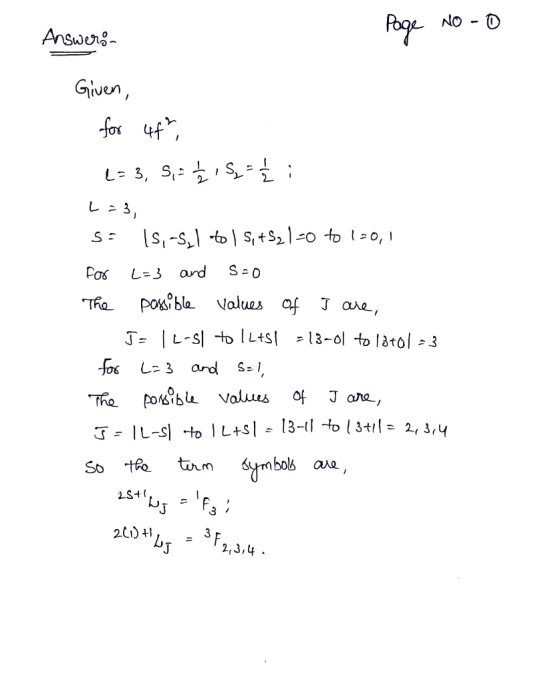
Determine the LS terms of the ns^2, nd^2, and 4f^2 configurations. Using Hund's rule, determine the...
Determine the LS terms of the ns^2, nd^2, and 4f^2 configurations. Using Hund's rule, determine the lowest LS term of the 4f^2 configuration.
Homework Answers
Add Answer to:
Determine the LS terms of the ns^2, nd^2, and 4f^2
configurations. Using Hund's rule, determine the...
2. For the following electronic configurations use Hund's rule to determine [3x3=9] the ground free ion...
 2. For the following electronic configurations use Hund's rule to determine [3x3=9] the ground free ion state. c) 65, 4P, 4G, 21 b) 3P, 5D, 3H, 'I, 'G a) 1P, 3P, 3F, G
give the ground-state Russell-Saunders terms for the following electronic configurations (a) Give the ground-state Russell-Saunders terms...
 give the ground-state Russell-Saunders terms for the following
electronic configurations
(a) Give the ground-state Russell-Saunders terms for the following electronic configurations: i. (3d) ii. (41) (Hint: S, P, D, F, G, H, I... for L=0, 1, 2, 3, 4, 5, 6 ...) (4 marks each, total 8 marks) (b) Determine ALL the atomic term symbols for the electronic configuration p3. Calculate the number of microstates and deduce the ground state term using Hund's rule. (10 marks)
give the ground-state Russell-Saunders terms for the following
electronic configurations
(a) Give the ground-state Russell-Saunders terms for the following electronic configurations: i. (3d) ii. (41) (Hint: S, P, D, F, G, H, I... for L=0, 1, 2, 3, 4, 5, 6 ...) (4 marks each, total 8 marks) (b) Determine ALL the atomic term symbols for the electronic configuration p3. Calculate the number of microstates and deduce the ground state term using Hund's rule. (10 marks)
Obtain term symbols for the electron configuration (ns)^1(nd)^1 and (ns)^2 (nd)^1 Order these according to Hund’s...
Obtain term symbols for the electron configuration (ns)^1(nd)^1 and (ns)^2 (nd)^1 Order these according to Hund’s Rules
X 2. For the following electronic configurations use Hund's rule to determine the ground free ion state. [3x3=9] * a...
 X 2. For the following electronic configurations use Hund's rule to determine the ground free ion state. [3x3=9] * a) 1P, 3P, 3F, 'G b) 3P, 5D, 3H, 41, 4G c) 65, 4P, 4G, 21 * 3a. What is the coordination number of the Fe atom in K3[Fe(C204)3]? [2] 3b. What is the coordination number of the Au atom ink[Au(CN)2(SCN)2]? [2] * 3c. Among the following 3d transition metal ions which one is kinetically inert? Cr2+, C03+, Co2+, Fe3+ [2]
a)List the L-S terms that arise from the (ns)(np)2 and(ns)2(np) configurations. [HINT: (np)2 gives 1S, 3P,...
a)List the L-S terms that arise from the (ns)(np)2 and(ns)2(np) configurations. [HINT: (np)2 gives 1S, 3P, 1D; to get sp2 couple an s electron to these three states.] b) List the electric dipole allowed transitions between terms of the sp2 and s2 p configurations. (Ignore fine-structure splitting of L-S terms into J-states.)
1. Using the Slater rule, determine the effective nuclear charge of platinum. 2. For element M,...
1. Using the Slater rule, determine the effective nuclear charge of platinum. 2. For element M, whose electronic configuration of its differential electron is: (5, 2, +1, -1/2), answer: a) Which orbital has the greatest screen effect, 6s, 5d or 4f (based on your answer with mathematical calculations)? b) Determine the value of Z * for the M + ion
Ligand Field theory and spectrochemical assignment: Use the LS coupling approach to determine the free ion...
Ligand Field theory and spectrochemical assignment: Use the LS coupling approach to determine the free ion states for a p3 configuration & identify the ground state term. In order to use the LS approach you must: 1) Determine the number of microstates for the p3 configuration (show work) 2) Construct a microstate table 3) Reduce the table to its constituent free-ion terms and give their symbols 4) Identify the ground state term
Q Consider Carbon (2=6) atom (a) What is the ground state configuratin. (b) What is the...
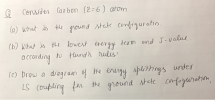 Q Consider Carbon (2=6) atom (a) What is the ground state configuratin. (b) What is the lowest evergy term and J-value. according to Hund's rules? (c) Draw a diagram of the energy splittings under LS coupling for the ground state configuration, -
Determine the number of distinct quantum states for each of the following configurations. In each case,...
 Determine the number of distinct quantum states for each of the following configurations. In each case, list the spectroscopic symbols of the allowed states. (a) two equivalent d electrons [e.g. (3d)?] (b) two non-equivalent d electrons [e.g. (3d)-(4d'] (c) the configuration (4p)(48) (d) the configuration (2p)? (3p)1 Use Hund's rules to predict the ordering in energy of the (3d)2 states-i.e. those found in Part (a) of Problem 1.
What atomic terms are possible for the electron configuration ns1nd1? (Select all that apply.) T...
 What atomic terms are possible for the electron configuration
ns1nd1? (Select all that apply.)
The wavenumber of the J = 3 ← 2 rotational transition
of 1H35Cl considered as a rigid rotor is
63.57 cm−1; what is the H–Cl bond length?
What atomic terms are possible for the electron configuration ns nd1? (Select all that apply.) 3 D3 22D2 32D3 23D2 33D3 12D1 13D Which term is likely to lie lowest in energy? O the D1D set of terms O...
What atomic terms are possible for the electron configuration
ns1nd1? (Select all that apply.)
The wavenumber of the J = 3 ← 2 rotational transition
of 1H35Cl considered as a rigid rotor is
63.57 cm−1; what is the H–Cl bond length?
What atomic terms are possible for the electron configuration ns nd1? (Select all that apply.) 3 D3 22D2 32D3 23D2 33D3 12D1 13D Which term is likely to lie lowest in energy? O the D1D set of terms O...
 2. For the following electronic configurations use Hund's rule to determine [3x3=9] the ground free ion state. c) 65, 4P, 4G, 21 b) 3P, 5D, 3H, 'I, 'G a) 1P, 3P, 3F, G
 give the ground-state Russell-Saunders terms for the following
electronic configurations
(a) Give the ground-state Russell-Saunders terms for the following electronic configurations: i. (3d) ii. (41) (Hint: S, P, D, F, G, H, I... for L=0, 1, 2, 3, 4, 5, 6 ...) (4 marks each, total 8 marks) (b) Determine ALL the atomic term symbols for the electronic configuration p3. Calculate the number of microstates and deduce the ground state term using Hund's rule. (10 marks)
give the ground-state Russell-Saunders terms for the following
electronic configurations
(a) Give the ground-state Russell-Saunders terms for the following electronic configurations: i. (3d) ii. (41) (Hint: S, P, D, F, G, H, I... for L=0, 1, 2, 3, 4, 5, 6 ...) (4 marks each, total 8 marks) (b) Determine ALL the atomic term symbols for the electronic configuration p3. Calculate the number of microstates and deduce the ground state term using Hund's rule. (10 marks)
 X 2. For the following electronic configurations use Hund's rule to determine the ground free ion state. [3x3=9] * a) 1P, 3P, 3F, 'G b) 3P, 5D, 3H, 41, 4G c) 65, 4P, 4G, 21 * 3a. What is the coordination number of the Fe atom in K3[Fe(C204)3]? [2] 3b. What is the coordination number of the Au atom ink[Au(CN)2(SCN)2]? [2] * 3c. Among the following 3d transition metal ions which one is kinetically inert? Cr2+, C03+, Co2+, Fe3+ [2]
 Q Consider Carbon (2=6) atom (a) What is the ground state configuratin. (b) What is the lowest evergy term and J-value. according to Hund's rules? (c) Draw a diagram of the energy splittings under LS coupling for the ground state configuration, -
 Determine the number of distinct quantum states for each of the following configurations. In each case, list the spectroscopic symbols of the allowed states. (a) two equivalent d electrons [e.g. (3d)?] (b) two non-equivalent d electrons [e.g. (3d)-(4d'] (c) the configuration (4p)(48) (d) the configuration (2p)? (3p)1 Use Hund's rules to predict the ordering in energy of the (3d)2 states-i.e. those found in Part (a) of Problem 1.
 What atomic terms are possible for the electron configuration
ns1nd1? (Select all that apply.)
The wavenumber of the J = 3 ← 2 rotational transition
of 1H35Cl considered as a rigid rotor is
63.57 cm−1; what is the H–Cl bond length?
What atomic terms are possible for the electron configuration ns nd1? (Select all that apply.) 3 D3 22D2 32D3 23D2 33D3 12D1 13D Which term is likely to lie lowest in energy? O the D1D set of terms O...
What atomic terms are possible for the electron configuration
ns1nd1? (Select all that apply.)
The wavenumber of the J = 3 ← 2 rotational transition
of 1H35Cl considered as a rigid rotor is
63.57 cm−1; what is the H–Cl bond length?
What atomic terms are possible for the electron configuration ns nd1? (Select all that apply.) 3 D3 22D2 32D3 23D2 33D3 12D1 13D Which term is likely to lie lowest in energy? O the D1D set of terms O...
Most questions answered within 3 hours.
-
Where is the error in this code sequence?
String s1 = "Hello";
String s2 = "ello";...
asked 11 months ago -
Financial data for Joel de Paris, Inc., for last year
follow:
Joel de Paris, Inc.
Balance...
asked 11 months ago -
Consider this reaction:
Al2(SO4)3 (aq)+ BaCl3
(aq) Al2Cl6 (aq)- +
3BaSO4(s) . What is the...
asked 11 months ago -
Suppose that Savneet is considering increasing her
recent random sample from 20 car rentals to 40...
asked 11 months ago -
Trucks arrive at an unloading terminal at an average rate of 120
per hour.
Trucks arrive...
asked 11 months ago -
Why are methanol and ethanol completely soluble in water while
octanol is not very little soluble....
asked 11 months ago -
A facilities manager at a university reads in a research report
that the mean amount of...
asked 11 months ago -
When the CuSO4 is rehydrated by adding water to the anhydrous
compound, is this an endothermic...
asked 11 months ago -
A ray of sunlight is passing from diamond into crown glass; the
angle of incidence is...
asked 11 months ago -
A block of mass 0.249 kg is placed on top of a light, vertical
spring of...
asked 11 months ago -
how do the kidneys compensate in the presences of acidosis
a) trigger hyperventilate
b) reserve acid...
asked 11 months ago -
Question 501 pts
The rental rate of capital to the firm increases. Which of the
following...
asked 11 months ago