a) Arrange the following species in terms of increasing CL-O bond energy ( lowest to highest,...
a) Arrange the following species in terms of increasing CL-O bond energy ( lowest to highest, use "=" if you believe two have the same energy).
CLOH, CLO4-, CLO3-, CLO2-
b) What is the average charge (formal) on the oxygen in each compound? (Show formula for Average formal charge)
c) Which compound do you think is more basic? why?
Homework Answers
Answer :
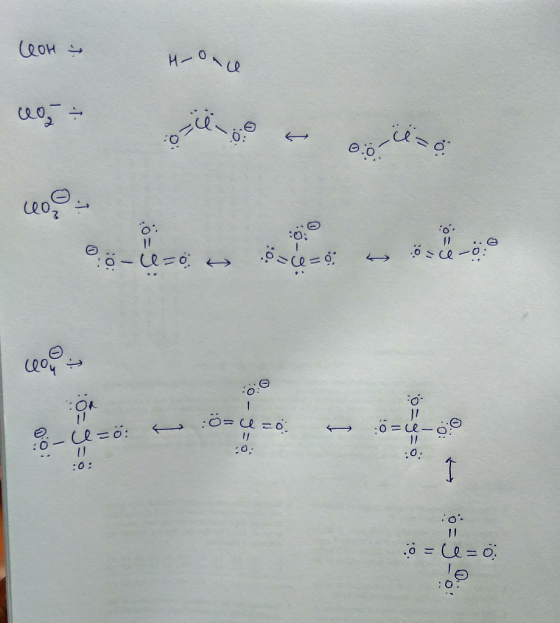
| Molecule | resonance forms | no. of total ClO bond in structure | Cl-O bond order = total no. of ClO bond / resonance structure | bond energy rank | |
| HOCl | 1 | 1 | 1/1 = 1 | 4 (lowest ) | |
| ClO2- | 2 | 3 | 3/2 = 1.5 | 3 | |
| ClO3 - | 3 | 5 | 5/3 = 1.66 | 2 | |
| ClO4 - | 4 | 7 | 7/4 = 1.75 | 1(highest) |
Since bond order is directly proportional to bond energy ( higher is the bond order higher is the energy required to break that bond ) .
b) : average charge on oxygen in each compound = charge / no. of oxygen atom
| Compound | charge on compound | no. of oxygen atom | average charge on each oxygen |
| HOCl | 0 | 1 | 0/1 = 0 |
| ClO2 - | -1 | 2 | -1/2 = -0.5 |
| ClO3 - | -1 | 3 | -1/ 3 = -0.33 |
| ClO4 - | -1 | 4 |
-1/4 = -0.25 |
C) : more basic is HOCl .
For acting as a Lewis base Cl has to donate the electrons . Maximum basic character is observed when Cl has maximum number of lone pair of electrons .
Also , as O is electronegative atom than Cl , it will show -I effect and will decrease the lone pair donation capacity of Cl . So, maximum will be the no. of O atom with Cl , lesser will be it's basicity .
According to both reason basicity order is :
HOCl > ClO2 - > ClO3 - > ClO4 - .
Add Answer to:
a) Arrange the following species in terms of increasing CL-O
bond energy ( lowest to highest,...
Arrange the following ions in terms of increasing atomic radius (arrange them increasing from left [lowest]...
Arrange the following ions in terms of increasing atomic radius (arrange them increasing from left [lowest] to right [largest]): P3-, Cl-, K+, S2-
Arrange the following from lowest to highest ionization energy: O, O2, O2-, and O2+.
Arrange the following from lowest to highest ionization energy: O, O2, O2-, and O2+. Please explain why. I'm thinking it has to do something with the bond energy. Sofar, I drew the MO model for each, but I don't know how that helps determine the ionization energy. Please help. Thank you
Arrange the following in order of decreasing bond energyPart A Arrange the following in order...
 Arrange the following in order of decreasing bond energyPart A Arrange the following in order of decreasing bond energy. A blank molecular orbital diagram (Figure 1) has been provided to help you. Rank the fluorine species from highest to lowest bond energy. To rank items as equilvalent, overlap them.
Using only the periodic table arrange the following elements in order of increasing ionization energy: boron,...
Using only the periodic table arrange the following elements in order of increasing ionization energy: boron, carbon, nitrogen, oxygen Lowest Highest
Using only the periodic table arrange the following elements in order of increasing ionization energy: oxygen,...
 Using only the periodic table arrange the following elements in order of increasing ionization energy: oxygen, polonium, sulfur, selenium Lowest Highest
4. Arrange the following compounds in order of INCREASING lattice energy. You may do so by...
 4. Arrange the following compounds in order of INCREASING lattice energy. You may do so by placing a "1" under the lowest lattice energy through a "6" under the highest lattice energy Bal2 MgCl2 BaCl₂ MgF2 SrCl2 CaCl2
Arrange the following in order of increasing bond strength (bond energy): 1st choice P-O 2nd choice...
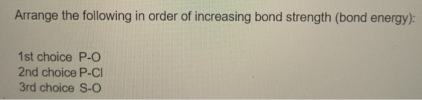 Arrange the following in order of increasing bond strength (bond energy): 1st choice P-O 2nd choice P-CI 3rd choice S-O
1. a) (1 mark) Arrange these elements in order of increasing atomic radius, from smallest to...
 1. a) (1 mark) Arrange these elements in order of increasing atomic radius, from smallest to largest: Sb, S, Pb, Se Smallest smallest b) (1 mark) Arrange this isoelectronic series in order of increasing radius, from smallest to largest: Se?, Sr2*, Rb, Br Smallest Largest c) (1 mark) Arrange these elements in order of increasing first ionization energy, from smallest to largest: CI, S, Ge, Pb smallest < < < Largest NAME AND STUDENT NUMBER: 2. (4 marks) A molecule...
Arrange the following species in increasing size: AI, A13+, S, and 52- 52- <AL<S<A13+ O A13+...
 Arrange the following species in increasing size: AI, A13+, S, and 52- 52- <AL<S<A13+ O A13+ < Al<5<52- S<A13+ < Al 52- 52-< Al<A13+ <S O Al3+ <S<AL<52- What is the average bond order for a Si–O bond in the ion SiO32-? O 1 2/3 o 3/2 02 4/3 0
Arrange the following in order of increasing bond length: P-O P-CI S-O ther session 3 4...
 Arrange the following in order of increasing bond length: P-O P-CI S-O ther session 3 4 5 6 7 8 a 10 11 12 13 Arrange the following in order of increasing bond strength (bond energy): nene. P-O P-CI S-O session Rank the following N-N bonds in increasing bond energy N-N N=N • NEN mer 3 4 5 6 7 8 9 10 11 12 13 Rank the following C-C bonds in increasing bond length. ergy): C-C C=C . CEC...
 Arrange the following in order of decreasing bond energyPart A Arrange the following in order of decreasing bond energy. A blank molecular orbital diagram (Figure 1) has been provided to help you. Rank the fluorine species from highest to lowest bond energy. To rank items as equilvalent, overlap them.
 Using only the periodic table arrange the following elements in order of increasing ionization energy: oxygen, polonium, sulfur, selenium Lowest Highest
 4. Arrange the following compounds in order of INCREASING lattice energy. You may do so by placing a "1" under the lowest lattice energy through a "6" under the highest lattice energy Bal2 MgCl2 BaCl₂ MgF2 SrCl2 CaCl2
 Arrange the following in order of increasing bond strength (bond energy): 1st choice P-O 2nd choice P-CI 3rd choice S-O
 1. a) (1 mark) Arrange these elements in order of increasing atomic radius, from smallest to largest: Sb, S, Pb, Se Smallest smallest b) (1 mark) Arrange this isoelectronic series in order of increasing radius, from smallest to largest: Se?, Sr2*, Rb, Br Smallest Largest c) (1 mark) Arrange these elements in order of increasing first ionization energy, from smallest to largest: CI, S, Ge, Pb smallest < < < Largest NAME AND STUDENT NUMBER: 2. (4 marks) A molecule...
 Arrange the following species in increasing size: AI, A13+, S, and 52- 52- <AL<S<A13+ O A13+ < Al<5<52- S<A13+ < Al 52- 52-< Al<A13+ <S O Al3+ <S<AL<52- What is the average bond order for a Si–O bond in the ion SiO32-? O 1 2/3 o 3/2 02 4/3 0
 Arrange the following in order of increasing bond length: P-O P-CI S-O ther session 3 4 5 6 7 8 a 10 11 12 13 Arrange the following in order of increasing bond strength (bond energy): nene. P-O P-CI S-O session Rank the following N-N bonds in increasing bond energy N-N N=N • NEN mer 3 4 5 6 7 8 9 10 11 12 13 Rank the following C-C bonds in increasing bond length. ergy): C-C C=C . CEC...
Most questions answered within 3 hours.
-
Where is the error in this code sequence?
String s1 = "Hello";
String s2 = "ello";...
asked 11 months ago -
Financial data for Joel de Paris, Inc., for last year
follow:
Joel de Paris, Inc.
Balance...
asked 11 months ago -
Consider this reaction:
Al2(SO4)3 (aq)+ BaCl3
(aq) Al2Cl6 (aq)- +
3BaSO4(s) . What is the...
asked 11 months ago -
Suppose that Savneet is considering increasing her
recent random sample from 20 car rentals to 40...
asked 11 months ago -
Trucks arrive at an unloading terminal at an average rate of 120
per hour.
Trucks arrive...
asked 11 months ago -
Why are methanol and ethanol completely soluble in water while
octanol is not very little soluble....
asked 11 months ago -
A facilities manager at a university reads in a research report
that the mean amount of...
asked 11 months ago -
When the CuSO4 is rehydrated by adding water to the anhydrous
compound, is this an endothermic...
asked 11 months ago -
A ray of sunlight is passing from diamond into crown glass; the
angle of incidence is...
asked 11 months ago -
A block of mass 0.249 kg is placed on top of a light, vertical
spring of...
asked 11 months ago -
how do the kidneys compensate in the presences of acidosis
a) trigger hyperventilate
b) reserve acid...
asked 11 months ago -
Question 501 pts
The rental rate of capital to the firm increases. Which of the
following...
asked 11 months ago