
Homework Answers
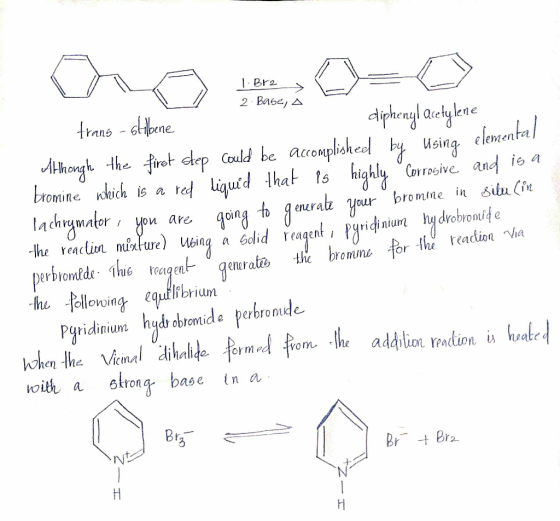
Conversion of stilbene to diphenylacetylene

Add Answer to:
conversion of stilbene to diphenylacetylene
Report Questions: What would you get as a product in Part...
1. Most of the class will be brominating trans-stilbene (part B) and the rest cis-stilbene (part...
 1. Most of the class will be brominating trans-stilbene (part B) and the rest cis-stilbene (part A). For this assignment write a detailed procedure in your lab notebook for Part B. Upload a picture/scanned copy (5 pts). Tip: If you write the procedure down the left half of the page, you can leave space to record your measurements/observations down the right side of the page. If you end up using cis-stilbene in the experimental there will only be a few...
Discussion Questions: 1. a) Carefully draw a three-dimensional structure of each stereoisomer of stilbene dibromide. Do...
 Discussion Questions: 1. a) Carefully draw a three-dimensional structure of each stereoisomer of stilbene dibromide. Do not include any identical structures. b) Identify the enantiomeric pair, and identify one pair of structures that are diastereomers. 2. Give careful stereo-drawings representing the complete mechanism for the reaction of cis-stilbene with bromine. Remember to show the two different modes of anti-attack that are possible, depending on whether you add the bromine from above to the left-hand or the right-hand carbon of the...
Look up and draw the mechanism for the addition of Br2 to double bonds. Reference the...
 Look up and draw the mechanism for the addition of Br2 to
double bonds. Reference the source from which you acquired the
mechanism.
Give the IUPAC name of the major product in the above-mentioned
reaction.
Draw the major product of obtained in the addition of Br2 to
stilbene.
Is this isomer chiral? What would be the optical rotation if
this sample was placed in a polarimeter?
Would a student obtain the same product if you started with
cis-stilbene instead of...
Look up and draw the mechanism for the addition of Br2 to
double bonds. Reference the source from which you acquired the
mechanism.
Give the IUPAC name of the major product in the above-mentioned
reaction.
Draw the major product of obtained in the addition of Br2 to
stilbene.
Is this isomer chiral? What would be the optical rotation if
this sample was placed in a polarimeter?
Would a student obtain the same product if you started with
cis-stilbene instead of...
3. The previous mechanism was for the bromination of trans-stilbene. The next several questions Uy will...
 3. The previous mechanism was for the bromination of trans-stilbene. The next several questions Uy will refer to the same mechanism, but using cis-stilbene. i t a. Draw cis-stilbene. (3 pts) deb baho o o dston 50302- adi ola) obblehemsiz n 20 Bobong odib-1-modb- 023 YOYO MOY on yd behou om bb b. Draw the bromonium ion intermediate that would be obtained in the bromination of ubo cis-stilbene. (5 pts) 2012 mainsbemastr o na 5 18-18: 19 19. HP C....
Hello, can you help me with any of these questions please? Any help would be much appreciated. Using diagrams indic...
 Hello, can you help me with any of these questions please? Any
help would be much appreciated.
Using diagrams indicate the symmetry elements present for each of the two isomers cis- and trans-[Mo(CO)(L)2] (IV and V). Assign the point groups of IV and V. Taking the four CO triple bonds of the carbonyl ligands (Si -S4) as your basis set, work out the reducible representation spanned by these bonds for the cis isomer V, below. IK OEC O SE Using...
Hello, can you help me with any of these questions please? Any
help would be much appreciated.
Using diagrams indicate the symmetry elements present for each of the two isomers cis- and trans-[Mo(CO)(L)2] (IV and V). Assign the point groups of IV and V. Taking the four CO triple bonds of the carbonyl ligands (Si -S4) as your basis set, work out the reducible representation spanned by these bonds for the cis isomer V, below. IK OEC O SE Using...
What is answer of #10?? Report: Hydroboration of 1-Methylcyclohexene Mechanism / GC Analysis / Calculations 1....
 What is answer of #10??
Report: Hydroboration of 1-Methylcyclohexene Mechanism / GC Analysis / Calculations 1. After reviewing the GC and 'H NMR spectra, what is the major product of the reaction? + 3 a. BH: . THF 3 b. 3 H2O2 OH + 3 OH c. NaOH MOH OH racemic racemic major 2. Draw the complete curved arrow mechanism for the reaction to produce the major product, including both the hydroboration and oxidation steps. Repetitive steps need only be...
What is answer of #10??
Report: Hydroboration of 1-Methylcyclohexene Mechanism / GC Analysis / Calculations 1. After reviewing the GC and 'H NMR spectra, what is the major product of the reaction? + 3 a. BH: . THF 3 b. 3 H2O2 OH + 3 OH c. NaOH MOH OH racemic racemic major 2. Draw the complete curved arrow mechanism for the reaction to produce the major product, including both the hydroboration and oxidation steps. Repetitive steps need only be...
1st picture is the questions and the next two pictures are the experiment the questions are...
 1st picture is the questions and the next two pictures are the
experiment the questions are based off of
Prelab Questions 1) Based on the Material Safety Data Sheets (MSDS) for the compounds, which of the compounds in this experiment is the most hazardous, and why? 2) Fill in the reagent table below. Make sure you correctly calculate the molar amounts of your materials. Name Formula Mol.-eq. Mw mmol Density/Conc. Amount 10 400 mg Meso-Stilbene Dibromide Potassium Hydroxide 5.75 Triethylene...
1st picture is the questions and the next two pictures are the
experiment the questions are based off of
Prelab Questions 1) Based on the Material Safety Data Sheets (MSDS) for the compounds, which of the compounds in this experiment is the most hazardous, and why? 2) Fill in the reagent table below. Make sure you correctly calculate the molar amounts of your materials. Name Formula Mol.-eq. Mw mmol Density/Conc. Amount 10 400 mg Meso-Stilbene Dibromide Potassium Hydroxide 5.75 Triethylene...
What is answer of #9??? Help me Report: Hydroboration of 1-Methylcyclohexene Mechanism / GC Analysis /...
 What is answer of #9???
Help me
Report: Hydroboration of 1-Methylcyclohexene Mechanism / GC Analysis / Calculations 1. After reviewing the GC and 'H NMR spectra, what is the major product of the reaction? + 3 a. BH: . THF 3 b. 3 H2O2 OH + 3 OH c. NaOH MOH OH racemic racemic major 2. Draw the complete curved arrow mechanism for the reaction to produce the major product, including both the hydroboration and oxidation steps. Repetitive steps need...
What is answer of #9???
Help me
Report: Hydroboration of 1-Methylcyclohexene Mechanism / GC Analysis / Calculations 1. After reviewing the GC and 'H NMR spectra, what is the major product of the reaction? + 3 a. BH: . THF 3 b. 3 H2O2 OH + 3 OH c. NaOH MOH OH racemic racemic major 2. Draw the complete curved arrow mechanism for the reaction to produce the major product, including both the hydroboration and oxidation steps. Repetitive steps need...
what would be the percent yield if the final weight of my product is 0.1357g this...
 what would be the percent yield if the final weight of my product
is 0.1357g this is a green chemistry wittig reaction to produce
1,4-diphenyl-1,3-butadiene from benzyltriphenylphosphonium chloride
and trans- cinnamaledyde using sodium hydroxide as the base
You will be using a Green Chemistry Wittig reaction (NOT Wittig-Horner Emmons reaction) to produce 1,4-diphenyl-1,3-butadiene starting with benzyltriphenylphosphonium chloride and trans- cinnamaledyde using sodium hydroxide as the base. This reaction is considered a "green" reaction, because an aqueous solution will be used...
what would be the percent yield if the final weight of my product
is 0.1357g this is a green chemistry wittig reaction to produce
1,4-diphenyl-1,3-butadiene from benzyltriphenylphosphonium chloride
and trans- cinnamaledyde using sodium hydroxide as the base
You will be using a Green Chemistry Wittig reaction (NOT Wittig-Horner Emmons reaction) to produce 1,4-diphenyl-1,3-butadiene starting with benzyltriphenylphosphonium chloride and trans- cinnamaledyde using sodium hydroxide as the base. This reaction is considered a "green" reaction, because an aqueous solution will be used...
What is answer of #6??? Lab Section: 0 2 Report: Hydroboration of 1-Methylcyclohexene Mechanism / GC...
 What is answer of #6???
Lab Section: 0 2 Report: Hydroboration of 1-Methylcyclohexene Mechanism / GC Analysis / Calculations 1. After reviewing the GC and 'H NMR spectra, what is the major product of the reaction? a. BHS. THF, OH O a. BH3. THE OH + b. 3 H2O2 3 + 3 c. NaOH OH ОН racemic racemic major 2. Draw the complete curved arrow mechanism for the reaction to produce the major product, including both the hydroboration and oxidation...
What is answer of #6???
Lab Section: 0 2 Report: Hydroboration of 1-Methylcyclohexene Mechanism / GC Analysis / Calculations 1. After reviewing the GC and 'H NMR spectra, what is the major product of the reaction? a. BHS. THF, OH O a. BH3. THE OH + b. 3 H2O2 3 + 3 c. NaOH OH ОН racemic racemic major 2. Draw the complete curved arrow mechanism for the reaction to produce the major product, including both the hydroboration and oxidation...
 1. Most of the class will be brominating trans-stilbene (part B) and the rest cis-stilbene (part A). For this assignment write a detailed procedure in your lab notebook for Part B. Upload a picture/scanned copy (5 pts). Tip: If you write the procedure down the left half of the page, you can leave space to record your measurements/observations down the right side of the page. If you end up using cis-stilbene in the experimental there will only be a few...
 Discussion Questions: 1. a) Carefully draw a three-dimensional structure of each stereoisomer of stilbene dibromide. Do not include any identical structures. b) Identify the enantiomeric pair, and identify one pair of structures that are diastereomers. 2. Give careful stereo-drawings representing the complete mechanism for the reaction of cis-stilbene with bromine. Remember to show the two different modes of anti-attack that are possible, depending on whether you add the bromine from above to the left-hand or the right-hand carbon of the...
 Look up and draw the mechanism for the addition of Br2 to
double bonds. Reference the source from which you acquired the
mechanism.
Give the IUPAC name of the major product in the above-mentioned
reaction.
Draw the major product of obtained in the addition of Br2 to
stilbene.
Is this isomer chiral? What would be the optical rotation if
this sample was placed in a polarimeter?
Would a student obtain the same product if you started with
cis-stilbene instead of...
Look up and draw the mechanism for the addition of Br2 to
double bonds. Reference the source from which you acquired the
mechanism.
Give the IUPAC name of the major product in the above-mentioned
reaction.
Draw the major product of obtained in the addition of Br2 to
stilbene.
Is this isomer chiral? What would be the optical rotation if
this sample was placed in a polarimeter?
Would a student obtain the same product if you started with
cis-stilbene instead of...
 3. The previous mechanism was for the bromination of trans-stilbene. The next several questions Uy will refer to the same mechanism, but using cis-stilbene. i t a. Draw cis-stilbene. (3 pts) deb baho o o dston 50302- adi ola) obblehemsiz n 20 Bobong odib-1-modb- 023 YOYO MOY on yd behou om bb b. Draw the bromonium ion intermediate that would be obtained in the bromination of ubo cis-stilbene. (5 pts) 2012 mainsbemastr o na 5 18-18: 19 19. HP C....
 Hello, can you help me with any of these questions please? Any
help would be much appreciated.
Using diagrams indicate the symmetry elements present for each of the two isomers cis- and trans-[Mo(CO)(L)2] (IV and V). Assign the point groups of IV and V. Taking the four CO triple bonds of the carbonyl ligands (Si -S4) as your basis set, work out the reducible representation spanned by these bonds for the cis isomer V, below. IK OEC O SE Using...
Hello, can you help me with any of these questions please? Any
help would be much appreciated.
Using diagrams indicate the symmetry elements present for each of the two isomers cis- and trans-[Mo(CO)(L)2] (IV and V). Assign the point groups of IV and V. Taking the four CO triple bonds of the carbonyl ligands (Si -S4) as your basis set, work out the reducible representation spanned by these bonds for the cis isomer V, below. IK OEC O SE Using...
 What is answer of #10??
Report: Hydroboration of 1-Methylcyclohexene Mechanism / GC Analysis / Calculations 1. After reviewing the GC and 'H NMR spectra, what is the major product of the reaction? + 3 a. BH: . THF 3 b. 3 H2O2 OH + 3 OH c. NaOH MOH OH racemic racemic major 2. Draw the complete curved arrow mechanism for the reaction to produce the major product, including both the hydroboration and oxidation steps. Repetitive steps need only be...
What is answer of #10??
Report: Hydroboration of 1-Methylcyclohexene Mechanism / GC Analysis / Calculations 1. After reviewing the GC and 'H NMR spectra, what is the major product of the reaction? + 3 a. BH: . THF 3 b. 3 H2O2 OH + 3 OH c. NaOH MOH OH racemic racemic major 2. Draw the complete curved arrow mechanism for the reaction to produce the major product, including both the hydroboration and oxidation steps. Repetitive steps need only be...
 1st picture is the questions and the next two pictures are the
experiment the questions are based off of
Prelab Questions 1) Based on the Material Safety Data Sheets (MSDS) for the compounds, which of the compounds in this experiment is the most hazardous, and why? 2) Fill in the reagent table below. Make sure you correctly calculate the molar amounts of your materials. Name Formula Mol.-eq. Mw mmol Density/Conc. Amount 10 400 mg Meso-Stilbene Dibromide Potassium Hydroxide 5.75 Triethylene...
1st picture is the questions and the next two pictures are the
experiment the questions are based off of
Prelab Questions 1) Based on the Material Safety Data Sheets (MSDS) for the compounds, which of the compounds in this experiment is the most hazardous, and why? 2) Fill in the reagent table below. Make sure you correctly calculate the molar amounts of your materials. Name Formula Mol.-eq. Mw mmol Density/Conc. Amount 10 400 mg Meso-Stilbene Dibromide Potassium Hydroxide 5.75 Triethylene...
 What is answer of #9???
Help me
Report: Hydroboration of 1-Methylcyclohexene Mechanism / GC Analysis / Calculations 1. After reviewing the GC and 'H NMR spectra, what is the major product of the reaction? + 3 a. BH: . THF 3 b. 3 H2O2 OH + 3 OH c. NaOH MOH OH racemic racemic major 2. Draw the complete curved arrow mechanism for the reaction to produce the major product, including both the hydroboration and oxidation steps. Repetitive steps need...
What is answer of #9???
Help me
Report: Hydroboration of 1-Methylcyclohexene Mechanism / GC Analysis / Calculations 1. After reviewing the GC and 'H NMR spectra, what is the major product of the reaction? + 3 a. BH: . THF 3 b. 3 H2O2 OH + 3 OH c. NaOH MOH OH racemic racemic major 2. Draw the complete curved arrow mechanism for the reaction to produce the major product, including both the hydroboration and oxidation steps. Repetitive steps need...
 what would be the percent yield if the final weight of my product
is 0.1357g this is a green chemistry wittig reaction to produce
1,4-diphenyl-1,3-butadiene from benzyltriphenylphosphonium chloride
and trans- cinnamaledyde using sodium hydroxide as the base
You will be using a Green Chemistry Wittig reaction (NOT Wittig-Horner Emmons reaction) to produce 1,4-diphenyl-1,3-butadiene starting with benzyltriphenylphosphonium chloride and trans- cinnamaledyde using sodium hydroxide as the base. This reaction is considered a "green" reaction, because an aqueous solution will be used...
what would be the percent yield if the final weight of my product
is 0.1357g this is a green chemistry wittig reaction to produce
1,4-diphenyl-1,3-butadiene from benzyltriphenylphosphonium chloride
and trans- cinnamaledyde using sodium hydroxide as the base
You will be using a Green Chemistry Wittig reaction (NOT Wittig-Horner Emmons reaction) to produce 1,4-diphenyl-1,3-butadiene starting with benzyltriphenylphosphonium chloride and trans- cinnamaledyde using sodium hydroxide as the base. This reaction is considered a "green" reaction, because an aqueous solution will be used...
 What is answer of #6???
Lab Section: 0 2 Report: Hydroboration of 1-Methylcyclohexene Mechanism / GC Analysis / Calculations 1. After reviewing the GC and 'H NMR spectra, what is the major product of the reaction? a. BHS. THF, OH O a. BH3. THE OH + b. 3 H2O2 3 + 3 c. NaOH OH ОН racemic racemic major 2. Draw the complete curved arrow mechanism for the reaction to produce the major product, including both the hydroboration and oxidation...
What is answer of #6???
Lab Section: 0 2 Report: Hydroboration of 1-Methylcyclohexene Mechanism / GC Analysis / Calculations 1. After reviewing the GC and 'H NMR spectra, what is the major product of the reaction? a. BHS. THF, OH O a. BH3. THE OH + b. 3 H2O2 3 + 3 c. NaOH OH ОН racemic racemic major 2. Draw the complete curved arrow mechanism for the reaction to produce the major product, including both the hydroboration and oxidation...
Most questions answered within 3 hours.
-
Where is the error in this code sequence?
String s1 = "Hello";
String s2 = "ello";...
asked 11 months ago -
Financial data for Joel de Paris, Inc., for last year
follow:
Joel de Paris, Inc.
Balance...
asked 11 months ago -
Consider this reaction:
Al2(SO4)3 (aq)+ BaCl3
(aq) Al2Cl6 (aq)- +
3BaSO4(s) . What is the...
asked 11 months ago -
Suppose that Savneet is considering increasing her
recent random sample from 20 car rentals to 40...
asked 11 months ago -
Trucks arrive at an unloading terminal at an average rate of 120
per hour.
Trucks arrive...
asked 11 months ago -
Why are methanol and ethanol completely soluble in water while
octanol is not very little soluble....
asked 11 months ago -
A facilities manager at a university reads in a research report
that the mean amount of...
asked 11 months ago -
When the CuSO4 is rehydrated by adding water to the anhydrous
compound, is this an endothermic...
asked 11 months ago -
A ray of sunlight is passing from diamond into crown glass; the
angle of incidence is...
asked 11 months ago -
A block of mass 0.249 kg is placed on top of a light, vertical
spring of...
asked 11 months ago -
how do the kidneys compensate in the presences of acidosis
a) trigger hyperventilate
b) reserve acid...
asked 11 months ago -
Question 501 pts
The rental rate of capital to the firm increases. Which of the
following...
asked 11 months ago