


Homework Answers
Q.10. Option 4. It is the sum of private and public saving
Q.9. Option 4. As the cost of lending is less with lesser expected inflation
Option 2. With the technological developments the supply curve shifts to right
Add Answer to:
JOY Question 10 (1 point) National saving is composed of: O private saving and government spending....
S3 S1 S2 real interest rate D1 D2 Loanable funds Refer to the figure above. If...
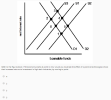 S3 S1 S2 real interest rate D1 D2 Loanable funds Refer to the figure above. If the economy starts at point o, how would you illustrate the effect of a positive technological shock that increases returns to investment in high-tech industries, by moving to point: im
1. Which of the following is true regarding spending and saving? a. Money that is spent...
1. Which of the following is true regarding spending and saving? a. Money that is spent cannot be saved. b. Spending is good for the economy; saving is bad for the economy. c. Spending money on items that are on sale is the same as saving money. d. Saving money and spending the same dollars has become easier with online banking. 2. If savers were to decrease the level of savings in an economy, what would happen in the loanable...
Question 2 (1 point) In an open economy suppose that GDP is $12 trillion. Consumption is...
 Question 2 (1 point) In an open economy suppose that GDP is $12 trillion. Consumption is $8 trillion and government spending is $2 trillion, Taxes are $0.5 trillion. Exports are $1 trillion and imports are $3 trillion. What is private saving? $4 trillion $3.5 trillion $2.5 trillion $1.5 trillion Question 1 (1 point) Interest rate (%) Supply of loanable funds Demand for loanable funds 0 10 20 30 40 50 60 70 80 90 100 Quantity of loanable funds (billions...
Question 8 (1 point) A rise in government spending shifts the IS curve because it_ national...
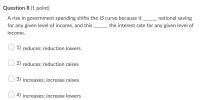 Question 8 (1 point) A rise in government spending shifts the IS curve because it_ national saving the interest rate for any given level of for any given level of income, and this income. 1) reduces; reduction lowers 2) reduces; reduction raises 3) increases; increase raises 4) increases; increase lowers
Question 7 (1 point) S3 S1 S2 3 0 5 1 D1 D2 Loanable funds real...
 Question 7 (1 point) S3 S1 S2 3 0 5 1 D1 D2 Loanable funds real interest rate 12 Refer to the figure above. In the 2000 elections George Bush made a proposal to give away the budget surpluses in lower taxes. If the economy started at point 0, then the effect of such a policy would be: to move the economy to point 2 to move the economy to point 4 nothing, the economy would stay at point 0...
Question 13 (Ch21&22) An increase in (i) tax benefits for saving; (ii) the desire of households...
 Question 13 (Ch21&22) An increase in (i) tax benefits for saving; (ii) the desire of households to consume today; (iii) corporate taxes; (iv) expected future profits; and (v) the government's budget deficit will cause effects shown in the following graphs respectively. SS SS a. b. A) b, a, b, c, and a B) c, a, d, c, and a C) b, a, d, d, and a D) b, a, d, c, and a Question 14 (Ch21&22) What kind of situations...
1. In a closed economy, suppose GDP equals $21 trillion, consumption equals $13 trillion, the government...
1. In a closed economy, suppose GDP equals $21 trillion, consumption equals $13 trillion, the government spends $7 trillion and has a budget deficit of $800 billion. a. Find government saving, taxes, private saving, national saving, and investment. Please show clearly how you calculated your final answers, and box/circle your final answers (in trillions of dollars) with proper labels No credit will be given to an answer in incorrect units, in notations that differ from what’s used in the lectures,...
Question 22 (1 point) The monetary aggregate M1 refers to: O O all outstanding notes and...
 Question 22 (1 point) The monetary aggregate M1 refers to: O O all outstanding notes and coin. notes and coin in circulation. notes and coin in circulation + demand deposits. notes and coin in circulation + demand deposits + travelers checks. Save Question 23 (1 point) The primary instrument for controlling money supply: is credit and interest rate ceilings. is open market operations. is the discount rate. is the reserve requirement. Save Question 24 (1 point) Refer to the table...
Question 21 (1 point) Recently, the Chinese government has acknowledged that its GDP growth rate for...
 Question 21 (1 point) Recently, the Chinese government has acknowledged that its GDP growth rate for 2015 will fall to 7%, which is substantially below China's recent annual growth rates, including that for 2014 (Wall Street Journal, March 5, 2015). Over the past several decades, China has invested heavily in capital, increasing its capital stock. However, its economic system provides entrepreneurs little incentive to work to develop new technologies. What is the effect of the Chinese government doubling its spending...
Question 50 (1 point) A(n) _____ in oil prices and a(n) _____ in taxes will shift...
Question 50 (1 point) A(n) _____ in oil prices and a(n) _____ in taxes will shift short-run aggregate supply to the left. Question 50 options: a) decrease; increase b) decrease; decrease c) increase; decrease d) increase; increase Question 51 (1 point) Which of the following events will shift the aggregate demand curve to the right? Question 51 options: a) an increase in household debt b) a catastrophic hurricane hitting the northeastern United States c) a decrease in taxes d) a...
 S3 S1 S2 real interest rate D1 D2 Loanable funds Refer to the figure above. If the economy starts at point o, how would you illustrate the effect of a positive technological shock that increases returns to investment in high-tech industries, by moving to point: im
 Question 2 (1 point) In an open economy suppose that GDP is $12 trillion. Consumption is $8 trillion and government spending is $2 trillion, Taxes are $0.5 trillion. Exports are $1 trillion and imports are $3 trillion. What is private saving? $4 trillion $3.5 trillion $2.5 trillion $1.5 trillion Question 1 (1 point) Interest rate (%) Supply of loanable funds Demand for loanable funds 0 10 20 30 40 50 60 70 80 90 100 Quantity of loanable funds (billions...
 Question 8 (1 point) A rise in government spending shifts the IS curve because it_ national saving the interest rate for any given level of for any given level of income, and this income. 1) reduces; reduction lowers 2) reduces; reduction raises 3) increases; increase raises 4) increases; increase lowers
 Question 7 (1 point) S3 S1 S2 3 0 5 1 D1 D2 Loanable funds real interest rate 12 Refer to the figure above. In the 2000 elections George Bush made a proposal to give away the budget surpluses in lower taxes. If the economy started at point 0, then the effect of such a policy would be: to move the economy to point 2 to move the economy to point 4 nothing, the economy would stay at point 0...
 Question 13 (Ch21&22) An increase in (i) tax benefits for saving; (ii) the desire of households to consume today; (iii) corporate taxes; (iv) expected future profits; and (v) the government's budget deficit will cause effects shown in the following graphs respectively. SS SS a. b. A) b, a, b, c, and a B) c, a, d, c, and a C) b, a, d, d, and a D) b, a, d, c, and a Question 14 (Ch21&22) What kind of situations...
 Question 22 (1 point) The monetary aggregate M1 refers to: O O all outstanding notes and coin. notes and coin in circulation. notes and coin in circulation + demand deposits. notes and coin in circulation + demand deposits + travelers checks. Save Question 23 (1 point) The primary instrument for controlling money supply: is credit and interest rate ceilings. is open market operations. is the discount rate. is the reserve requirement. Save Question 24 (1 point) Refer to the table...
 Question 21 (1 point) Recently, the Chinese government has acknowledged that its GDP growth rate for 2015 will fall to 7%, which is substantially below China's recent annual growth rates, including that for 2014 (Wall Street Journal, March 5, 2015). Over the past several decades, China has invested heavily in capital, increasing its capital stock. However, its economic system provides entrepreneurs little incentive to work to develop new technologies. What is the effect of the Chinese government doubling its spending...
Most questions answered within 3 hours.
-
Where is the error in this code sequence?
String s1 = "Hello";
String s2 = "ello";...
asked 10 months ago -
Financial data for Joel de Paris, Inc., for last year
follow:
Joel de Paris, Inc.
Balance...
asked 10 months ago -
Consider this reaction:
Al2(SO4)3 (aq)+ BaCl3
(aq) Al2Cl6 (aq)- +
3BaSO4(s) . What is the...
asked 10 months ago -
Suppose that Savneet is considering increasing her
recent random sample from 20 car rentals to 40...
asked 10 months ago -
Trucks arrive at an unloading terminal at an average rate of 120
per hour.
Trucks arrive...
asked 10 months ago -
Why are methanol and ethanol completely soluble in water while
octanol is not very little soluble....
asked 10 months ago -
A facilities manager at a university reads in a research report
that the mean amount of...
asked 10 months ago -
When the CuSO4 is rehydrated by adding water to the anhydrous
compound, is this an endothermic...
asked 10 months ago -
A ray of sunlight is passing from diamond into crown glass; the
angle of incidence is...
asked 10 months ago -
A block of mass 0.249 kg is placed on top of a light, vertical
spring of...
asked 10 months ago -
how do the kidneys compensate in the presences of acidosis
a) trigger hyperventilate
b) reserve acid...
asked 10 months ago -
Question 501 pts
The rental rate of capital to the firm increases. Which of the
following...
asked 10 months ago