A 0.42 2 kg block is sliding down a rough surface that is inclined 13.6 degrees...
A 0.42 2 kg block is sliding down a rough surface that is inclined 13.6 degrees with respect to the horizontal. The coefficient of kinetic friction for the surface is 0.162. A force, directly opposing the blogs motion, sufficient to cause it to slide with constant velocity, is being exerted on the Block while it moves.
a) Draw a free body diagram for the block and appropriately tilt/rotate its axes.
b) Write Newton's laws of motion equations for the x and y components of the net force acting on the block and use these equations to find the magnitude of the force that is opposing the block's motion.
Homework Answers
Solution) Frictional force is opposing force . That is opposes
motion of a body . 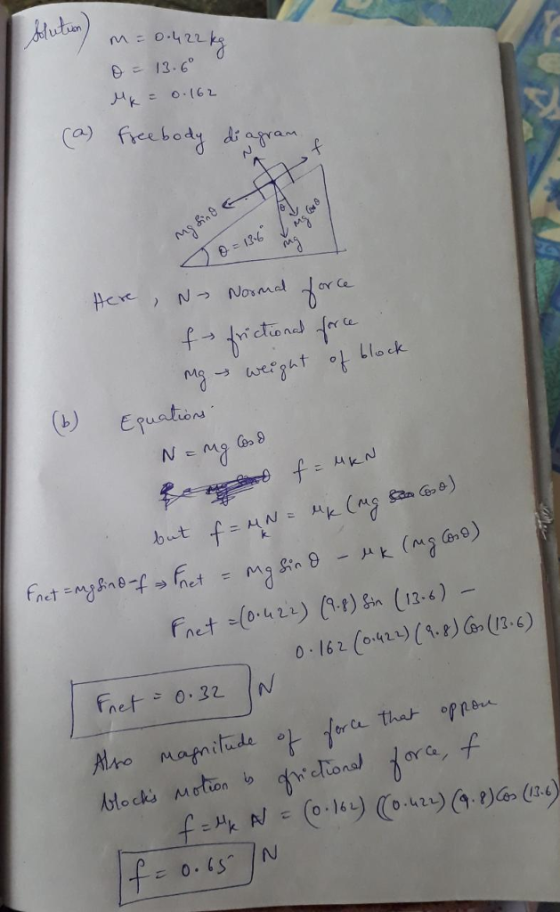
Add Answer to:
A 0.42 2 kg block is sliding down a rough surface that is
inclined 13.6 degrees...
So we are learning about the Free Body diagram and method but I don't fully understand...
 So we are learning about the Free Body diagram and method but I
don't fully understand how to apply the steps to the problem. 1st I
have to identify all the forces acting such as gravity by drawing
it out. 2nd I have to use that drawing and draw it in a free body
diagram form in the x-axis and y-axis where the object is at the
origin and that the forces are arrows and then rotate it the degree...
So we are learning about the Free Body diagram and method but I
don't fully understand how to apply the steps to the problem. 1st I
have to identify all the forces acting such as gravity by drawing
it out. 2nd I have to use that drawing and draw it in a free body
diagram form in the x-axis and y-axis where the object is at the
origin and that the forces are arrows and then rotate it the degree...
A 6.52 kg object is at rest at the top of a rough surface that is...
A 6.52 kg object is at rest at the top of a rough surface that is inclined 25.3 degrees with respect to the horizontal. It is then released and slides down the surface, traveling 0.873m in 1.45s. a) Draw a free body diagram for the block and appropriately tilt/rotate its axes. b) Write Newton's laws of motion equations for the x and y components of the net force acting on the block and use these equations to find the coefficient...
A 6.52 kg object is at rest at the top of a rough surface that is...
A 6.52 kg object is at rest at the top of a rough surface that is inclined 25.3 degrees with respect to the horizontal. It is then released and slides down the surface, traveling 0.873m in 1.45s. a) Draw a free body diagram for the block and appropriately tilt/rotate its axes. b) Write Newton's laws of motion equations for the x and y components of the net force acting on the block and use these equations to find the coefficient...
A solid block of mass 60.0 kg starts from rest and slides down a rough surface...
 A solid block of mass 60.0 kg starts from rest and slides down a rough surface with a length of 10.0 m where the coefficient of friction is uk=0.20. The surface is inclined at 40.0°. After sliding 10 meters down the incline it hits a spring with a spring constant of ks = 550.0 N/m. Draw a freebody Diagram indicating all forces. Write out and solve the force and energy equations. How high is the block above the spring at...
A 2-kg block is sliding on a plane inclined at 49 degrees. The friction coefficient between...
A 2-kg block is sliding on a plane inclined at 49 degrees. The friction coefficient between the block and the surface is 0.4. (a) The acceleration of the block is m/s2 (b) The minimum force to be applied to the block parallel to the incline to prevent the block from sliding is N.
3) A 5 kg block is set into motion up an inclined plane with an initial...
 3) A 5 kg block is set into motion up an inclined plane with an initial velocity of 8 m/s as shown below. The block comes to rest after travelling 3 m up the plane which is inclined at an angle of 30° W, = 8.00 m/s 3.00 m 30.0° For this motion, determine: a) The change in the block's kinetic energy b) The change in the block's potential energy c) The frictional force exerted on the object d) The...
2. a- A 1.5 kg block slides down an inclined ramp with u 0.4. If the...
 2. a- A 1.5 kg block slides down an inclined ramp with u 0.4. If the ramp angle is 17.0° and the length of it is 30.0 m, assuming it started sliding at 5 m/s. Find the speed of the block as it reaches the end of the ramp b- a- A 3 kg block is pushed against a spring with negligible mass and force constant k 4500 N/m, compressing it 0.220 m. When the block is released, it moves...
A block with a mass of 4 kg is sliding across a horizontal surface with an...
A block with a mass of 4 kg is sliding across a horizontal surface with an initial speed of 5 m/s. Because of kinetic friction, the energy of this system will decrease linearly with the distance travelled by the block. a. What is the magnitude of the force of kinetic friction (in N) acting on the block if the block moves 4 m before coming to a stop? b. What is the average power (in W) supplied by the force...
A block with mass 12.0 kg is on a ramp that is inclined at an angle...
A block with mass 12.0 kg is on a ramp that is inclined at an angle of 50.0 degrees above the horizontal. The block is accelerating up the ramp at 3.0 m/s2 as you pull on it with a string parallel to the surface of the ramp with a constant force of 140 N.\ A) Draw a free body diagram for the block moving up the ramp and choose a convenient xy-coordinate system to apply Newton's laws of motion. B)...
A block of mass 1.00 kg and the surface of an inclined plane have a coefficient...
A block of mass 1.00 kg and the surface of an inclined plane have a coefficient of static friction of 0.7. If the angle of the incline is 37 degrees, will the block slide down the plane? Include a force vector diagram. State all equations you are using, and show your solution.
 So we are learning about the Free Body diagram and method but I
don't fully understand how to apply the steps to the problem. 1st I
have to identify all the forces acting such as gravity by drawing
it out. 2nd I have to use that drawing and draw it in a free body
diagram form in the x-axis and y-axis where the object is at the
origin and that the forces are arrows and then rotate it the degree...
So we are learning about the Free Body diagram and method but I
don't fully understand how to apply the steps to the problem. 1st I
have to identify all the forces acting such as gravity by drawing
it out. 2nd I have to use that drawing and draw it in a free body
diagram form in the x-axis and y-axis where the object is at the
origin and that the forces are arrows and then rotate it the degree...
 A solid block of mass 60.0 kg starts from rest and slides down a rough surface with a length of 10.0 m where the coefficient of friction is uk=0.20. The surface is inclined at 40.0°. After sliding 10 meters down the incline it hits a spring with a spring constant of ks = 550.0 N/m. Draw a freebody Diagram indicating all forces. Write out and solve the force and energy equations. How high is the block above the spring at...
 3) A 5 kg block is set into motion up an inclined plane with an initial velocity of 8 m/s as shown below. The block comes to rest after travelling 3 m up the plane which is inclined at an angle of 30° W, = 8.00 m/s 3.00 m 30.0° For this motion, determine: a) The change in the block's kinetic energy b) The change in the block's potential energy c) The frictional force exerted on the object d) The...
 2. a- A 1.5 kg block slides down an inclined ramp with u 0.4. If the ramp angle is 17.0° and the length of it is 30.0 m, assuming it started sliding at 5 m/s. Find the speed of the block as it reaches the end of the ramp b- a- A 3 kg block is pushed against a spring with negligible mass and force constant k 4500 N/m, compressing it 0.220 m. When the block is released, it moves...
Most questions answered within 3 hours.
-
Where is the error in this code sequence?
String s1 = "Hello";
String s2 = "ello";...
asked 10 months ago -
Financial data for Joel de Paris, Inc., for last year
follow:
Joel de Paris, Inc.
Balance...
asked 10 months ago -
Consider this reaction:
Al2(SO4)3 (aq)+ BaCl3
(aq) Al2Cl6 (aq)- +
3BaSO4(s) . What is the...
asked 10 months ago -
Suppose that Savneet is considering increasing her
recent random sample from 20 car rentals to 40...
asked 10 months ago -
Trucks arrive at an unloading terminal at an average rate of 120
per hour.
Trucks arrive...
asked 10 months ago -
Why are methanol and ethanol completely soluble in water while
octanol is not very little soluble....
asked 10 months ago -
A facilities manager at a university reads in a research report
that the mean amount of...
asked 10 months ago -
When the CuSO4 is rehydrated by adding water to the anhydrous
compound, is this an endothermic...
asked 10 months ago -
A ray of sunlight is passing from diamond into crown glass; the
angle of incidence is...
asked 10 months ago -
A block of mass 0.249 kg is placed on top of a light, vertical
spring of...
asked 10 months ago -
how do the kidneys compensate in the presences of acidosis
a) trigger hyperventilate
b) reserve acid...
asked 10 months ago -
Question 501 pts
The rental rate of capital to the firm increases. Which of the
following...
asked 10 months ago