
Homework Answers


Add Answer to:
Th e purpose is to refresh your memory on force diagrams and Newton's laws and to...
The purpose is to refresh your memory on force diagrams and Newton's laws and to generate...
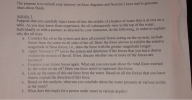 The purpose is to refresh your memory on force diagrams and Newton's laws and to generate ideas about fluids. Activity 1 Suppose that you carefully inject some oil into the middle of a beaker of water that is at rest on a table. As you may know from experience, the oil subsequently rises to the top of the water. Individually or with a partner, as directed by your instructor, do the following, in order to explain why the oil rises:...
Activity 2 You have made some conclusions about the water pressure at various points int water....
 Activity 2 You have made some conclusions about the water pressure at various points int water. Do the following to test these conclusions: he beaker of a. Consider a container of water at rest. b. Imagine a cylindrical column of the water from the top of the water to a depth h below the top of the water; assume that the cross-sectional area is A. Draw all forces acting c the column of water. You may assume that the forces...
I need help with part E please Conceptual Review ree-Body Diagrams and Newton's Laws 3 of4...
 I need help with part E please
Conceptual Review ree-Body Diagrams and Newton's Laws 3 of4 Problem Solving: Free Body Diagrams and Newton's Laws laws, the following summary of things to do will start your mind thinking about getting involved in the problem at hand 1. Draw a sketch of the situation 2 Consider only one object (at a time), and draw a free-body diagram for that body, showing all the forces acting on that body. Do not show any...
I need help with part E please
Conceptual Review ree-Body Diagrams and Newton's Laws 3 of4 Problem Solving: Free Body Diagrams and Newton's Laws laws, the following summary of things to do will start your mind thinking about getting involved in the problem at hand 1. Draw a sketch of the situation 2 Consider only one object (at a time), and draw a free-body diagram for that body, showing all the forces acting on that body. Do not show any...
A: Applying Newton's laws to interacting objects which velocity are moving with a constant A factory...
 A: Applying Newton's laws to interacting objects which velocity are moving with a constant A factory worker is pushing two touching crates across the floor. The crates move at a constant velocity since there is kinetic friction between each crate and the floor. You may assume that the coefficient of kinetic friction between each crate and the floor is the same. 3M M on M to that on 3M. Explain your ans Compare the net force (magnitude and direction) 1....
Mech Newton's second and third laws HW-40 2. Two crates, A and B, are in an...
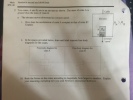 Mech Newton's second and third laws HW-40 2. Two crates, A and B, are in an elevator as shown. The mass of crate A is Cable greater than the mass of crate B. a. The elevator moves downward at constant speed. Elevator i. How does the acceleration of crate A compare to that of crate B? Explain. A MA Constant ii. In the spaces provided below, draw and label separate free-body speed diagrams for the crates. Free-body diagram for Free-body...
1. Starting with one of Newton's laws and your free body diagram, derive an expression for...
 1. Starting with one of Newton's laws and your free body
diagram, derive an expression for the normal force exerted on the
block by floor.
- Assess you answer in the following way: If you
let \(\theta\) = 0, what does your
solution predict for the normal force? Does this make physical
sense?
2. Starting with one of Newton's laws and your free body
diagram, derive an expression for the coefficient of kinetic
friction \(\mu_{k}\) between the
block and the...
1. Starting with one of Newton's laws and your free body
diagram, derive an expression for the normal force exerted on the
block by floor.
- Assess you answer in the following way: If you
let \(\theta\) = 0, what does your
solution predict for the normal force? Does this make physical
sense?
2. Starting with one of Newton's laws and your free body
diagram, derive an expression for the coefficient of kinetic
friction \(\mu_{k}\) between the
block and the...
You have made some conclusions abou the water pressure at various points in th water. Do...
 You have made some conclusions abou the water pressure at various points in th water. Do the following to test these conclusions: a. Consider a container of water at rest. b. Imagine a cylindrical column of the water from the top of the water to a depth h below c. d. e. f. g. the top of the water assume that the cross-sectional area is A. Draw all forces acting on the column of water. You may assume that the...
Spreading forces over surfaces I. Block that floats when released A cubical block is observed to...
 Spreading forces over surfaces I. Block that floats when released A cubical block is observed to float in a beaker of water. The block is then held near the center of the beaker as shown and released. A. Describe the motion of the block after it is released. Lab section B. Draw a free-body diagram for the block at the instant that it is Free-body diagram for block at instant it is released released. Rather than drawing a single force...
You have learned that Newton's 3rd Law states that when one mass exerts a force on...
 You have learned that Newton's 3rd Law states that when one mass exerts a force on another mass, there will be equal but opposite forces between then. If you recall, this is what allows us to jump UP off the ground, even though we press DOWN with our legs into the Earth. But... what about the following scenario? A tractor is hooked to a trailer full of horses. Once the tractor begins pulling the trailer forward on a level surface,...
understanding newton's law 1. An object cannot remain at rest unless which of the following holds? a. The net force act...
understanding newton's law 1. An object cannot remain at rest unless which of the following holds? a. The net force acting on it is zero. b. The net force acting on it is constant and nonzero. c. There are no forces at all acting on it. d. There is only one force acting on it. which one is the answer? there can be more than one answer.... 2. If a block is moving to the left at a constant velocity,...
 The purpose is to refresh your memory on force diagrams and Newton's laws and to generate ideas about fluids. Activity 1 Suppose that you carefully inject some oil into the middle of a beaker of water that is at rest on a table. As you may know from experience, the oil subsequently rises to the top of the water. Individually or with a partner, as directed by your instructor, do the following, in order to explain why the oil rises:...
 Activity 2 You have made some conclusions about the water pressure at various points int water. Do the following to test these conclusions: he beaker of a. Consider a container of water at rest. b. Imagine a cylindrical column of the water from the top of the water to a depth h below the top of the water; assume that the cross-sectional area is A. Draw all forces acting c the column of water. You may assume that the forces...
 I need help with part E please
Conceptual Review ree-Body Diagrams and Newton's Laws 3 of4 Problem Solving: Free Body Diagrams and Newton's Laws laws, the following summary of things to do will start your mind thinking about getting involved in the problem at hand 1. Draw a sketch of the situation 2 Consider only one object (at a time), and draw a free-body diagram for that body, showing all the forces acting on that body. Do not show any...
I need help with part E please
Conceptual Review ree-Body Diagrams and Newton's Laws 3 of4 Problem Solving: Free Body Diagrams and Newton's Laws laws, the following summary of things to do will start your mind thinking about getting involved in the problem at hand 1. Draw a sketch of the situation 2 Consider only one object (at a time), and draw a free-body diagram for that body, showing all the forces acting on that body. Do not show any...
 A: Applying Newton's laws to interacting objects which velocity are moving with a constant A factory worker is pushing two touching crates across the floor. The crates move at a constant velocity since there is kinetic friction between each crate and the floor. You may assume that the coefficient of kinetic friction between each crate and the floor is the same. 3M M on M to that on 3M. Explain your ans Compare the net force (magnitude and direction) 1....
 Mech Newton's second and third laws HW-40 2. Two crates, A and B, are in an elevator as shown. The mass of crate A is Cable greater than the mass of crate B. a. The elevator moves downward at constant speed. Elevator i. How does the acceleration of crate A compare to that of crate B? Explain. A MA Constant ii. In the spaces provided below, draw and label separate free-body speed diagrams for the crates. Free-body diagram for Free-body...
 1. Starting with one of Newton's laws and your free body
diagram, derive an expression for the normal force exerted on the
block by floor.
- Assess you answer in the following way: If you
let \(\theta\) = 0, what does your
solution predict for the normal force? Does this make physical
sense?
2. Starting with one of Newton's laws and your free body
diagram, derive an expression for the coefficient of kinetic
friction \(\mu_{k}\) between the
block and the...
1. Starting with one of Newton's laws and your free body
diagram, derive an expression for the normal force exerted on the
block by floor.
- Assess you answer in the following way: If you
let \(\theta\) = 0, what does your
solution predict for the normal force? Does this make physical
sense?
2. Starting with one of Newton's laws and your free body
diagram, derive an expression for the coefficient of kinetic
friction \(\mu_{k}\) between the
block and the...
 You have made some conclusions abou the water pressure at various points in th water. Do the following to test these conclusions: a. Consider a container of water at rest. b. Imagine a cylindrical column of the water from the top of the water to a depth h below c. d. e. f. g. the top of the water assume that the cross-sectional area is A. Draw all forces acting on the column of water. You may assume that the...
 Spreading forces over surfaces I. Block that floats when released A cubical block is observed to float in a beaker of water. The block is then held near the center of the beaker as shown and released. A. Describe the motion of the block after it is released. Lab section B. Draw a free-body diagram for the block at the instant that it is Free-body diagram for block at instant it is released released. Rather than drawing a single force...
 You have learned that Newton's 3rd Law states that when one mass exerts a force on another mass, there will be equal but opposite forces between then. If you recall, this is what allows us to jump UP off the ground, even though we press DOWN with our legs into the Earth. But... what about the following scenario? A tractor is hooked to a trailer full of horses. Once the tractor begins pulling the trailer forward on a level surface,...
Most questions answered within 3 hours.
-
Where is the error in this code sequence?
String s1 = "Hello";
String s2 = "ello";...
asked 10 months ago -
Financial data for Joel de Paris, Inc., for last year
follow:
Joel de Paris, Inc.
Balance...
asked 10 months ago -
Consider this reaction:
Al2(SO4)3 (aq)+ BaCl3
(aq) Al2Cl6 (aq)- +
3BaSO4(s) . What is the...
asked 10 months ago -
Suppose that Savneet is considering increasing her
recent random sample from 20 car rentals to 40...
asked 10 months ago -
Trucks arrive at an unloading terminal at an average rate of 120
per hour.
Trucks arrive...
asked 10 months ago -
Why are methanol and ethanol completely soluble in water while
octanol is not very little soluble....
asked 10 months ago -
A facilities manager at a university reads in a research report
that the mean amount of...
asked 10 months ago -
When the CuSO4 is rehydrated by adding water to the anhydrous
compound, is this an endothermic...
asked 10 months ago -
A ray of sunlight is passing from diamond into crown glass; the
angle of incidence is...
asked 10 months ago -
A block of mass 0.249 kg is placed on top of a light, vertical
spring of...
asked 10 months ago -
how do the kidneys compensate in the presences of acidosis
a) trigger hyperventilate
b) reserve acid...
asked 10 months ago -
Question 501 pts
The rental rate of capital to the firm increases. Which of the
following...
asked 10 months ago