Your brother has asked you to help him with choosing an investment. He has $4,500 to...
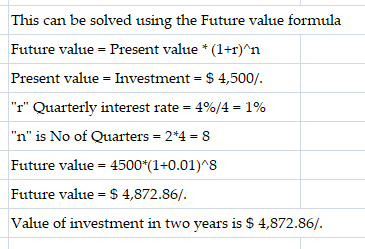
Your brother has asked you to help him with choosing an investment. He has $4,500 to invest today for a period of two years. You identify a bank CD that pays an interest rate of 0.0400 annually with the interest being paid quarterly. What will be the value of the investment in two years? Round to two decimal places
Homework Answers
Add Answer to:
Your brother has asked you to help him with choosing an
investment. He has $4,500 to...
Question 7 (1 point) Your brother has asked you to help him with choosing an investment....
Question 7 (1 point) Your brother has asked you to help him with choosing an investment. He has $6,400 to invest today for a period of two years. You identify a bank CD that pays an interest rate of 0.0500 annually with the interest being paid quarterly. What will be the value of the investment in two years? Round to two decimal places. Question 8 (1 point) You are evaluating a growing perpetuity product from a large financial services firm....
Please solve using financial calculator only and show work. Thank you. 28. Your brother has asked you to help him with c...
Please solve using financial calculator only and show work. Thank you. 28. Your brother has asked you to help him with choosing an investment. He has $5,200 to invest today for a period of five years. You identify a bank CD that pays an interest rate of 3.60 percent with the interest being paid quarterly. What will be the value of the investment in five years? 29. Tim has loaned money to his brother at an interest rate of 6...
Question 5 (1 point) Stanley Roper has $2,400 that he is looking to invest. His brother...
Question 5 (1 point) Stanley Roper has $2,400 that he is looking to invest. His brother approached him with an investment opportunity that could give Patrick $4,600 in 4 years. What interest rate would the investment have to yield in order for Stanley’s brother to deliver on his promise? (Answer needs to be stated as a decimal. For example: .1192) Round to four decimal places. Your Answer: Question 5 options: Answer Question 6 (1 point) Chuck Brown will receive from...
Your grandmother asks for your help in choosing a certificate of deposit (CD) from a bank...
Your grandmother asks for your help in choosing a certificate of deposit (CD) from a bank with a one-year maturity and a fixed interest rate. The first certificate of deposit, CD #1, pays 5.95 percent APR compounded quarterly, while the second certificate of deposit, CD #2, pays 6.00 percent APR compounded annually. What is the effective annual rate (the EAR) of each CD, and which CD do you recommend to your grandmother? If the first certificate of deposit, CD #1,...
If you invest $2,500 today, $3,600 in 2 years, $4,500 in 5 years, and $1,600 in...
If you invest $2,500 today, $3,600 in 2 years, $4,500 in 5 years, and $1,600 in 7 years, how much will be in the bank 15 years from today if interest is 8.5% compounded annually? 2. Charlie hopes to accumulate $83,000 in a savings account in 10 years. If he wishes to make a single deposit today and the bank pays 3 percent compounded annually on deposits of this size, how much should Charlie deposit in the account? 3. If...
(Related to Checkpoint 5.7) (Calculating an EAR) Your grandmother asks for your help in choosing...
(Related to Checkpoint 5.7) (Calculating an EAR) Your grandmother asks for your help in choosing a certificate of deposit (CD) from a bank with a one-year maturity and a fixed interest rate. The first certificate of deposit, CD #1, pays 2.45 percent APR compounded quarterly, while the second certificate of deposit, CD #2, pays 2.50 percent APR compounded weekly. What is the effective annual rate (the EAR) of each CD, and which CD do you recommend to your grandmother?...
How much would you loan your brother-in-law if he said he could repay you $200 in...
How much would you loan your brother-in-law if he said he could repay you $200 in six months, $400 in a year, and $700 in two years if you can get 3 percent interest from the bank on a six month CD? Show you are indifferent between the loan and putting your money in the bank for the next two years
Problem 5.11 Your brother has asked you for a loan and has promised to pay you...
 Problem 5.11 Your brother has asked you for a loan and has promised to pay you $5,450 at the end of three years. If you normally invest to earn 7.60 percent per year, how much will you be willing to lend to your brother if you view this purely as a financial transaction (i.e., you don't give your brother a special deal)? (If you solve this problem with algebra round intermediate calculations to 6 decimal places, in all cases round...
Your grandmother asks for your help in choosing a certificate of deposit (CD) from a bank...
Your grandmother asks for your help in choosing a certificate of deposit (CD) from a bank with a one-year maturity and a fixed interest rate. The first certificate of deposit, CD #1, pays 5.95 percent APR compounded quarterly, while the second certificate of deposit, CD #2, pays 6.00 percent APR compounded weekly. ****What is the effective annual rate (the EAR) of each CD, If the first certificate of deposit, CD #1, pays 5.95 percent APR compounded , the EAR for...
(Related to Checkpoint 5.7) (Calculating an EAR) Your grandmother asks for your help in choosing a...
 (Related to Checkpoint 5.7) (Calculating an EAR) Your grandmother asks for your help in choosing a certificate of deposit (CD) from a bank with a one-year maturity and a fixed interest rate. The first certificate of deposit, CD #1, pays 5.45 percent APR compounded semiannually, while the second certificate of deposit, CD #2, pays 5.50 percent APR compounded quarterly. What is the effective annual rate (the EAR) of each CD, and which CD do you recommend to your grandmother? If...
 Problem 5.11 Your brother has asked you for a loan and has promised to pay you $5,450 at the end of three years. If you normally invest to earn 7.60 percent per year, how much will you be willing to lend to your brother if you view this purely as a financial transaction (i.e., you don't give your brother a special deal)? (If you solve this problem with algebra round intermediate calculations to 6 decimal places, in all cases round...
 (Related to Checkpoint 5.7) (Calculating an EAR) Your grandmother asks for your help in choosing a certificate of deposit (CD) from a bank with a one-year maturity and a fixed interest rate. The first certificate of deposit, CD #1, pays 5.45 percent APR compounded semiannually, while the second certificate of deposit, CD #2, pays 5.50 percent APR compounded quarterly. What is the effective annual rate (the EAR) of each CD, and which CD do you recommend to your grandmother? If...
Most questions answered within 3 hours.
-
Where is the error in this code sequence?
String s1 = "Hello";
String s2 = "ello";...
asked 10 months ago -
Financial data for Joel de Paris, Inc., for last year
follow:
Joel de Paris, Inc.
Balance...
asked 10 months ago -
Consider this reaction:
Al2(SO4)3 (aq)+ BaCl3
(aq) Al2Cl6 (aq)- +
3BaSO4(s) . What is the...
asked 10 months ago -
Suppose that Savneet is considering increasing her
recent random sample from 20 car rentals to 40...
asked 10 months ago -
Trucks arrive at an unloading terminal at an average rate of 120
per hour.
Trucks arrive...
asked 10 months ago -
Why are methanol and ethanol completely soluble in water while
octanol is not very little soluble....
asked 10 months ago -
A facilities manager at a university reads in a research report
that the mean amount of...
asked 10 months ago -
When the CuSO4 is rehydrated by adding water to the anhydrous
compound, is this an endothermic...
asked 10 months ago -
A ray of sunlight is passing from diamond into crown glass; the
angle of incidence is...
asked 10 months ago -
A block of mass 0.249 kg is placed on top of a light, vertical
spring of...
asked 10 months ago -
how do the kidneys compensate in the presences of acidosis
a) trigger hyperventilate
b) reserve acid...
asked 10 months ago -
Question 501 pts
The rental rate of capital to the firm increases. Which of the
following...
asked 10 months ago