
Homework Answers
Initially when drive starts
Only force on diver is = Mg (since v(0) =0 m/s -Resistance =0)
As he accelerates down and picks up speed
Net Force = Mg - 15 I v I = Mg - 15 gt for 25 seconds
Velocity at time t = V(0) +
= 9.8 t- (15/60) ( 9.8 ) t^2/2 = (9.8 x 25) - (9.8/4) ( 25^2/2)
=
Add Answer to:
2. A 60 kilogram skydiver (more correctly termed a "skyflopper", as the picture below indicates) jumps...
A 50kg skydiver jumps out of an airplane. We assume that the forces acting on the body are the force of gravity and a retarding force of air resistance with direction opposite to the direction of motion and with magnitude cv^2 where c=.1275 kg/m and i
A 50kg skydiver jumps out of an airplane. We assume that the forces acting on the body are the force of gravity and a retarding force of air resistance with direction opposite to the direction of motion and with magnitude cv^2 where c=.1275 kg/m and is the velocity of the skydiver at time t (and upward is positive velocity). The gravitational constant is 9.8 m/s^2 . a) Find a differential equation for the velocity. b) Determine the terminal velocity in...
A skydiver jumps out of an airplane at a high altitude and reaches terminal speed. Which...
A skydiver jumps out of an airplane at a high altitude and reaches terminal speed. Which of the following statements about the falling skydiver at terminal speed is FALSE? The air resistance force does negative work on the skydiver. The gravitational force on the skydiver must be larger than the air resistance force in order to maintain a downward velocity. At terminal speed, the kinetic energy of the skydiver is constant. The thermal energy of the skydiver-Earth-atmosphere system is increasing....
Suppose a skydiver jumps out of a plane at 15,000 meters above the ground. It takes...
Suppose a skydiver jumps out of a plane at 15,000 meters above the ground. It takes him 2.0 seconds to pull the cord to deploy the parachute and another 2.0 seconds for the parachute to be fully deployed. Additionally, in order to land safely on the ground, his parachute must be fully deployed 10.0 seconds before he hits the ground. With this information and assuming there is no additional air resistance or changes in atmospheric density, what is the maximum...
Note that the answer is not: - 0 m/s^2 - 7.848 m/s^2 A skydiver jumps off...
 Note that the answer is
not:
- 0 m/s^2
- 7.848 m/s^2
A skydiver jumps off of an airplane. The plane flies at an altitude of 4 km, and at a speed of 100 km/hr. The skydiver "jumps" by simply letting go of the plane and falling out. Gravity is the only thing affecting their motion until they open their parachute at a height of 2.5 km. After opening their parachute, they experience constant acceleration until they land perfectly, with...
Note that the answer is
not:
- 0 m/s^2
- 7.848 m/s^2
A skydiver jumps off of an airplane. The plane flies at an altitude of 4 km, and at a speed of 100 km/hr. The skydiver "jumps" by simply letting go of the plane and falling out. Gravity is the only thing affecting their motion until they open their parachute at a height of 2.5 km. After opening their parachute, they experience constant acceleration until they land perfectly, with...
help please! See "Schedule for Due Date If an average-sized man jumps from an airplane with...
 help please!
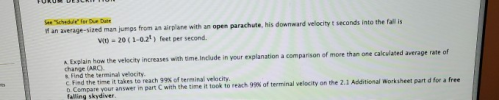
See "Schedule for Due Date If an average-sized man jumps from an airplane with an open parachute, his downward velocity Seconds into the fall is V(t) = 20 (1-0.2") feet per second. A Explain how the velocity increases with time. Include in your explanation a comparison of more than one calculated average rate of change (ARC). 8. Find the terminal velocity. C. Find the time it takes to reach 99% of terminal velocity. D. Compare your answer in...
help please!
See "Schedule for Due Date If an average-sized man jumps from an airplane with an open parachute, his downward velocity Seconds into the fall is V(t) = 20 (1-0.2") feet per second. A Explain how the velocity increases with time. Include in your explanation a comparison of more than one calculated average rate of change (ARC). 8. Find the terminal velocity. C. Find the time it takes to reach 99% of terminal velocity. D. Compare your answer in...
HI CAAAN YOU PLEASE ASSIST IN THESE PHYSICS PROBLEMS 5. (6 pts) Stan jumps out of an airplane with a parachute. After 3...
 HI CAAAN YOU PLEASE ASSIST IN THESE PHYSICS PROBLEMS
5. (6 pts) Stan jumps out of an airplane with a parachute. After 34 seconds, he opens the parachute. The graph to the right shows Stan's vertical velocity versus time, in a coordinate system where down is positive. Velocity versus Time for a 70 kg Parachuter 60 Stan opens parachute Jumps at t 0 Opens parachute att34 s 10 Stan jumps from airplane 0 10 20 30 40 50 60 time...
HI CAAAN YOU PLEASE ASSIST IN THESE PHYSICS PROBLEMS
5. (6 pts) Stan jumps out of an airplane with a parachute. After 34 seconds, he opens the parachute. The graph to the right shows Stan's vertical velocity versus time, in a coordinate system where down is positive. Velocity versus Time for a 70 kg Parachuter 60 Stan opens parachute Jumps at t 0 Opens parachute att34 s 10 Stan jumps from airplane 0 10 20 30 40 50 60 time...
 Note that the answer is
not:
- 0 m/s^2
- 7.848 m/s^2
A skydiver jumps off of an airplane. The plane flies at an altitude of 4 km, and at a speed of 100 km/hr. The skydiver "jumps" by simply letting go of the plane and falling out. Gravity is the only thing affecting their motion until they open their parachute at a height of 2.5 km. After opening their parachute, they experience constant acceleration until they land perfectly, with...
Note that the answer is
not:
- 0 m/s^2
- 7.848 m/s^2
A skydiver jumps off of an airplane. The plane flies at an altitude of 4 km, and at a speed of 100 km/hr. The skydiver "jumps" by simply letting go of the plane and falling out. Gravity is the only thing affecting their motion until they open their parachute at a height of 2.5 km. After opening their parachute, they experience constant acceleration until they land perfectly, with...
 help please!
See "Schedule for Due Date If an average-sized man jumps from an airplane with an open parachute, his downward velocity Seconds into the fall is V(t) = 20 (1-0.2") feet per second. A Explain how the velocity increases with time. Include in your explanation a comparison of more than one calculated average rate of change (ARC). 8. Find the terminal velocity. C. Find the time it takes to reach 99% of terminal velocity. D. Compare your answer in...
help please!
See "Schedule for Due Date If an average-sized man jumps from an airplane with an open parachute, his downward velocity Seconds into the fall is V(t) = 20 (1-0.2") feet per second. A Explain how the velocity increases with time. Include in your explanation a comparison of more than one calculated average rate of change (ARC). 8. Find the terminal velocity. C. Find the time it takes to reach 99% of terminal velocity. D. Compare your answer in...
 HI CAAAN YOU PLEASE ASSIST IN THESE PHYSICS PROBLEMS
5. (6 pts) Stan jumps out of an airplane with a parachute. After 34 seconds, he opens the parachute. The graph to the right shows Stan's vertical velocity versus time, in a coordinate system where down is positive. Velocity versus Time for a 70 kg Parachuter 60 Stan opens parachute Jumps at t 0 Opens parachute att34 s 10 Stan jumps from airplane 0 10 20 30 40 50 60 time...
HI CAAAN YOU PLEASE ASSIST IN THESE PHYSICS PROBLEMS
5. (6 pts) Stan jumps out of an airplane with a parachute. After 34 seconds, he opens the parachute. The graph to the right shows Stan's vertical velocity versus time, in a coordinate system where down is positive. Velocity versus Time for a 70 kg Parachuter 60 Stan opens parachute Jumps at t 0 Opens parachute att34 s 10 Stan jumps from airplane 0 10 20 30 40 50 60 time...
Most questions answered within 3 hours.
-
Where is the error in this code sequence?
String s1 = "Hello";
String s2 = "ello";...
asked 10 months ago -
Financial data for Joel de Paris, Inc., for last year
follow:
Joel de Paris, Inc.
Balance...
asked 10 months ago -
Consider this reaction:
Al2(SO4)3 (aq)+ BaCl3
(aq) Al2Cl6 (aq)- +
3BaSO4(s) . What is the...
asked 10 months ago -
Suppose that Savneet is considering increasing her
recent random sample from 20 car rentals to 40...
asked 10 months ago -
Trucks arrive at an unloading terminal at an average rate of 120
per hour.
Trucks arrive...
asked 10 months ago -
Why are methanol and ethanol completely soluble in water while
octanol is not very little soluble....
asked 10 months ago -
A facilities manager at a university reads in a research report
that the mean amount of...
asked 10 months ago -
When the CuSO4 is rehydrated by adding water to the anhydrous
compound, is this an endothermic...
asked 10 months ago -
A ray of sunlight is passing from diamond into crown glass; the
angle of incidence is...
asked 10 months ago -
A block of mass 0.249 kg is placed on top of a light, vertical
spring of...
asked 10 months ago -
how do the kidneys compensate in the presences of acidosis
a) trigger hyperventilate
b) reserve acid...
asked 10 months ago -
Question 501 pts
The rental rate of capital to the firm increases. Which of the
following...
asked 10 months ago